
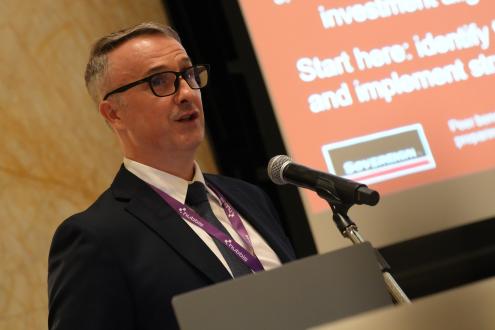
At the Hubbis Wealth Planning & Structuring Forum – Singapore 2026, Andrew Galway, Managing Director at The Sovereign Group, examined why governance is becoming central to succession planning as Asia enters a major phase of intergenerational wealth transfer.
Andrew’s presentation focused on the difficult but necessary conversations families need to have around power, control, rights, decision-making, escalation and next-generation involvement.
The central message was that many families recognise the need for succession planning, and many have already adopted tools such as trusts, wills, life insurance and PPLI. But too few have converted those tools and conversations into a documented governance blueprint. As wealth moves across generations, jurisdictions and family branches, the families best placed to preserve continuity will be those that codify intent into clear structures, roles and decision rights.
Key Takeaways
Asia’s Wealth Transfer Is Accelerating: Andrew noted that Asia accounts for 42% of global wealth, while around USD 2.5 trillion is expected to transition to the next generation in Asia-Pacific by 2030.
Wealth Is Growing, But Readiness Is Lagging: UHNW growth in Asia is outpacing the global average, yet only 30% of families have a comprehensive documented legacy plan, and only 23% have a completed leadership succession plan.
Tax Should Not Eclipse Succession: Tax changes in markets such as Australia, India and the UK matter, but families need clear succession priorities before they can make informed decisions about structures, residency or relocation.
Families Are Talking, But Not Codifying: Many families hold meetings and value communication, yet still stop short of documenting decision rights, powers, escalation routes and governance rules.
The Next Generation Is Often Involved Too Late: Andrew cited data showing that only 26% of families involve the next generation from the outset, increasing the risk of poor alignment.
Tools Need A Blueprint: Trusts, wills, life insurance and PPLI can all be useful, but they need to operate within a joined-up plan that reflects the family’s objectives and decision-making framework.
Fragmentation Can Happen Without Conflict: Wealth may fragment simply through time, geography, marriage, divorce, tax residency changes and generational drift.
Structured Ownership Supports Continuity: Trusts, foundations, holding companies and governance bodies can help separate benefit from control and enable deliberate authority transition.
Readiness Starts With Practical Questions: Families need to examine incapacity, banking access, next-generation exposure, fairness and fragmentation before those issues become urgent.
Advisers Can Help Surface The Hard Issues: Wealth advisers, lawyers, trustees, tax specialists and insurance advisers all have a role in helping families turn sensitive discussions into workable governance.
Governance Before Tax
Andrew began by linking his presentation to earlier forum discussions on global tax change, particularly in markets such as India and Australia. Tax, he said, will always be a major part of cross-border wealth planning, especially when families are considering whether a trust remains suitable, whether a structure needs to change, or whether a move of residency is required.
But he argued that tax should sit behind the family’s broader succession objectives. If succession decisions have already been made, a family can assess tax developments from a position of clarity. If those decisions have not been made, tax reform can expose a much deeper planning gap.
“My worry is that families haven’t had those discussions,” Andrew said. “A lot of families, especially Asian families, are still reluctant to have these important governance discussions about power, control, rights and escalation.”
For Andrew, corporate governance is relevant to family wealth because it gives structure to those difficult questions. It defines who decides, who controls, who benefits, what happens when disagreement emerges, and how authority moves to the next generation.
The Sovereign Group’s role, he said, is to help families and advisers move from sensitive discussion to practical implementation. Sovereign is a privately owned, family-owned business with an international trust, corporate and wealth planning footprint across Europe, Africa, the GCC and Asia, and Andrew said Asia is now a strategic focus for the group’s continued expansion.
The firm’s regional trust, legal, tax, compliance and corporate services specialists are intended to support advisers rather than displace them.
“We all have a part to play,” Andrew said. “We have all got various relationships with family members about taking these very sensitive discussions and codifying them.”
Asia’s Wealth Transfer And The Readiness Gap
Andrew said the scale of Asia’s wealth base makes the governance issue urgent.
Asia now accounts for 42% of global wealth, with UHNW growth in the region running ahead of the global average. Hong Kong has overtaken Switzerland as the world’s top cross-border wealth hub, while both Hong Kong and Singapore continue to attract significant family office activity.
At the same time, the Great Wealth Transfer is already underway. Andrew cited estimates that USD 5.8 trillion has either shifted or is actively shifting globally, with around USD 2.5 trillion expected to transition in Asia-Pacific by 2030.
The opportunity for advisers is clear, but the readiness gap remains substantial. Industry data cited in the presentation showed that only 30% of families have a comprehensive and documented legacy plan, while only 23% have completed a leadership succession plan.
Many more families are in progress, which suggests the issue is understood. The problem is conversion. Families may intend to plan, and may even have begun, but they often struggle to complete the map.
As Andrew put it, families are not short of intent. They are short of structure.
The Communication Paradox
Andrew then focused on the gap between conversation and governance.
Many families are already doing more communication work than before. Around 70% hold regular family meetings, 53% identify communication and transparency as a critical best practice, and families with meetings show higher plan completion than the average.
Yet those meetings do not automatically produce governance. A family can talk regularly and still avoid the hardest subjects: voting rights, control, employment in the family enterprise, access to information, the role of spouses, fairness between branches, and what happens when consensus breaks down.
“These discussions aren’t being codified into decision rights, powers and escalation procedures,” Andrew said.
That is particularly important in Asian family contexts, where succession, authority and control may be culturally sensitive topics. The challenge is not only to encourage dialogue, but to turn dialogue into rules that can operate when the founder is unavailable, family members move jurisdictions, or family expectations diverge.
Governance gives family conversations durability. It converts preferences into documented principles, roles and processes.
Toolkit Versus Blueprint
Andrew distinguished between having planning tools and having a joined-up plan.
Many families already use trusts, wills, life insurance and, increasingly, PPLI. Each can serve an important function. But none of them automatically resolves questions of family authority, alignment or continuity.
A trust can separate beneficial ownership from control, but it does not by itself define how the family should engage with the trustee. A will can transfer assets, but it does not manage future family participation. Insurance can provide liquidity, but it does not settle competing views of fairness. PPLI may be valuable within a broader structure, but it still needs to fit the family’s objectives.
“There is clearly a gap,” Andrew said. “Corporate governance is looked at as a blueprint.”
That blueprint should connect the tools into one operating framework. It should define the purpose of the structure, the roles of family members, the powers of trustees or directors, the rights of beneficiaries, the process for making decisions, and the mechanisms for resolving disputes.
Without that layer, families may have technically sound components but no coherent system.
The Risk Of Fragmentation
Andrew described fragmentation as one of the most serious risks in intergenerational transfer.
Fragmentation does not require a major conflict. It can happen gradually through time, geography, marriages, divorces, lawsuits, changing tax residency, different investment preferences, and the dispersal of ownership across multiple family branches.
“Fragmentation doesn’t require any conflict,” Andrew said. “It just requires time.”
The consequences can be material. Fragmented ownership may reduce scale, weaken decision-making, limit institutional access and make the family wealth platform harder to manage. A family that once operated with institutional scale can lose that advantage if ownership and control disperse without a deliberate framework.
Structured ownership can help address this risk. Trusts, foundations, holding companies and family governance bodies can support continuity by separating benefit from control, preserving scale and allowing authority to transition deliberately.
The objective is not to impose complexity. It is to stop complexity emerging unmanaged.
Five Questions That Surface Governance Needs
Andrew closed the technical part of the presentation by sharing a readiness tool Sovereign uses with families. The purpose is to surface governance gaps through practical questions rather than abstract theory.
The first question is incapacity: if the founder could not act for six to 12 months, what decisions would stall, and who would be authorised to act?
The second is banking and jurisdiction risk: if a key bank, jurisdiction or access point became restricted, where would the family feel the impact first?
The third is next-generation exposure: if a child married, divorced, was sued or became tax resident elsewhere, which assets could be unintentionally exposed?
The fourth is fairness: if each family member defines fair differently, where is disagreement most likely — roles, control, money or information?
The fifth is fragmentation: if ownership divides over time, what breaks first — decision-making, investment alignment, the platform around the wealth, or family cohesion?
“If we can get the families to even hook onto one or two of these questions, and discuss them proactively, then we can codify governance,” Andrew said.
These questions are designed to move families from general awareness to specific action. They reveal where a family’s current arrangements may be vulnerable and where a charter, decision framework, escalation mechanism or structure may be required.
Closing The Readiness Gap
Andrew concluded by calling for more collaboration across the advisory ecosystem.
Wealth advisers, private banks, lawyers, trustees, tax specialists, insurance advisers and family office professionals often see different parts of the family picture. Some have the founder’s trust. Some understand the structures. Some are closer to the next generation. That creates an opportunity to bring sensitive issues to the table before they become disputes or tax-driven emergencies.
For Andrew, the task is to help families move from personal ownership to structured ownership, and from informal intent to documented governance. The end point is a cohesive plan that can absorb change, support succession and reduce the risk of fragmentation.
His message was that the Great Wealth Transfer is not only an asset transfer event. It is a governance test.
Families that close the readiness gap will be better positioned to preserve scale, maintain continuity and transition authority with clarity. Advisers who help them do so will be central to one of the most important planning conversations now facing Asian wealth.