
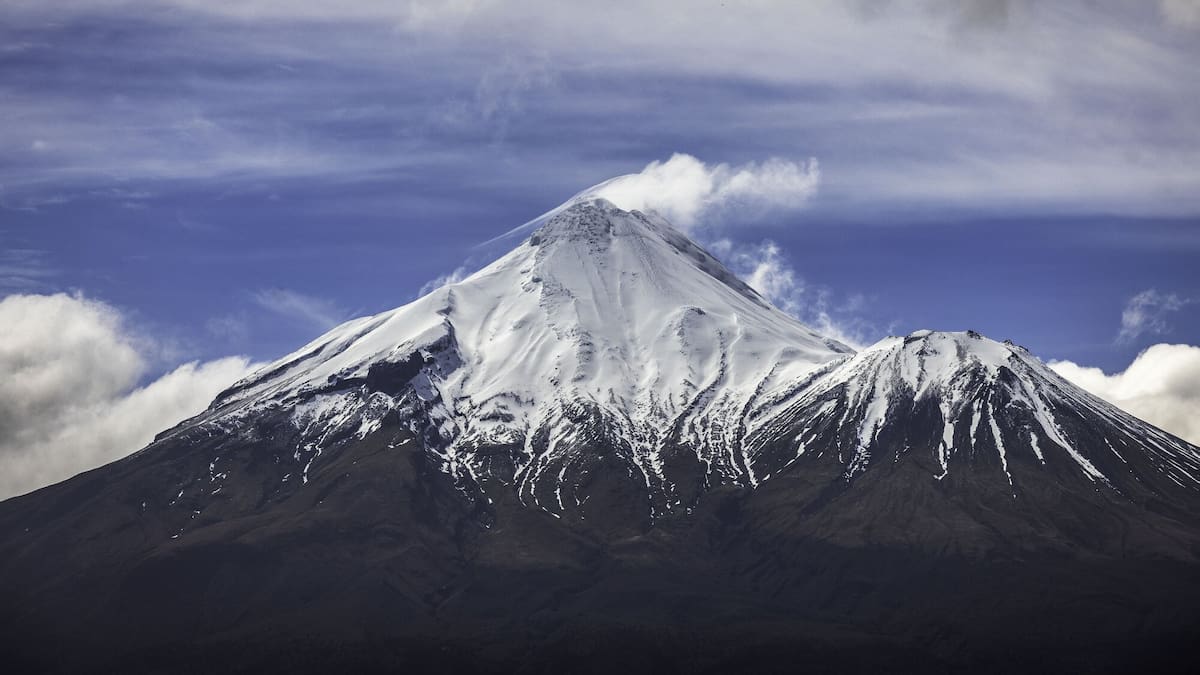
In findings released today, a coroner ruled the death was “entirely preventable”.
Coroner Rachael Schmidt-McCleave found the novice climber had attempted the “treacherous climb” with inadequate skills and unsuitable equipment, and both men had become complacent on the descent.
According to the findings, Levchenko, a Whangaparāoa retiree who enjoyed hiking and other outdoor pursuits, died on September 30 last year after falling on an icy slope near the summit of Taranaki Maunga.
A post-mortem examination found he suffered multiple blunt force injuries in the fall.
The findings stated Levchenko had become friends with a fellow Russian, who was an experienced mountaineer with elite alpine qualifications and rescue experience gained in Russia.
The pair joined five others for a trip to Taranaki Maunga, spending the night at Kapuni Lodge before setting out for Syme Hut and the summit the following morning.
While Levchenko was regarded as a confident hiker, he had no mountain climbing experience in snow and ice and received only minimal instruction in the use of crampons, ice axes and self-arrest techniques.
Before the trip, his friend loaned him equipment and gave him a lesson in how to use it.
After reaching Syme Hut, the pair decided to continue upwards. On several occasions, as the climb became steeper, his friend suggested they turn back, but Levchenko wanted to continue.
His friend cut steps into the ice with his ice axe to help them gain traction on their last 25m to the top.
“They climbed to the crater edge and looked in, before starting their descent the same way they had summited,” the findings stated.
The pair made their way through a narrow gully before moving on to less hazardous terrain.
Rescue experts later told police the area likely consisted of hard, uneven ice formations that increased the likelihood of tripping and made self-arrest difficult or impossible.
Levchenko’s friend was about 20m ahead of him and kept looking back to check on him.
The friend stopped about 150m below the summit to check on Levchenko, before taking shelter for a time behind an icy formation and losing sight of him.
“He did not witness Mr Levchenko fall but, when he could not see him, descended further, regrouped with the other members of the party and Emergency Services were called.”
Taranaki Alpine Cliff Rescue team members were flown onto the mountain and eventually discovered a blood trail at the top of a gully near Skeet Ridge.
The trail led them to Levchenko’s body. His helmet had come off during the fall. One crampon had detached from his boot and the other could not be found. His ice axe and backpack were also missing.
‘A reckless act’
Coroner Schmidt-McCleave found the death was entirely preventable.
“The critical factors which could have prevented this death are the underestimation of the conditions and suitability of this trip for Mr Levchenko, and both men succumbing to complacency on the descent,” she wrote.
The coroner found Levchenko was not prepared for the level of skill demanded by the climb.
He had minimal training, was not using a rope and anchors on the descent and was wearing crampons that were not designed for the type of flexible tramping boots he was using.
The findings were also critical of the friend’s decision-making, saying he became complacent by thinking Taranaki Maunga was a simple climb for him but would be difficult for a novice climber.
“He walked ahead of his friend, losing sight and contact with him, and was not roped or setting anchors. The seriousness of the slope was demonstrated by the fact that [the friend] chose to cut steps in the ice on their final approach to the summit,” the coroner said.
“I acknowledge that Mr Levchenko was adamant about continuing to the summit, but I consider it was incumbent on [the friend], as the far more experienced mountaineer of the pair, to convey to Mr Levchenko the risks inherent in continuing with such limited experience on steep ice and snow.”
Coroner Schmidt-McCleave endorsed comments made in previous coronial inquiries, that experience gained climbing elsewhere may not be enough to prepare people for the Taranaki Maunga’s unique conditions.
Evidence from the Mountain Safety Council (MSC) described parts of the upper mountain as “no fall” zones, where hard, impenetrable ice can make it impossible to stop a slide, regardless of a climber’s experience or self-arrest ability.
“Simply put, Taranaki Maunga in winter is a climb where one does not want to fall,” the coroner said.
She concluded that “an inexperienced climber taking on this climb in winter with inadequate equipment and experience was a reckless act which sadly ended in death”.
Recommendations included novice climbers undertaking alpine skills training before attempting Taranaki Maunga in snow and ice conditions, ensuring boots and crampons were properly matched, and limiting summit attempts to the summer months.
MSC welcomed the findings, which Mike Daisley, the council’s chief executive, said highlighted the importance of being thoroughly prepared for icy alpine conditions.
That included having the appropriate skills, experience and equipment, Daisley said in a statement.
“This is relevant not only for Taranaki Maunga, but for any alpine climb in snow and ice.”
Tara Shaskey is an assistant editor and reporter for the Open Justice team. She joined NZME in 2022 and has worked as a journalist since 2014.