
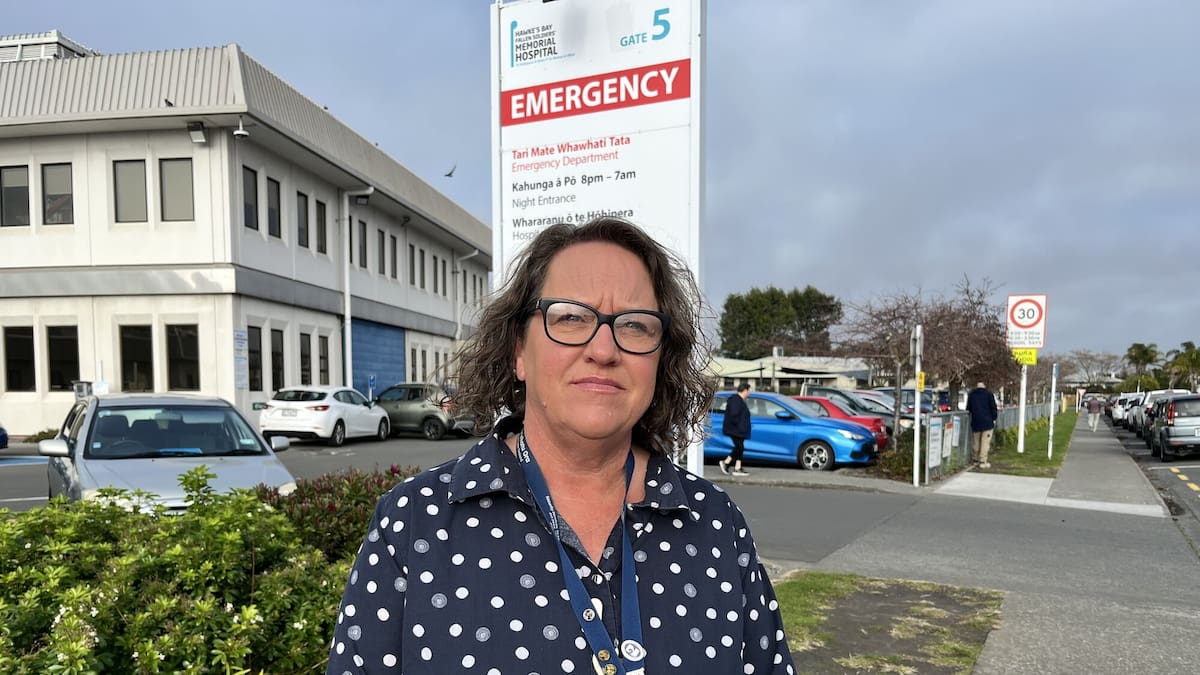
Over the past month, Hawke’s Bay’s ED in Hastings has seen an average of 157 patients daily. Over the past 12 months the baseline average has been about 150 presentations per day.
“Most of our patients spend their entire journey in the ED waiting room, which is not a clinical space, so the quality of care is reduced,” Revell said.
She said up to 60 people could be in the waiting room at times, and some patients could be assessed, treated, admitted or discharged without reaching a proper cubicle.
“Sometimes [they are] really not getting the privacy and not having the dignity that they should be getting of their assessment,” Revell said.
“Some things can get missed because sometimes the doctor or the nurse might not ask the personal questions, because they know that they are being overheard by the whole waiting room, and that can be significant for that patient.”
She said staff were doing their best, but patient flow was being slowed by a shortage of beds across the hospital and a lack of community care options for patients who no longer needed an acute hospital bed but were not safe to go home.
Revell said Hawke’s Bay Hospital needed more capacity, more staffed beds, better community care and more support outside hospital to stop ED becoming the place where wider system problems ended up.
“It all manifests in ED,” she said.
“People say it’s going to take a tragedy before somebody does anything.
“We’ve had tragedies, and it still doesn’t seem to be that anybody makes a meaningful change.”
Revell said winter initiatives were welcome, but years of underinvestment, combined with changing priorities whenever governments changed, had made it difficult to achieve lasting improvements.
Health NZ Group director of operations for Hawke’s Bay David Warrington said while winter always brought more respiratory illnesses, Hawke’s Bay had a “really good winter plan” in place.
The winter boost initiatives included introducing six surgical assessment beds, adding a doctor specialising in older people in ED, increasing weekend phlebotomy, physiotherapy and occupational therapy services, appointing a cardiology chest pain clinical nurse specialist to ED, providing three extra transition-to-home beds for older people who are well enough to leave hospital but still need some support before going home.
Health NZ had also opened the Rapid Inpatient Capacity Expansion Unit to increase bed capacity by 22 beds.
Revell said extra beds would help but would have little impact while the hospital remained full.
“It is a bit of a drop in the ocean,” she said.
“When the hospital’s at 105% capacity, then you can’t move. Flow doesn’t occur really, especially if there’s nowhere to discharge them to.”
Health Minister Simeon Brown acknowledged “there’s more work to do” and said the Government had introduced shorter-stays-in-emergency-departments targets and winter support.
“We are seeing, after years of decline, every single one of our health targets showing improvement,” he said.
Hawke’s Bay Hospital is among four regional hospitals sharing in the Government’s $680 million Budget 2026 health infrastructure package.
Brown said the funding would allow design work and early works on the wider redevelopment to progress, with details of the Hawke’s Bay upgrade to be announced “shortly”.
“We want to get that work right,” he said.
Napier Urgent Care
The pressure on Hawke’s Bay’s health system earlier in the year affected Napier’s overnight urgent care service.
The service closed 13 times between January and early March because of unplanned staff absences or clinicians being required at Hawke’s Bay Hospital’s ED.
There have been no closures since.
Napier MP Katie Nimon said while the disruptions were “not acceptable”, they reflected ongoing workforce pressures.
“When demand spikes in ED, staff can be redeployed to ensure those with the most urgent needs are prioritised,” she said.
“In a small workforce environment, that can have a knock-on effect locally.”
She said expanding nurse prescriber roles and introducing overnight telehealth support from a doctor had strengthened the service, but she would continue advocating for more recruitment, training and practical solutions to improve its reliability.
Rafaella Melo has more than 10 years of experience as a journalist in Brazil. She has worn many hats, from radio and TV presenter and producer to magazine editor before joining the Hawke’s Bay Today team as a multimedia journalist.