
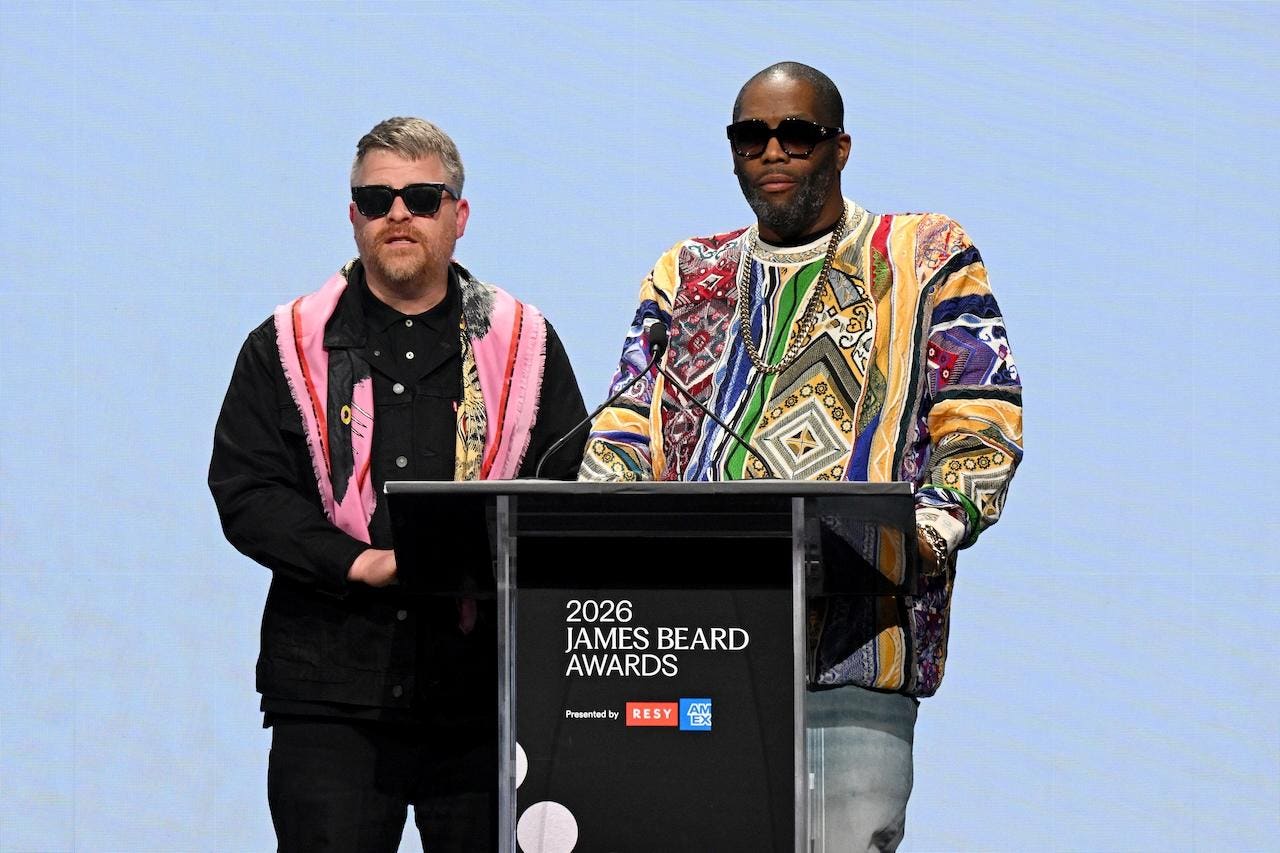
El-P and Killer Mike of Run the Jewels present Best New Bar and Outstanding Professional in Beverage Service during the 2026 James Beard Restaurant and Chef Awards on June 15, 2026, in Chicago. The beverage honors were part of a larger night that showed how bars, drink programs and service professionals now shape the American dining conversation.
Daniel Boczarski/Getty Images for the James Beard FoundationThe James Beard Awards Are No Longer Just About Food In 2026
What if the clearest signal from the 2026 James Beard Awards was not on the plate at all?
The James Beard Awards still carries the pageantry of America’s biggest night for chefs. The regional categories. The speeches. The room full of operators, cooks, writers, restaurateurs and industry lifers. But the 2026 winners list kept pulling the eye away from the kitchen and toward the bar.
The James Beard Foundation announced the Restaurant and Chef Awards winners on in June at the Lyric Opera of Chicago, with American Express and Resy presenting the ceremony. The Foundation presented beverage winners across five categories.
Dawn Padmore, VP of Awards at the James Beard Foundation, frames beverage as its own creative discipline. “Beverage programs matter because they’re a big part of how people experience many restaurants and, of course, bars,” Padmore says. “They’re not a supporting act. They stand alone, reflecting craft, creativity and storytelling, contributing to a memorable experience.”
Padmore also notes that the Restaurant and Chef Awards have recognized beverage professionals and programs since 1992. The difference now is how wide the beverage conversation has become. Wine, cocktails, beer, coffee, sake, low- and no-alcohol drinks, ethical sourcing, regional identity and service all sit inside the broader conversation around excellence.
The business side of dining has already caught up. National Restaurant Association research found that drinks account for about 21% of sales at full-service restaurants that sell alcohol. The same research found that 84% of adults who drink wine, beer or cocktails see restaurants as a good place to learn about beverages they have not tried before, and 82% trust local restaurant staff to make good beverage recommendations.
The person guiding the drink carries real influence. NIQ’s 2025 bartender research found that 72% of consumers turn to bar staff for guidance when they are unsure, while 79% of bartenders say they suggest specific drinks to guests on every shift.
That is what diners often remember later: not just the drink, but the person who made ordering it feel easy. Padmore describes beverage professionals as people who “help set the tone and connect the guest to their establishment’s overarching story.” The 2026 winners show five different versions of that work.
The James Beard Awards 2026 Drinks Winners At A Glance
Kato, Los Angeles
Outstanding Wine and Other Beverages Program. Kato’s menu includes a traditional wine flight, vintage wine flight, alcohol-free flight and bar tasting menu, with the bar tasting menu limited to 12 guests a night.
Scotch Lodge, Portland
Outstanding Bar. Scotch Lodge calls itself “a cocktail bar for Whisky lovers” curated by Tommy Klus, with a Pacific Northwest-inspired menu from chef Tim Artale.
Loma, Providence
Best New Bar. Loma describes itself as “a private club where everyone is invited,” with monthly featured spirits and classic cocktails built as an approachable way for guests to engage with the backbar.
Lee Campbell, Borgo, New York
Outstanding Professional in Beverage Service. Campbell is Borgo’s wine director, and the restaurant’s by-the-glass list includes a non-alcoholic Gut Oggau option alongside sparkling, white, rosé, chilled red and red wines.
Kevin Diedrich, Pacific Cocktail Haven, San Francisco
Outstanding Professional in Cocktail Service. P.C.H. is a Union Square bar founded by Diedrich in 2016, known for creative, balanced cocktails inspired by Asian-Pacific ingredients and a staff that is “never pretentious.”
Kato Made Alcohol-Free Pairings Feel Equal
Ryan Bailey, Austin Hennelly and Jon Yao of Kato attend the 2026 James Beard Restaurant and Chef Awards on June 15, 2026, in Chicago. Kato won Outstanding Wine and Other Beverages Program, one of the night’s clearest signals that beverage programs are now central to the modern dining experience.
Getty Images for the James Beard Foundation
Kato’s beverage program feels built for this moment. On the same menu, guests can choose a traditional wine flight, a vintage wine flight, an alcohol-free flight, or the bar tasting menu, a separate five-to-seven-course experience distinct from the dining room. The structure gives alcohol-free the same seriousness as wine, not a quieter place on the side.
Ryan Bailey, Kato’s co-owner and sommelier, gave the idea its cleanest line during his acceptance speech. He said the team wanted guests to feel that “no matter what was in your glass you were raising to cheer, you felt equal.”
The market is moving in the same direction, with IWSR projecting the U.S. no-alcohol market will approach $5 billion by 2028. Kato is not treating alcohol-free as a workaround. It is treating it as belonging.
The Beard Bump Now Moves From Awards Stage To Reservation Search
Pablo Rivero, CEO of Resy and SVP of American Express Global Dining, speaks onstage during the 2026 James Beard Restaurant and Chef Awards on June 15, 2026, in Chicago. As presenting partners, American Express and Resy helped frame the awards around the people, restaurants and beverage programs shaping American dining.
Daniel Boczarski/Getty Images for the James Beard Foundation
Padmore says JBF recognition can create what the industry calls the “Beard bump,” bringing visibility and bookings to the people and businesses involved. She says 96% of surveyed 2025 semifinalists reported a positive impact on their business and careers after recognition.
That attention used to move through press clips, word of mouth and reservation calls. Now it moves through search, booking pages and social posts before the after-party photos are done circulating. A name called from the stage can become a Tuesday-morning reservation hunt.
Pablo Rivero, CEO of Resy and SVP of American Express Global Dining, described the American Express and Resy partnership with JBF as a platform for “recognizing, uplifting and supporting the people behind America’s restaurants.” He also said the partnership would champion culinary talent across awards and dining series while advancing JBF Institute initiatives.
The pressure is that visibility does not solve the harder economics of running a serious beverage program. It can make demand arrive faster, but it does not lower the cost of staff training, inventory, glassware, storage or service. The James Beard Foundation’s 2026 Independent Restaurant Industry Report, created with Deloitte, describes a restaurant landscape shaped by persistent cost pressures, shifting consumer behavior, workforce complexity and rapid change across technology and service providers.
The award is still the award. The difference is the speed. The path from hearing a winner’s name to trying to book a seat is much shorter than it used to be.
The Modern Meal Is Being Judged By The Glass
The kitchen still has the old gravitational pull of the James Beard Awards. But the 2026 beverage winners widened the frame, making the meal feel less like a plate-first experience than a full-room conversation.
Padmore says independent beverage establishments are gathering places that carry a neighborhood’s identity and sustain jobs and livelihoods. This year’s James Beard Awards drinks winners made that visible from Los Angeles to Portland, Providence, New York and San Francisco, where wine, whiskey, low-alcohol cocktails and service all carried part of the story.
So yes, the clearest signal from the 2026 James Beard Awards may not have been on the plate. It was in the glass, in the room around it and in the professionals trusted to make the first sip feel like part of the meal.