
Hall is European.
Turner and his wife had been driving near his mother’s house that night when they paused at an intersection and spotted the man.
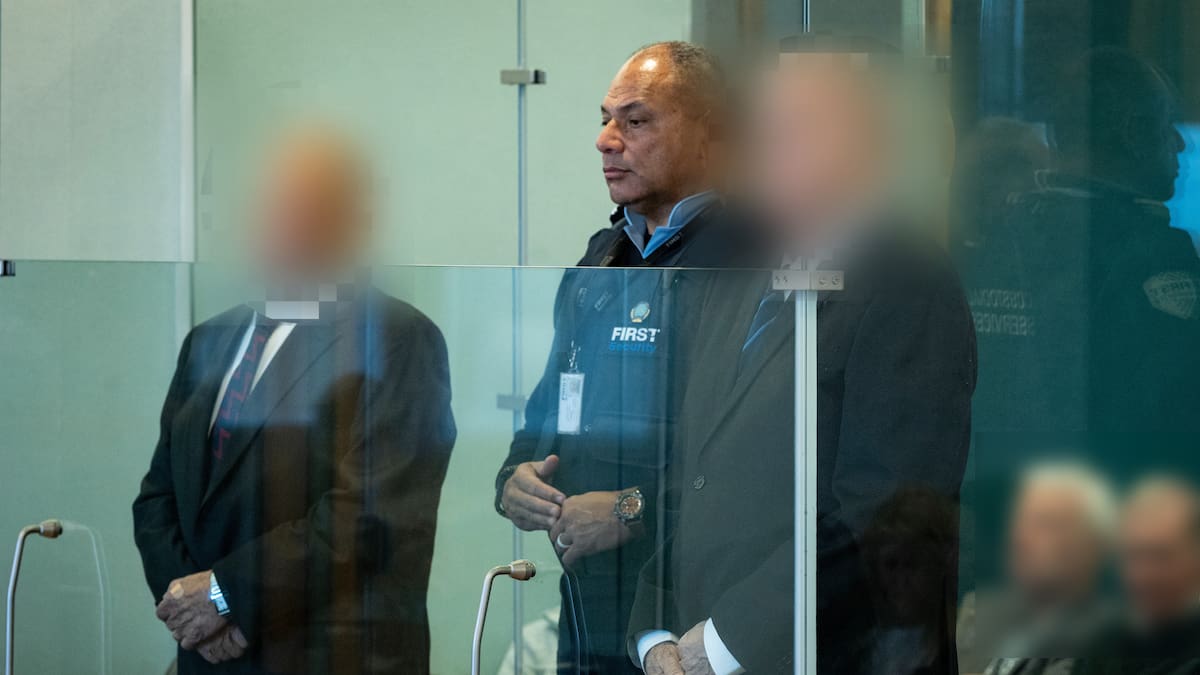
Alan Hall spent 17 years in prison before being exonerated in 2022. Photo / Greg Bowker
“I looked to my left and I saw this person running across Clevedon Rd,” Turner told police in a signed statement the next day. “He was really motoring across the road.
“He ran straight to the right of way… When he got to the right of way, he stopped and looked around behind him. He walked down the right of way a bit and kept looking around and then he ran off down the right of way. It was dark in the right of way and I couldn’t see his face when he looked around.
“I would describe the guy as being a male Māori and his height would be between 5′7″ [1.7m] and 6′ [1.83m]. I am 5′6″ [1.68m] and he was definitely taller than me… When he turned around I could see that he was definitely dark-skinned. He was not white.”
Police returned for a follow-up statement in February 1986.
“I still feel that person I saw that night was a Māori,” he wrote in that statement. “His features seemed Māori. His stance seemed to be Māori.
“When I asked my wife to look at this guy, I remember saying to my wife, ‘Look at the sneaky guy over there’. My wife reckons I said, ‘Look at the Māori guy’. I cannot remember if I said that or not.”
His statement continued: “I am 100% sure he was a Māori. That was my immediate impression. I do not feel he was a Pākehā, not even a dark-skinned one.”
Turner said today he had expected to give evidence at trial, at which point he would have said the same thing. But he got a call at some point stating he wasn’t needed.
He was approached two years after Hall’s conviction by a private investigator working on the appeal. Turner was shown a typed copy of his second statement, which authorities presented at a preliminary hearing in 1986, and he realised for the first time that all “Māori” references had been removed, he said.
He signed a new affidavit, dated March 1988. In it, he recalled that the police officer who took the second statement seemed very focused on race.
“[He] appeared to be trying to get me to be uncertain or change my mind as to whether I could say the man I saw was Māori,” he wrote. “I remained firm in the clear belief and recollection that the man I saw was a Māori.”
An officer had returned to his house in June 1986 and asked him to sign a typed version of the previously handwritten second statement, he recalled in the 1988 affidavit. He did not reread the typed version at that time, he said.
“I now note the important point that I definitely identified the person as being of Māori race has been omitted from my court statement,” he continued in the 1988 document. “I did not intend to exclude it and did not realise it had been omitted.
“I am extremely surprised by the omission … particularly after the police sergeant had tested me at length on this very point, and made an issue of it.
“I still believe that the person I saw that night was a Māori person and that would have been evidence if I was called to court, and the police certainly knew that I was definite on that identification…
“I am now aware that my statement was read to the jury in the trial of a European. I know that the person I saw running across Clevedon Rd that night was not a European, not even a dark-skinned European.
“It was definitely not what I saw, and police are aware of that.”
Aside from confirming that the prior statements were his own, Turner didn’t have much new to add today during direct examination from the prosecution. His memory has faded over the past four decades, he said.
Defence lawyer David Jones, KC, suggested the witness did not seem to be nearly as confident today as he was back then. When approached by an investigator before the current trial, Turner was described as having said something off the cuff along the lines of: “Think about it lots. Maybe I didn’t see the right person. Person I saw maybe wasn’t Māori”.
Defence lawyer David Jones, KC. Photo / Dean Purcell
Turner, who is Māori himself, didn’t deny having said those words. But he still thinks his racial identification was correct, he said.
Jones asked how Turner could have identified the stranger’s race when he couldn’t see the man’s facial features in the dark.
“Just his mannerisms and his movements,” Turner responded.
“Do you associate certain mannerisms with ethnicity?” the defence lawyer followed up.
“Yup,” the defendant said.
Jones noted Turner used the words “feel” and “seemed” as qualifiers when describing the man’s race. He also initially wrote in one of the handwritten statements that he was 95% sure before crossing that out and amending it to 100%.
The defence lawyer suggested the witness had heard a preliminary description of the unknown attacker as Māori on the radio on the night of the killing and tailored his statements to fit it. The victim’s sons had initially described the intruder as Māori.
“Were you trying to be helpful?” the lawyer asked.
“No,” the witness said of the implication he had embellished the police tip.
The court next heard from Turner’s ex-wife, who had been in the car with him during the sighting.
“It’s all quite vague – it’s so long ago,” she said of her current recollection.
“When I heard of the conviction, I was surprised. I said to my husband, ‘They’ve got the wrong guy’.”
During cross-examination, Jones noted it would have been dark for about an hour and a half when the couple saw the mystery man. The woman said her recollection was that visibility had been good.
The woman was also asked about a statement she made in 2022. In it, she said she now remembers being the person who first saw the mystery man – not her husband. They had a laugh about the mistake but never corrected the record because the other basic facts of what they had seen were correct, she said at the time.
“It’s been so long ago that I may be confused,” she admitted today.
Assuming it was her who saw the man, Jones asked her the same question as her ex: how could she know in the dark that he was Māori?
“It’s hard to describe, but back then Māori seemed to walk in a specific way,” she said, acknowledging that she would have only had a glance at the man’s eyes because he was wearing a balaclava. “It was the way he strutted, and that was my first impression of him.”
She had grown up with Māori, she said.
“I could be wrong,” she said.
The final witness of the day was defence lawyer Bruce Stainton, who had been practising law for about 10 years when Hall’s mother approached him in 1987 and asked him to help out with the appeal, which was being spearheaded by trial lawyer Peter Williams.
He described a frustrating indifference from authorities as he tried to get documents in preparation for the appeal. The main defence theory at that point, he said, was that the real killer had been an acquaintance of the victim – a man they knew to have a criminal record, and who happened to be Māori.
Based on this theory, he sent an urgent letter specifically requesting any police bulletins having previously described the suspect as “a six-foot Māori”.
“Could the statements Mr Turner made to police … have been of assistance to the appellant?” Crown prosecutor Grant Burston asked.
Crown prosecutor Grant Burston. Photo / Marty Melville
“I think the answer is clearly … it would have been critical to us, and it would have changed the balance of evidence before the jury…” Stainton replied. “We certainly would have made the maximum use of those two letters.”
Police may view some of the evidence they sought as unreliable, but “that is not the test”, Stainton said in a letter to authorities before the failed 1987 appeal.
It’s a sentiment that was repeated by prosecutors at the outset of the current trial. The defendants may have genuinely believed Hall was guilty, but hiding evidence from the defence was still a miscarriage of justice, they have said.
Stainton, who has not yet been cross-examined, is expected to continue giving evidence tomorrow as the trial continues before Justice Ian Gault.
Craig Kapitan is an Auckland-based journalist covering courts and justice. He joined the Herald in 2021 and has reported on courts since 2002 in three newsrooms in the US and New Zealand.
Sign up to The Daily H, a free newsletter curated by our editors and delivered straight to your inbox every weekday.
Tags:
- 1986
- after
- alan
- auckland
- authorities
- call
- called
- court
- critical
- crucial
- cut
- declined
- detail
- determined
- evidence
- forty
- from
- give
- greyhaired
- hall
- high
- information
- instead
- Justice
- later
- Miscarriage
- murder
- New Zealand
- News
- NewZealand
- NZ
- of
- omitting
- piece
- police
- ronald
- says
- statement
- submitting
- supreme
- today
- trial
- Turner
- what
- witness
- would
- written
- years