
The man’s vehicle appeared to be caught on a stump, with the full force of the water pushing into the vehicle’s side, Taite said.
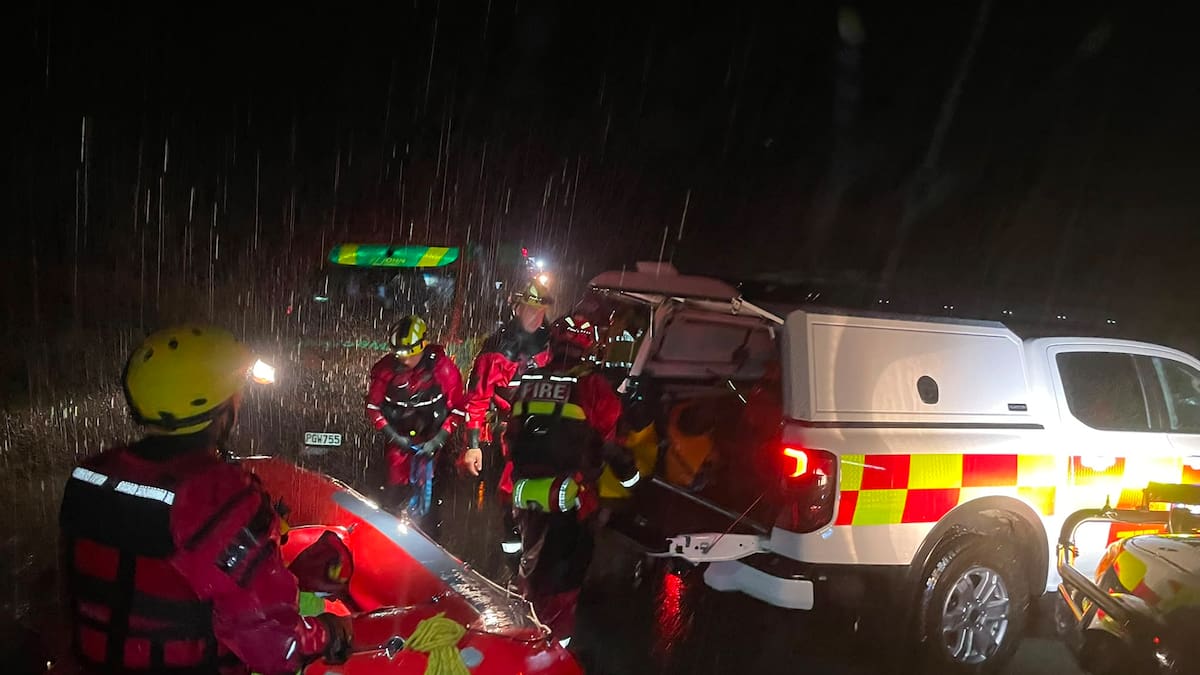
“[It was] very dark, very cold, driving rain – not a comfortable place to be hanging out.”
Between the man and safety were several willow trees, and “quite a bit of flood debris … logs and branches coming down”.
“There were quite a lot of willows downstream and what we call strainers, so things that if you get pinned against them in the flow can be quite dangerous.
“And then the flow was also pushing into a bluff system further down and redirecting, so there’s quite a hazardous piece of water downstream from us.”
Using a tethered system on an inflatable boat, the rescuers reached an eddy on the far side of the swift water where they could operate from a safe zone and access a bridge.
From there, they were able to wade to the car, Taite said.
“There was quite a swift channel across there. We used a group wading technique which uses strength in numbers to break the flow with a tethered system … so if [anyone] did lose their footing we could swing them back in.”
They weren’t able to speak to the man until reaching the car around 7am, and were relieved to find him “in good spirits”, Taite said.
A motorist was saved from raging floodwaters near Mt Lyford. Photo / Fire and Emergency New Zealand
“He’d been in there for some time before we could access him, so hypothermia was a very real possibility.”
The man was put in a life jacket and walked back through knee-deep water to the bridge, with rescuers using a “flying V” technique with one rescuer in front and two on each side, breaking the flow of water around the man.
At the bridge, where the water was ankle-deep, the man was put in the rescue boat and pulled across the “armpit-deep” main flow, Taite said.
“There was a lot going on – wind, rain, white water. It was a very dynamic environment and quite a complex rescue.”
He was grateful for the “exceptional” work of Waiau’s volunteer firefighters in supporting the rescue, said Taite, a firefighter based in Timaru, who was joined by SWRT colleagues from Christchurch.
“Good intel, good structure, good comms and that’s how this process is supposed to work. We do nothing in isolation.”
A Hato Hone St John Ambulance spokesman said ambulance staff assessed one person at the scene who was in a minor condition and didn’t need to go to hospital.
The man had done the right thing in staying put until rescue in what was a “very serious situation”, Taite said.
But it was also a “really good reminder to not drive through floodwater”.
“You just don’t know the condition of the road under the water – the depth, what the water’s going to do, whether you’re going to get a log jam washout and all of a sudden get a metre wall of water hitting your vehicle as you’re driving through it.
“It’s just not worth it, stay out of floodwater.”