
“We haven’t become volunteer firefighters to provide a back-up to Fire and Emergency during strike periods,” he told the Herald.
“We haven’t joined to respond to the other side of Auckland, to leave our jobs to do that. We’ve joined to provide assistance in our local community.”
He said “we’re certainly not the only brigade that have made this decision”, adding it has “ruffled a few feathers”.
“We’re often travelling quite long distances to get to these calls. So by the time we get there, generally the event has come to some sort of conclusion, whether the building’s burnt down or the person having a heart attack is dead.
“Having to often drop tools in the middle of the day to respond to calls which are well outside of our community, while we’re of course willing to help, it’s not why we signed up to do this.”
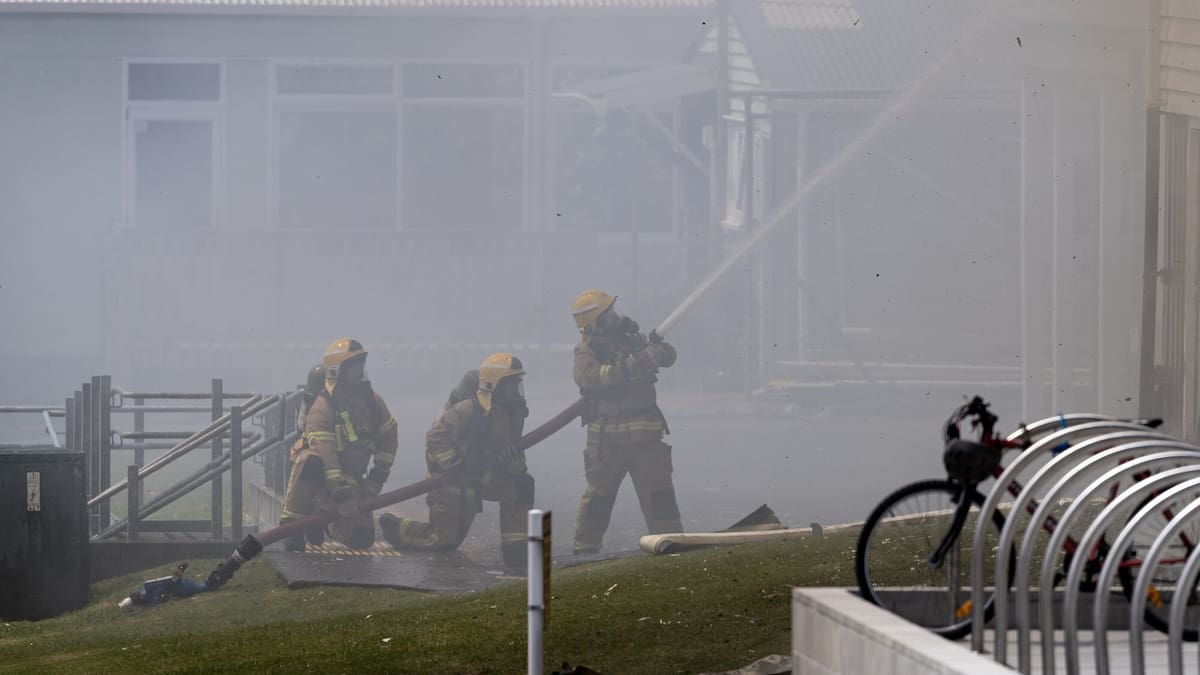
Multiple volunteer brigades around Auckland responded to a fire at Northcote College on February 20, which happened during strike action by career firefighters. The school’s sports pavilion was destroyed in the blaze. Photo / Dean Purcell
The Herald understands at least one volunteer brigade has officially raised the decision not to respond outside their area during strike periods with Fire and Emergency management, while some have made themselves “unofficially” unavailable.
When approached by the Herald, Fire and Emergency said it has not received “any requests from volunteer brigades across Auckland” about the issue.
Fire and Emergency did not answer questions about the plan to make up for fewer available volunteer firefighters during strike periods.
“Our advice to the public remains the same,” a spokesperson said.
“The public can be assured that all 111 calls will be received and responded to during strike periods. However, response times will be delayed in impacted areas as volunteer crews will be responding from the next closest location.
“We acknowledge and appreciate the dedication of our volunteers, and we understand the additional pressure continued strike action places on them.”
The firefighter said his brigade’s decision was not necessarily in direct support of the union.
“That’s not to say that we don’t support the Fire and Emergency career staff. We certainly do, but we are not doing this for that reason.
“We all want to see this industrial action come to a conclusion at some stage. It doesn’t directly affect us as volunteers, but indirectly it certainly puts a lot more pressure on us, which is certainly not something that we signed up for as volunteers.”
Volunteer firefighters say they’re under increased pressure during strike periods. Photo / NZME
He is now concerned about the “pretty big risk” to the public, recalling a strike period last month where no rescue tenders – engines equipped with cutting equipment that respond to motor vehicle accidents – were available across all of Auckland.
“Obviously all the Fire and Emergency career staff were unavailable and the volunteer brigades that had those appliances were also sort of unofficially unavailable outside of their normal areas as well, which is a pretty big risk.”
NZPFU Auckland local secretary and national vice-president Martin Campbell sympathised with volunteer firefighters’ “frustrations”.
“They’re right, they didn’t sign up to do this,” Campbell told the Herald. “So I appreciate their frustrations and their feelings.
“It’s again a lack of planning and a lack of organisation of Fire and Emergency that they haven’t been able to anticipate this sort of backlash from the volunteers.
“It doesn’t take rocket science to figure out if more and more volunteer brigades refuse to respond that Fire and Emergency is placing more and more of a risk on New Zealanders during those one hour stoppages.”
The union has been on strike, starting with one-hour stoppages a week before ramping it up to twice-weekly, since October last year over issues including pay, equipment, staffing, resourcing and workplace health and safety.
Career firefighters have also been working without a contract for more than two years, and haven’t had a pay rise in three years.
“We didn’t anticipate having to do the number of strikes that we did to try and get Fire and Emergency back to the bargaining table,” Campbell said.
“Unfortunately, we’ve got to the ridiculous situation now where we’re approaching 50 strikes.
“I would have thought that by now they would have come back to the bargaining table so that they’re actually taking the workload off the volunteers and sitting down with the union to discuss the concerns.”