
You could say the bar was low, but it was raised the moment I boarded the Aircarlin flight. From the first “Bonjour”, it belatedly hit me that I was heading somewhere French. Somewhat dumb, I know – but to clarify, not just an island holiday with sunshine and palm trees but a French island holiday with sunshine and palm trees. Just three hours away, a place awash with French food and wine, the language and culture.
Marche de Noumea. Photo / New Caledonia Tourism
It is also the home of the Kanak people, the indigenous Melanesian inhabitants of New Caledonia, making up roughly 40% of the population. No need for a history lesson but when I told people I was going to New Caledonia, the first question was “but what about the unrest”?
That was essentially two years ago. Noumea was the centre of a political dispute that has been resolved. Although ugly and tragic at the time, the tension was strictly political and aimed at governance, never targeting international travellers, but it has had an impact on tourism. Today, New Caledonia is safe and tranquil and waiting to welcome travellers back.
With elections just held, the country is very much about moving forward and so am I. So, imagine my surprise in ending up at the exact spot I was more than 30 years ago. Only now, it looks a little different. The old Club Med site is now the Chateau Royal Beach Resort and Spa, a four-star complex at the southern end of the Anse Vata beach.
Highlights include the Chateau Royal Beach Resort, Port Moselle market, and Tjibaou Arts and Cultural Centre. Photo / Jody Gill
After a complete overhaul, it bears no resemblance to my blurry memories. My spacious one-bedroom suite on the top floor provided panoramic views of the water and a bird’s eye view of the resort pool. It’s a beautiful resort, renowned for its Aquatonic spa, housing a massive indoor Aquatonic pool – one of only a handful in the world.
The waterfront of central Noumea has also been modified over the past few years, reducing traffic and creating a promenade. Palm trees have been planted, boardwalks and park spaces created – reminiscent of the south of France. But here’s the juxtaposition of Noumea. It wears its Frenchness and yet merges it with the culture and traditions of the Kanak people. Some call it the Paris of the Pacific. That may be a stretch but there is merit in noting and savouring the blend.
Boulangerie. Photo / E. Aubry NCT
The city itself is dotted with boulangeries, the smell of warm croissants mixed with French cuisine at the local markets, which are really worth visiting.
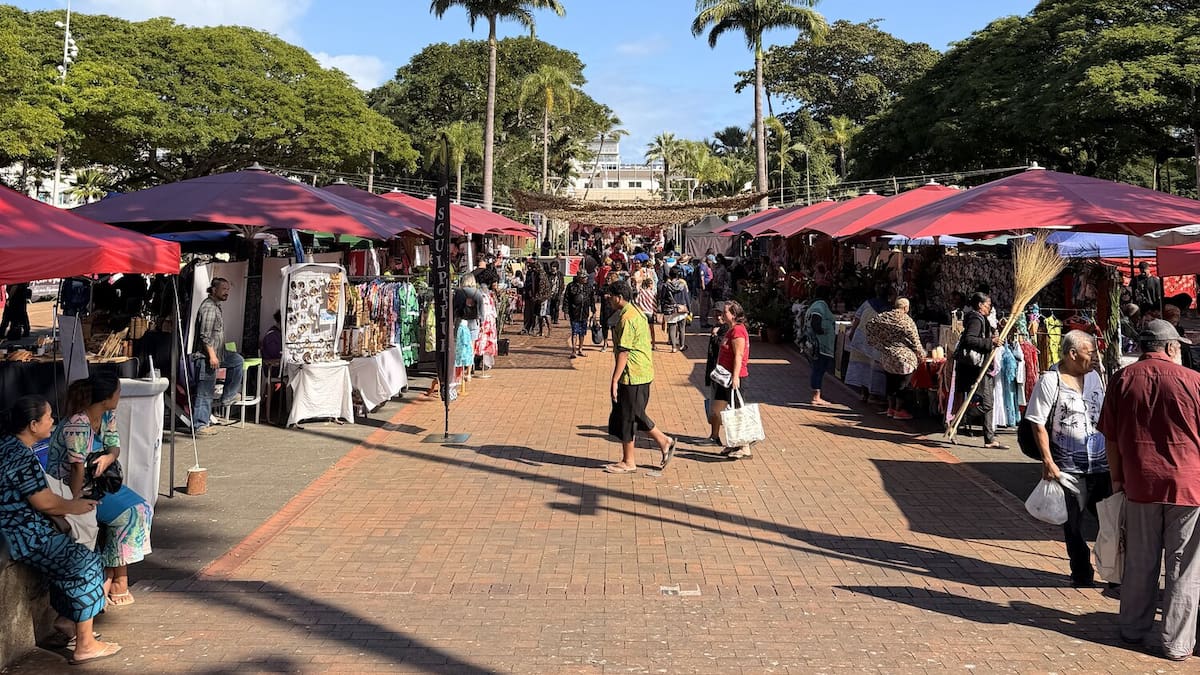
Most mornings from 5am to midday, the vibrant Port Moselle market is open, right on the edge of the marina, a backdrop of luxury yachts to a very island-style market. Tables piled high with local Pacific staples like massive yams, taro roots, papayas and bundles of vanilla beans, probably destined for a creme brulee.
You can also get a real barista coffee, more difficult than you might think since most cafes seem to prefer making coffee at the press of a button.
Our driver told us it’s not traditional to bargain, but stall holders are happy to let you browse at leisure without pressure to buy (something that usually sends me scuttling in the other direction). As in France, it really does help to have at least a smattering of French. Not everyone speaks English and it is always polite to greet someone in French and to at least say please and thank you. It was an enjoyable way to spend an hour or two browsing for souvenirs to take home.
If you’re lucky enough to be in Noumea on the right Thursday of the month, make sure you venture to Coconut Square (Place des Cocotiers) for the monthly Jeudi du Centre Ville street market.
The city has transformed with promenades and markets, offering French cuisine and local crafts. Photo / Jody Gill
Rows and rows of colourful stalls offer everything from woodwork by local artisans to take-home containers of tuna rillette – or taro in coconut wrapped in banana leaf – so delicious. I’d recommend going hungry and making the most of the food on offer. Take some time to sit in the sunshine, listen to a local band playing live and enjoy the people watching.
If shopping is on your agenda, check out La Promenade. It runs along the bottom of the Hilton hotel in the city centre, featuring a collection of shops including French boutiques, souvenir shops, ice cream parlours, restaurants and a few international brands. If you’re looking for French clothing labels, there’s one particularly chic boutique called Hype: sitting at the high end of the spectrum, it stocks Isabel Marant, Anine Bing and Bash among others. But I’m on a budget, so imagine my delight at discovering a section tucked down the back of the store, comprising what we would call designer recycling. The French call it vide-dressing, also known as wardrobe clearing – a second-hand selection where fashionable locals sell off their luxury items at reasonable prices. Definitely worth a rummage.
Jeudi de Centre Ville market. Photo / Jody Gill
As with France, no trip to Noumea would be complete without indulging in the food. Top of the indulgent list has to be Marmite et Tire-Bouchon (The Pot and Corkscrew) on the picturesque Orphelinat Bay, offering haute cuisine that marryies French and Pacific ingredients.
The literal “Tire-Bouchon” aspect is represented by an immense floor-to-ceiling, glass-walled wine cellar in the dining room holding a massive, curated collection ranging from French vintages to regional gems.
On a different level is Chai de l’Hippodrome, located near the entrance to the Henry Milliard racecourse, slightly off the main tourist drag. It’s a rustic but contemporary wine cave, a large cellar complete with wine barrels and quirky art: perfect for sharing a large charcuterie platter and tasting a flight of French wines.
It would be easy to spend a week in Noumea, relaxing by a pool, enjoying a spa, visiting the markets and taking in the sights. There are colonial homes to visit and the white steepled St Joseph’s Cathedral not only boasts a spectacular view, but it also contrasts with the soaring wooden sails of the Tjibaou Arts and Cultural Centre just outside town. The centre was designed by an Italian – the French love an architectural competition. Renzo Piano’s winning design is a stunning example of contemporary architecture in harmony with Kanak culture.
If you visit the centre, I’d highly recommend a guide, or at the very least an audio guide. There is so much to be learned about the Kanak way of life that I don’t think you would glean from just taking a wander. Our guide George was a real character, passionate about sharing the story of his people. A collection of contemporary and Oceanian art features in the galleries throughout the main building including quite a few pieces by New Zealand artists.
Outside the main centre but within the grounds, there are three traditional Kanak huts, each representing the different styles of a chief’s house; one from the north, one from the main island and one from the Loyalty Islands. The soaring huts will make you wonder how the Kanaks achieved such construction feats.
The city’s waterfront has been transformed into a palm-lined promenade. Photo / Jody Gill
Later in the day, a sunset cruise on a catamaran was the perfect way to wind down and take a moment to appreciate the beauty of the little bays and marinas fringing the city.
A glass of champagne and a fiery sunset showcase how Noumea merges the sweet life of the South Pacific with the perfect French touch.
Checklist
NEW CALEDONIA
GETTING THERE
Fly direct from Auckland to Noumea with Aircalin. Flight time is approximately 2 hours, 50 minutes.
DETAILS
The writer travelled courtesy of New Caledonia Travel.