
Barrett, who even in his prime had a tendency to turn his shoulders and body towards his intended pass target, was so laboured and clunky that defenders had an age to hunt down his pass recipients.
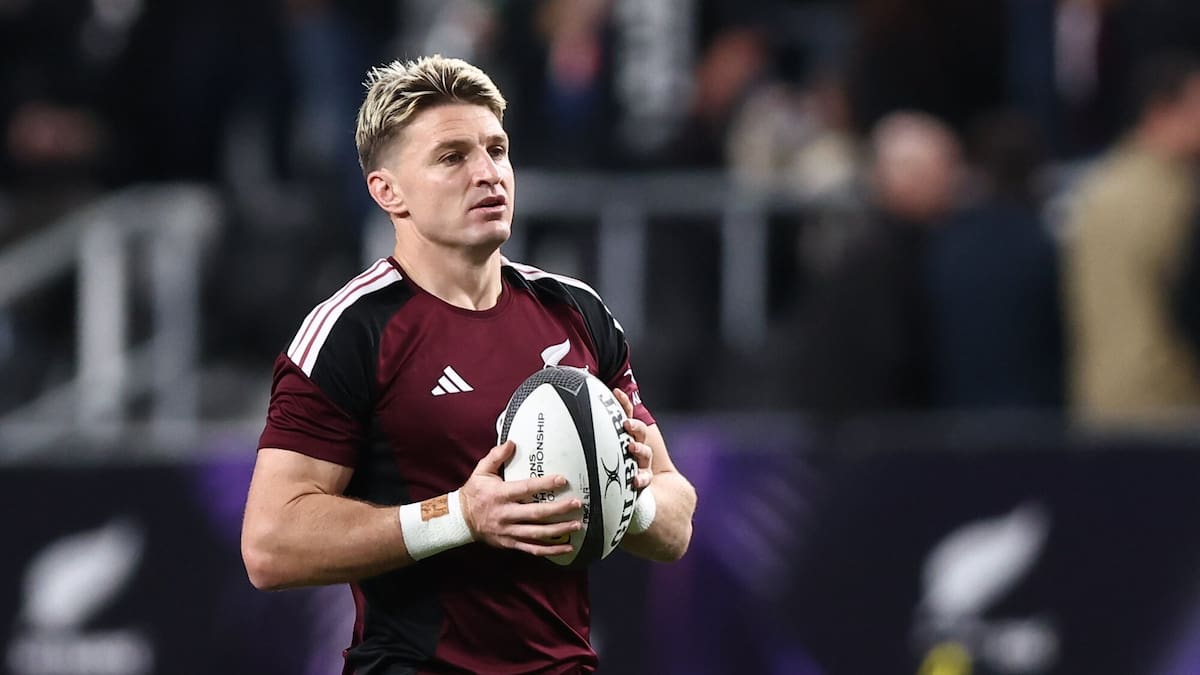
Beauden Barrett has returned to the All Blacks squad but was not selected to play against France. Photo / Photosport
And in a memorable play that was perhaps emblematic of Barrett’s malaise, he famously had a kick charged down by Hurricanes lock Warner Dearns that gifted the eventual champions a soft, momentum-changing try.
Not unfairly, Barrett looked so lost as to generate legitimate debate as to whether he could justifiably be selected by the All Blacks.
New coach Dave Rennie had promised to pick on form, and Barrett had produced precious little of that.
Less fairly, but predictably, the inevitable cliches about his age – he turned 35 in May – began to surface: the comments sections loaded with statements about Barrett being past it and not the athlete he once was.
Rennie, though, had no hesitation in picking Barrett for his squad. His promise to select on form wasn’t meant to be absolute and no serious, credible international coach would axe a player of Barrett’s quality and experience on the back of one poor Super Rugby campaign.
Barrett is by no means the first big-name All Black to not look like a big-name All Black during Super Rugby.
It almost became habitual between 2011 and 2014 for Ma’a Nonu to have a Super Rugby shocker only to turn up with the All Blacks as an entirely different player.
Former All Blacks head coach Steve Hansen didn’t want Nonu to be shambolic during Super Rugby, but he had justifiable faith that the bruising second five-eighths would come into the All Blacks and produce world-class performances no matter how he had been playing for his club.
Rennie is obviously subscribing to the same theory and backing himself, his coaching team and the All Blacks’ environment to rejuvenate Barrett.
The thinking seems to be that Barrett’s Super Rugby form was a product of the game plan and environment at the Blues, rather than evidence of a serious decline in Barrett’s athleticism and abilities.
The grapevine suggested there was tension between Barrett and Blues coach Vern Cotter – a tension that extended to other senior players – over the restrictive game plan.
Blues playmaker Beauden Barrett looks to pass as Hurricanes lock Warner Dearns approaches. Photo / Photosport
Bottom line being, Rennie thinks a happier Barrett working in a collaborative environment, where coaches and senior players swap ideas and his experience is valued and opinion sought, will be a different – better – player for the All Blacks.
And having not picked Barrett to play against France – a week in which Rennie said he was impressed with the veteran’s rugby IQ and commitment – the squad’s most experienced player may well feature in Wellington this Saturday against Italy in what may be a changed All Blacks team.
Rennie has given Barrett some time and space to rediscover himself and now, probably, the head coach wants to get him and other select squad members not involved against France on the park against Italy.
The selectors will likely want to keep a few combinations together this week, most notably the playmaking duo of Cam Roigard and Ruben Love, but it wouldn’t be a surprise to see Barrett selected at fullback in a new-look back three alongside Josh Moorby and Fehi Fineanganofo.
Not a surprise because Barrett is a great communicator and organiser and the ideal man to guide the two local wings, who were in incredible Super Rugby form, through what would be their first test starts (Fehi Fineanganofo played six minutes off the bench in Christchurch).
But also, Rennie’s new-look counter-attack game is perfectly set up for Barrett. It requires a fullback that is comfortable and accurate under the high ball.
It also needs the fullback to be a strong tactical decision-maker with an ability to quickly assess options and determine where there is space to attack.
Barrett ticks all the boxes, plus he’s got a long kicking range (off both feet), which the All Blacks need, because while the mindset is to try to run from the backfield, there will be times when the pragmatic will have to replace the optimistic and the ball be hoofed to touch.
The only question is whether Barrett still has the top-end pace, speed endurance and agility required to run from deep at test level.
Given how well he’s looked after himself and how hard he works, he’s likely to provide an emphatic “yes” to that question in Wellington if he gets a chance to do so, and the man who some said shouldn’t even be in the squad, could once again become the All Blacks’ preferred choice at fullback.
Gregor Paul is one of New Zealand’s most respected rugby writers and columnists. He has won multiple awards for journalism and written several books about sport.