
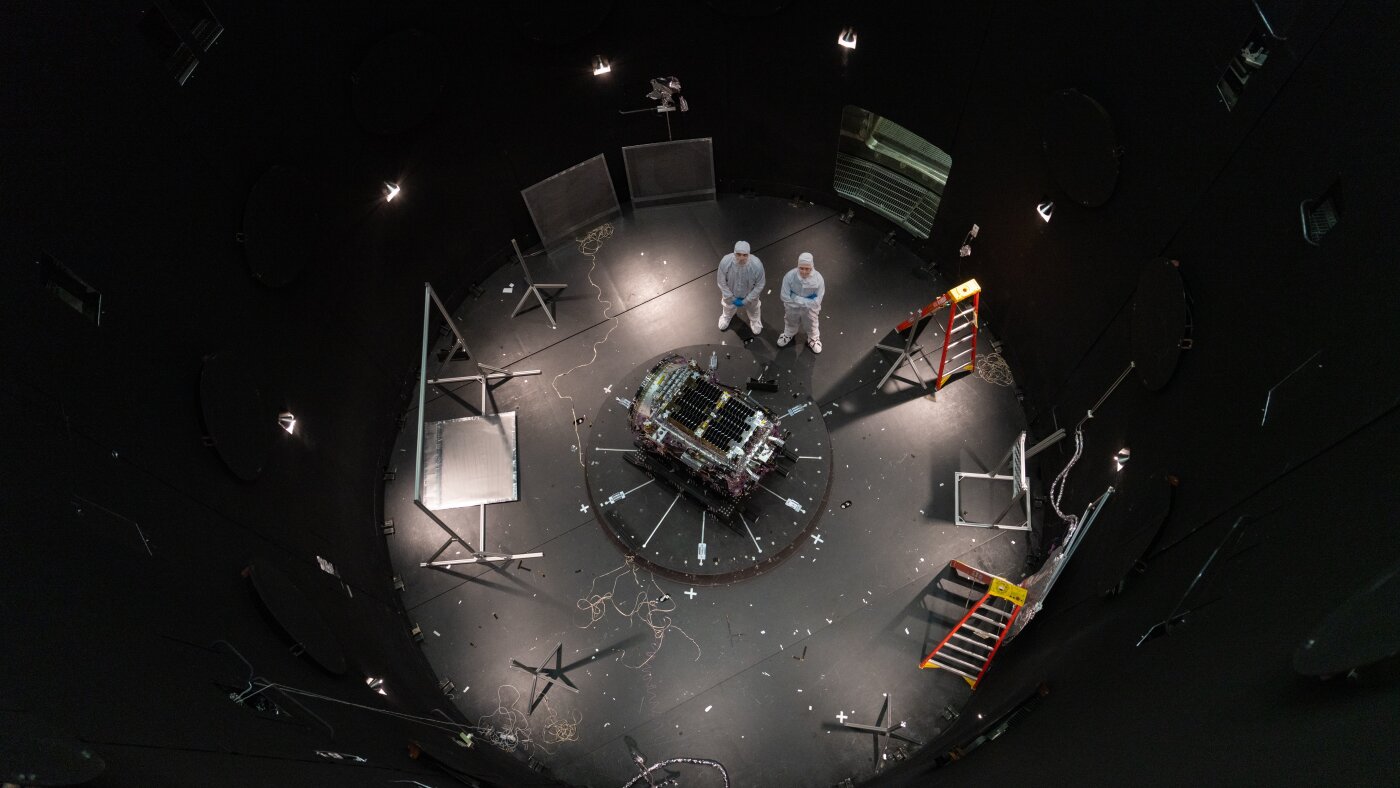
Kieran Wilson, LINK’s principal investigator, and Hunter Robertson, a space systems engineer, both at Katalyst Space, stand next to their spacecraft inside the SES (Space Environment Simulator) at NASA’s Goddard Space Flight Center in Greenbelt, Md., on April 17, 2026, ahead of thermal vacuum testing. During testing in the SES, LINK fired its three ion thrusters, deployed one of its three arms, and experienced space-like hot and cold temperatures.
Sophia Roberts/NASA
hide caption
toggle caption
Sophia Roberts/NASA
A valuable NASA satellite observatory is falling to Earth faster than scientists expected. It’s called the Neil Gehrels Swift Observatory, or “Swift” for short, and it can respond to celestial events much faster than its sky-gazing counterparts. To save Swift and test out a first-of-its-kind technology, NASA partnered with an Arizona-based startup to launch a refrigerator-sized robot, aptly named Link, into lower Earth orbit. That’s on its way right now to meet up with Swift to give it a boost.
Interested in more science in the news? Email us your question at shortwave@npr.org.
Support public media with NPR+ and enjoy perks for over 25 podcasts like this one. It includes perks like bonus episodes, early access, archive access, curated playlists and sponsor-free listening. Learn more at plus.npr.org.
Listen to Short Wave on Spotify and Apple Podcasts.
This episode was produced by Berly McCoy. It was edited by Rebecca Ramirez. Tyler Jones checked the facts. The audio engineer was Jimmy Keeley.