
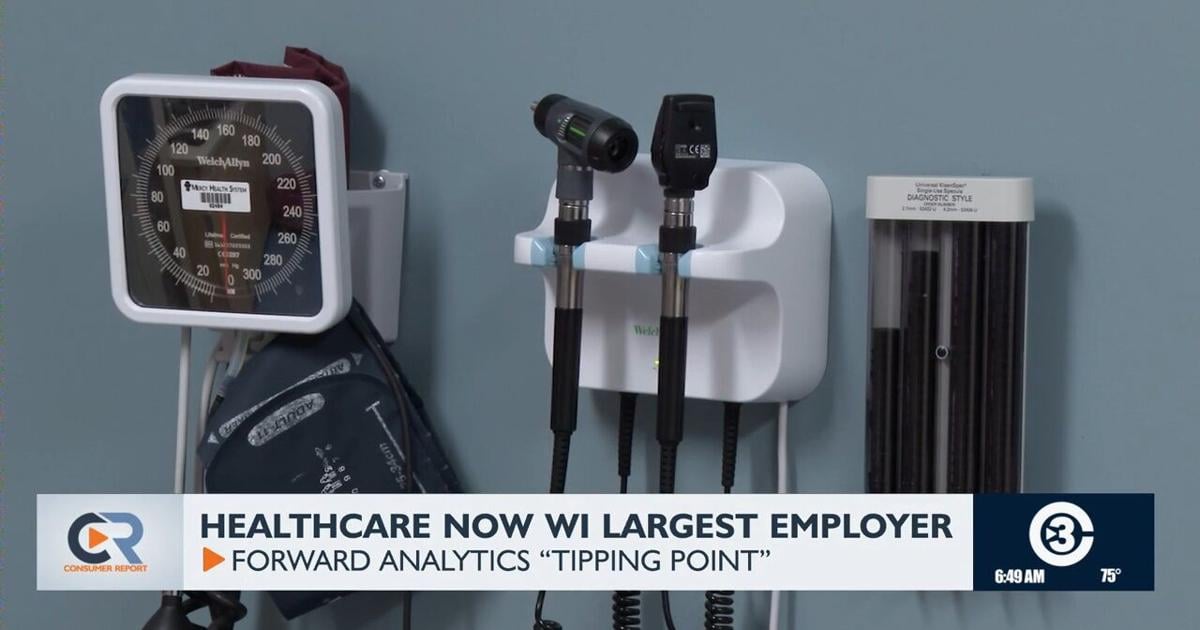
MADISON, Wis. – Wisconsin’s economy just crossed a major milestone: for the first time in decades, health care and social assistance jobs have overtaken manufacturing as the state’s largest employer.
A new report from Forward Analytics, lays out how and why this shift happened — and what it could mean for workers, communities and families across Wisconsin.
While manufacturing lost the top spot, it stays powerful. The report shows that in 2001, manufacturing dominated Wisconsin’s job market. It notes that manufacturing led the economy by “more than 230,000 jobs over the next largest sector.”
Since then, the state has lost more than 100,000 manufacturing jobs, dropping from about 560,000 positions in 2001 to fewer than 460,000 today.
The biggest hits came in: paper manufacturing (down nearly 45%), printing (down about 42%), transportation equipment, including auto and aerospace (down about 37%), these changes line up with major economic shifts — like the move from paper to digital products, and global competition in heavy industry.
Still, the report stresses this is not a collapse of manufacturing. It remains a core part of Wisconsin’s economy, supporting nearly 460,000 workers with average pay of about $75,000 a year and contributing an estimated $74 billion to the states economy.
But health care and social assistance are surging ahead. Data tracked since 2001 shows it has steadily expanded. According to Forward Analytics, employment in this sector “increased 44.6% from 2001 through 2025,” growing from about 321,000 jobs to more than 463,000.
The report calls this “an economic and demographic inevitability,” driven largely by an aging population that needs more medical and support services.
But not all health care jobs are growing, nor are they paying equally. Ambulatory and outpatient care (like clinics, dental offices and outpatient centers) grew about 54% and averages roughly $92,500 a year.
Hospitals grew about 36%, with average pay around $77,300. Social assistance — the lowest‑paid part of the sector, at about $30,000 a year — more than doubled, from around 48,000 to nearly 100,000 jobs.
Meanwhile, nursing and residential care — the piece most directly tied to senior and long‑term care — barely grew over two decades, just 5.6% compared to a national increase of 24.8%.
Since 2019, Wisconsin has actually lost about 5,000 jobs in this subsector, even as the nation saw a small gain. Forward Analytics warns that these patterns may collide with a major demographic reality.
The report notes that Wisconsin’s population age 65 and older is expected to grow by about 26.7% — roughly 283,000 people — between 2020 and 2030.
Older residents tend to use more health and long‑term care services. Yet the areas that serve them most directly — like nursing homes and residential care facilities — are growing slowly or even shrinking.
The report says “the ongoing struggle to maintain employment in this subsector is at least partly due to wage pressures,” as hospitals and other higher‑paying employers compete for the same nurses and caregivers.
Beyond these two sectors, the report finds that Wisconsin’s overall job growth has been slow. From 2001 to 2024, total employment in the state grew 8.3%, compared to 19.6% nationally — less than half the U.S. rate.
Find the full report here.
COPYRIGHT 2026 BY CHANNEL 3000. ALL RIGHTS RESERVED. THIS MATERIAL MAY NOT BE PUBLISHED, BROADCAST, REWRITTEN OR REDISTRIBUTED.