
Several reviews led to an overhaul of training procedures and ultimately New Zealand forging a training relationship with Australia’s military.
The Court of Inquiry, intended to find “lessons learned”, found no evidence of institutional failure but the extraordinary coincidence of a bullet fired by one soldier then striking a grenade as it was thrown and rebounding to hit someone else.
Two teams of four soldiers each were taking part in NZSAS squadron readiness training just before midday on the day the incident occurred.
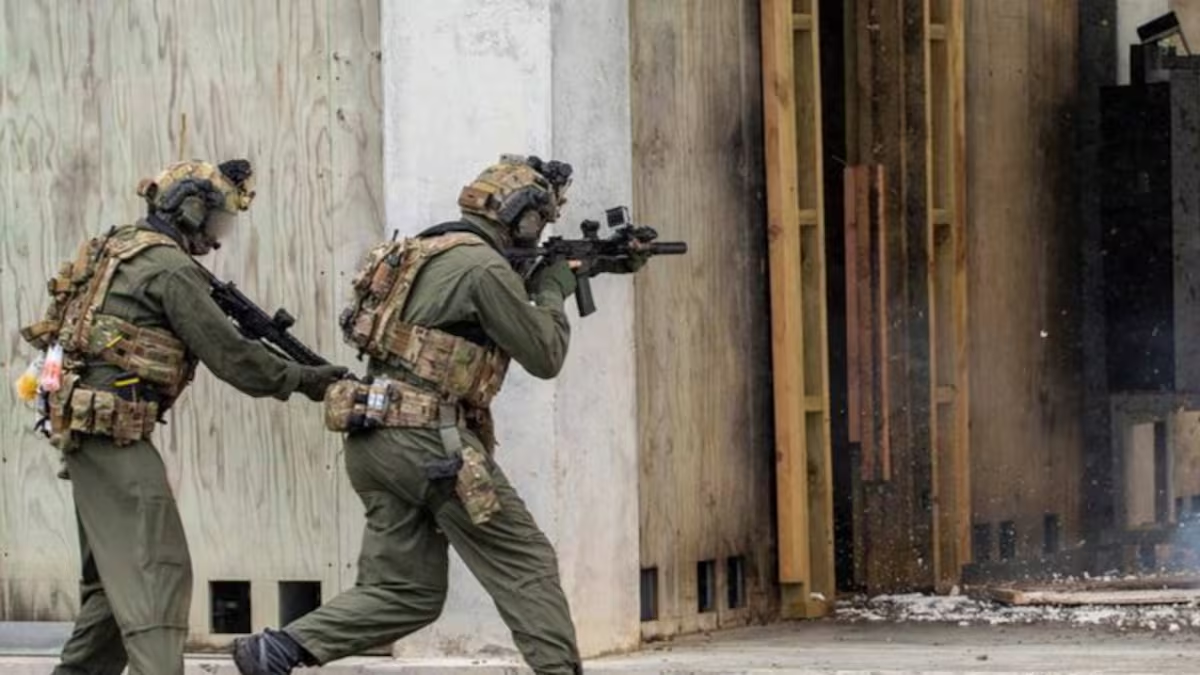
NZSAS troopers practising explosive door breaching at the Ardmore military training facility. Photo / Mike Scott
The soldiers were carrying out close-quarter battle drills involving fast room entries using live ammunition and inert training grenades.
The “method of entry” house is built specifically for that training, providing a multi-storeyed environment that can be rearranged internally to provide a range of training scenarios.
The exercise started with a safety briefing from a range officer, then two teams of soldiers carried out two live-fire runs through the training house without incident.
On Team 1’s third run, the soldiers moved through the house clearing first one room then the next before lining up outside the room where the incident happened.
One soldier used a Remington 870 shotgun to breach the locked door. Usually, the shotgun would be used to destroy hinges at the top and bottom of the door.
This time, the soldier fired once and then the shotgun jammed.
It’s the sort of situation that the soldiers are trained to manage. The soldier with the shotgun stepped back and the team leader – the soldier who would be shot – moved forward and kicked the door open.
After the opening of the door, the NZSAS team followed their training pattern – one soldier threw a dummy “flashbang” grenade into the room while a teammate entered and shot a target to the left, then one in front of him.
Seconds later, the team leader collapsed.
The Court of Inquiry found a 5.56mm bullet fired from NZDF’s service-wide MARS-L rifle had struck the dummy grenade as it was thrown into the room, ricocheted and hit the soldier in the right trapezius above his body armour.
It found the grenade was thrown in accordance with procedure and it also endorsed the actions of the soldier who fired the bullet, saying he was engaging a target as trained to do.
The incident had happened in “extraordinarily unlikely circumstances” and was a “freak accident”, the inquiry found.
An NZSAS soldier involved in resolving the Taliban assault on the British Council in Kabul, Afghanistan, in 2011.
The report said the team had believed the leader’s collapse to the floor was a medical test inserted into the training scenario.
Blood flooding out from the soldier quickly shattered that illusion, leading to an urgent halt to training as those present raced to help.
The inquiry report detailed how those present stripped the injured soldier’s kit, finding the wound near his right shoulder. Initial chest seals over the entry and exit wounds would not stick because of the blood.
Instead, the soldiers packed the wound with gauze, got their colleague on a stretcher with an IV and lifted him into an ambulance. The wounded soldier underwent surgery at Middlemore Hospital. While it was described as a “serious injury”, he was expected to eventually return to full duties.
The incident led to recently-appointed Chief of Army Major General Rose King calling a temporary halt to live-fire training. A command investigation and inspection of ammunition and weapons was also ordered. It found no evidence of equipment failure.
The inquiry found targets in the Method of Entry House had bullet catchers to minimise the chance of deflection. It also said planning and safety measures met required standards and were fit for purpose, and risk assessment work had been properly carried out.
Those carrying out the inquiry sought – but failed to find – any witness who could remember a similar incident.
“Witnesses describe what they saw as an extraordinarily unlikely event that occurred in the course of well-planned and conducted training by experienced soldiers,” the report said.
It concluded there had been no failure in preparation, safety measures, conduct, medical planning or adherence to orders that contributed to or could have prevented the incident.
The commander of Special Operations Command said the incident was an “extremely low probability event” and that the inquiry report validated the NZSAS training approach. No recommendations or changes were made.
A team of NZSAS soldiers attack a building at the Ardmore Battle Training Facility. Photo / Mike Scott
The commander said: “Our challenge now is to continue to train hard in order to meet our directed outputs, while continuing to take all practicable measures to ensure the safety of our team members.”
The Herald has reported on an Army-wide training safety review started in mid-2020 after a series of fatal and serious accidents.
The review found inconsistent procedures across the army, processes that were out of date and an inability for those carrying out training to judge how risky it might be.
In the case of Kahotea’s death in 2019, he fell to his death from the same training house while trying a new technique for the first time, at night, in an exercise involving a United States helicopter, practising a technique the NZSAS had never used and has not attempted since.
The findings of a February coroner’s inquiry into Kahotea’s death are yet to be published.
David Fisher is based in Northland and has worked as a journalist for more than 30 years, winning multiple journalism awards including being twice named Reporter of the Year and being selected as one of a small number of Wolfson Press Fellows to Wolfson College, Cambridge. He joined the Herald in 2004.
Sign up to The Daily H, a free newsletter curated by our editors and delivered straight to your inbox every weekday.