
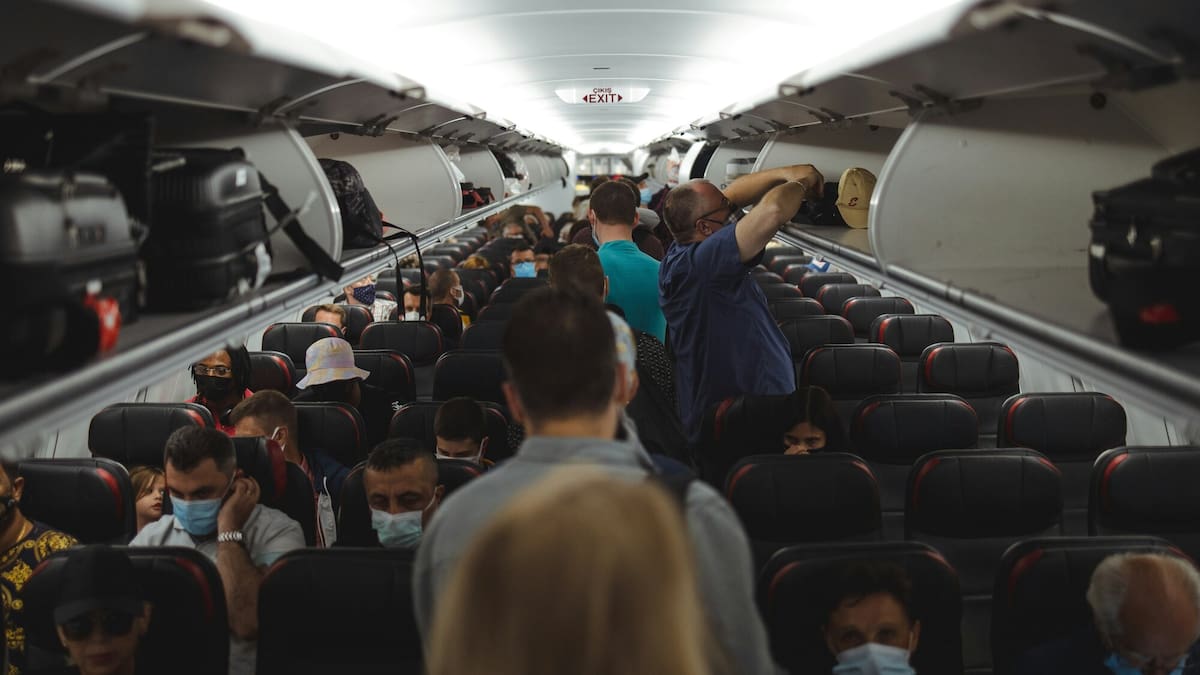
By the time boarding reaches Group 6, the mood has changed considerably.
Still in the aisle, those a bit less lucky, stutter-stepping toward the back and scanning the overhead compartments for any remaining sliver, snipers in searching.
Their eyes dart as they see a void, just the right size for their wheelie four rows down, and they begin hoping.
Maybe they’ll make it in time. Maybe no one in front of them will claim it. They start to see it as “theirs”.
What should be a simple exercise in putting a bag away has become one of the most contentious moments in modern air travel.
The widespread practice of charging separately for checked bags only became common in the airline industry during the mid-to-late 2000s. Photo / Unsplash
Reddit threads are full to bursting (and entertainingly so) with complaints ranging from mild irritation to operatic outrage.
Bags are too big. Boarding groups are ignored.
But what if the battle for overhead space isn’t about luggage at all?
It’s about fairness.
Jo Hayes, a Brisbane-based etiquette expert, believes it’s what lies beneath those strong emotions that matters.
“We all have an inherent sense of justice and what is right and fair,” she says.
“When we see something that isn’t, especially when it concerns us, it can trigger strong responses.”
Air travel creates the perfect conditions for those feelings to rear their ugly heads.
A hundred strangers crammed into a confined space, all ready to just get it over with already.
Some are tired. Some are wired. Then, they’re asked to share a finite resource with people they’ve never met and likely never will again.
The result can feel stingingly personal. It even has a name – tragedy of the commons – when individuals exploit a shared resource for personal gain until it degrades for everyone.
Originally, it referred to grazing land, but it’s been applied to everything from overfishing to office printer paper.
And now, baggage stowage.
One cheeky traveller I know admitted she’s befriended passengers in earlier boarding groups solely to find baggage space, and another uses airline points to board earlier, thus sidestepping the mortal fear of a last-minute gate check.
“The anxiety is real,” she laments.
Then, there’s my friend Jackie, who was struck in the head by a backpack the size of a toddler when a passenger wrestled it back out of a locker that it never had a chance of fitting in.
The grievances aren’t isolated, and they reveal a broader truth.
Many travellers pay extra just to board the plane earlier. Photo / Unsplash
Travellers are now actively strategising about carry-on access (or excess?), spending real money and burning loyalty points to secure what’s meant to be available to everyone.
The economics behind it are straightforward enough.
Airlines globally are seeing increased pressure on cabin baggage allowances, driven by passengers seeking to reduce checked luggage fees.
Air New Zealand says it reflects what carriers worldwide are experiencing.
“Many of our business travellers opt for cabin baggage only, particularly on shorter trips, as it can help make the journey faster and more convenient,” Kate Boyer, Air New Zealand’s Chief Operating Officer, Ground and Inflight, tells us.
Consumer NZ’s Jessica Walker says the affordability squeeze makes the calculus simple.
“We do know that the cost of living is New Zealanders’ number one concern. To that extent, we should expect that price is a primary consideration when making decisions about purchases, including airline tickets.”
No one wants to pay extra for checked luggage when carry on is free.
The problem is that overhead space hasn’t expanded at the same rate as our collective determination to avoid checking a bag.
Air New Zealand’s economy allowance is one carry-on bag up to 7kg, plus a small personal item.
The airline chalks it up to balancing convenience with weight and balance.
passengers in row waiting check-in counters at airport at Charles de Gaulle airport in France. No face, panoramic size Some passengers use loyalty points to secure cabin bag space. Photo / DepositPhotos
Boyer notes that most passengers are considerate, but “when a handful of people arrive with oversized bags, it can have a disproportionate impact on everyone else”.
That observation lands precisely where civility specialist Hayes’ thinking does.
People aren’t reacting to a breach of etiquette; they’re reacting to a perceived breach of the social contract.
Watching someone shoving a roller bag, a backpack and a duty-free haul into a shared space can trigger something visceral, because the imbalance is right there in plain sight.
Hayes says these moments can descend into an “every man for himself situation” where the impulse is to claim what you can before someone else does; it’s a scarcity mindset. (Remember the toilet paper situation during Covid?)
She argues that the passengers who navigate boarding most successfully are those with a “strong and flexible self,” those able to assert their own needs while remaining genuinely aware of the people around them.
It’s a useful standard, because the fight for overhead space was never really about the bags.