
About 80% of New Zealand’s kiwifruit was grown in Bay of Plenty and the report found the sector was on a strong growth trajectory.
New Zealand recently wrapped up a record-breaking 2025/26 harvest of 225 million trays.
Zespri’s global fruit sales revenue was $5.9b in the last season and was projected to reach $6.2b by 2030.
The report described Te Puke as a “powerhouse”, generating an estimated $698m in kiwifruit income in the 2024/25 season, followed by Tauranga ($320 million) and Katikati ($285 million).
This concentration of economic impacts in the region had “shaped housing demand, infrastructure pressures, workforce growth and investment”.
Tauranga’s population doubled in 30 years to reach 161,000 and was projected to hit 541,200 by 2053.
“In 10 years’ time, you would expect Tauranga to be sitting as the number one [economic hub] for New Zealand based on the growth it’s having,” Mapu told the Bay of Plenty Times.
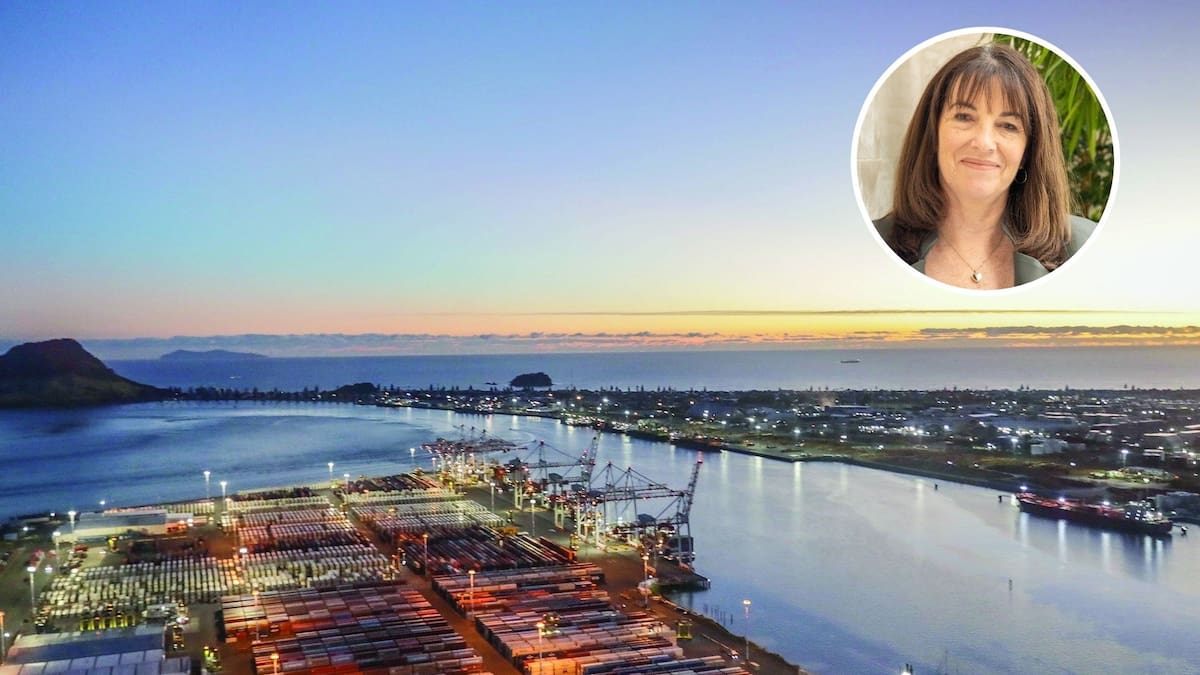
ANZ Bank New Zealand managing director business and agriculture Lorraine Mapu.
The report found that business registrations in the region for 2025 were 62.5% higher than in 2000.
Demand for industrial land was expected to be about 320 hectares over the next 30 years.
Mapu said Bay of Plenty was New Zealand’s primary trade gateway.
The report found the Port of Tauranga was a major driver of the regional economy and national supply chains.
Port of Tauranga chief executive Leonard Sampson said the port was New Zealand’s “international hub”.
He said the port handled most of the country’s dairy, kiwifruit, meat, and log exports.
The Port of Tauranga handles the majority of the country’s dairy, kiwifruit, meat and log exports. Photo / George Novak
New Zealand’s largest port, it handled 25 million tonnes of cargo and 1.2 million containers per year.
It shipped 48% of the country’s container exports – accounting for 70% of dairy exports, 65% of red meat exports and 90% of kiwifruit exports.
Sampson said the port had reached berth capacity. Its consent application to expand this was being considered under the Fast-track Approvals Act.
“[The project] will also allow us to introduce automation, which will make the port more efficient, increase landside capacity, enhance safety and reduce greenhouse gas emissions.”
Port of Tauranga chief executive Leonard Sampson said the port was New Zealand’s “international hub”.
Sampson said the project could double container volumes and “meet New Zealand’s needs for the next three decades”.
He said cargo volumes would increase via transhipment as Tauranga’s role as a “hub port” grows.
“Cargo will be transferred from smaller ports to Tauranga to meet larger ship services that will only call at one or two big New Zealand ports.”
Tauranga Business Chamber chief executive Matt Cowley said New Zealand’s economic prosperity would be determined by the golden triangle’s success – which included half of the country’s population and gross domestic product (GDP).
The golden triangle is the economic corridor between Tauranga, Auckland and Hamilton.
Cowley said Bay of Plenty had plans for future growth, but execution had been lacking.
“The [Western Bay of Plenty] regional deal with [the] Government aims to achieve better sequencing of local and central government projects to keep up with our growth needs and our economic potential.”
The Western Bay city and regional deal is an infrastructure partnership between central and local governments.
The Western Bay of Plenty city and regional deal was signed in May. Pictured are Bay of Plenty Regional Council chairwoman Matemoana McDonald (from left), Western Bay of Plenty Mayor James Denyer, Tauranga Mayor Mahé Drysdale, Local Government Minister Simon Watts and Infrastructure Minister Chris Bishop.
Stats NZ figures showed Tauranga’s population would surpass Wellington in 20 years, Cowley said.
“Although we’ve been through a period of tough times, people and businesses continue to flock to the Bay because of their confidence in building strong futures for themselves and loved ones.”
Greg Simmonds, general manager of Western Bay economic development agency Priority One, said kiwifruit would remain a cornerstone of the region’s economy.
“The next wave of growth will come from building greater value around our existing strengths in the primary sector.”
Simmonds said the region’s growth had outpaced transport, housing and enabling infrastructure.
“The good news is we’re now seeing significant investment and strong alignment between local and central government through the recently signed Western Bay of Plenty Regional Deal.”
Tauranga Mayor Mahé Drysdale said the council would “keep building” momentum and create conditions for the region’s continued success.
The regional deal was a “vital” part of supporting future growth and infrastructure investment.
Drysdale said it would help unlock the sub-region’s full potential.
Bijou Johnson is a multimedia journalist based in Bay of Plenty. A passionate writer and reader, she grew up in Tauranga and developed a love for journalism while exploring various disciplines at university. She holds a Bachelor of Arts in Classical Studies from Massey University.