
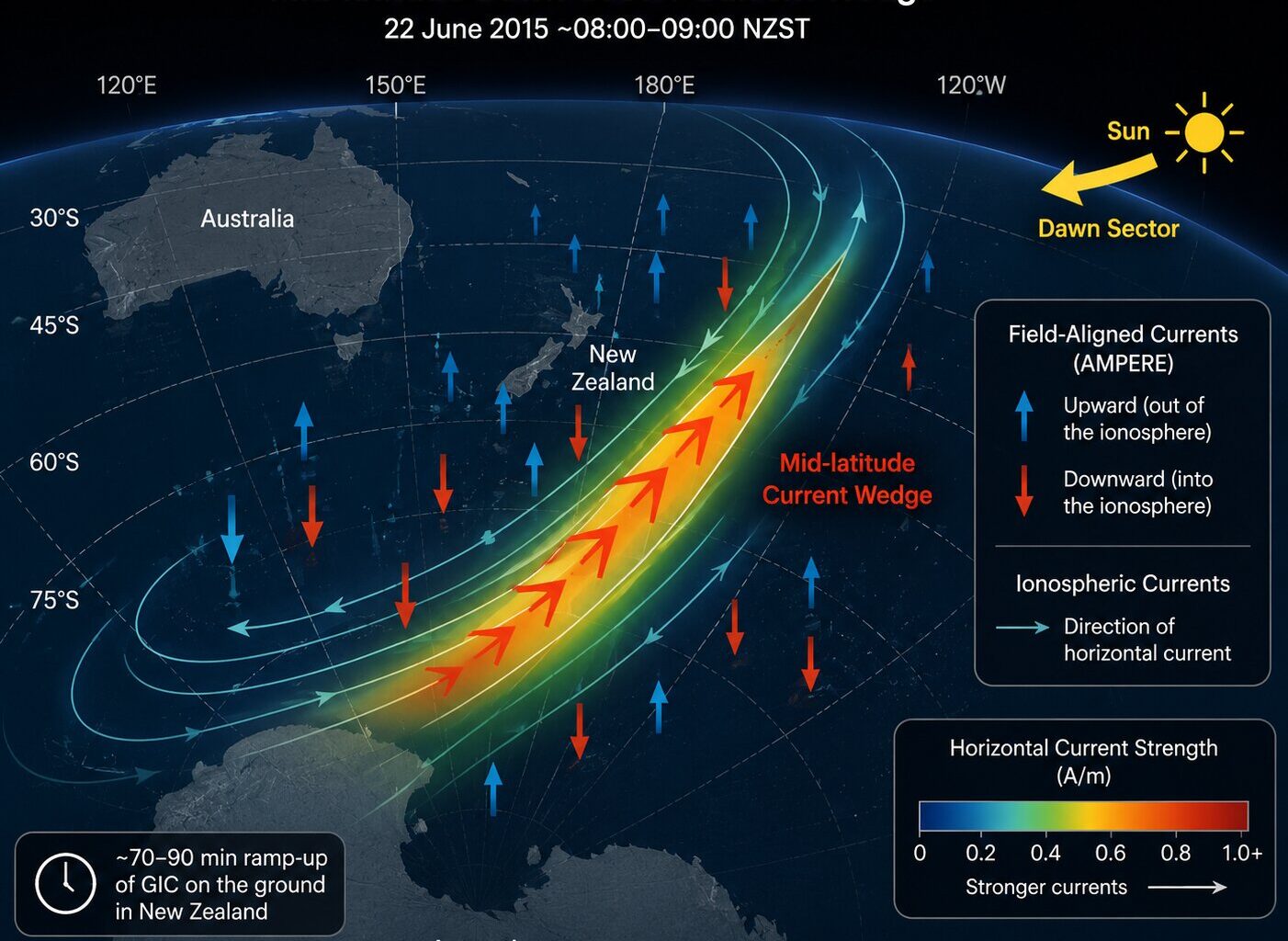
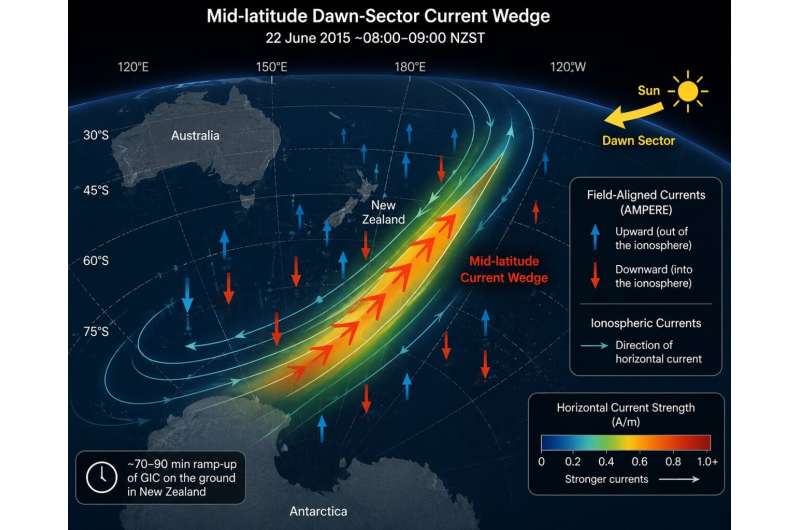
Illustration of the proposed mid-latitude dawn-sector current wedge during the 22 June 2015 geomagnetic storm. Researchers suggest this unusual ionospheric current system, linked to field-aligned currents, helped drive the slow, long-lasting geomagnetically induced currents recorded across New Zealand’s South Island power grid. Credit: Generated by AI using data points from Space Weather (2026). DOI: 10.1029/2026sw005032
June 2015’s geomagnetic storm barely registered on satellite alarms, yet it quietly sent a steady 20-ampere current into New Zealand’s power grid for more than an hour. While satellite dashboards remained calm, ground sensors across the South Island detected a slow, persistent rise in quasi-DC current. This “slow burn” was an unexpected twist, hinting at a hidden vulnerability.
This event challenged conventional wisdom. A new study published in Space Weather highlights that “long intervals of lower (relative) GIC can also be problematic.”
Most research on space weather hazards focuses on short, high-amplitude geomagnetically induced currents (GICs). But it turns out even a mild storm can quietly charge up a power network, proving that a still sky can indeed hide trouble.
Storm weather underground
If changing magnetism above can drive currents below, then a still sky can hide trouble. Every fluctuation in Earth’s magnetic shield induces electric fields in the ground, pushing currents through any connected metal network. These geomagnetically induced currents (GICs) act like a hidden DC bias on normal AC grids. When very large, they can trip protective devices or overheat transformers.
That danger was seen in March 1989, when a violent storm knocked out Hydro-Québec (6 million customers went dark). But this study shows the risk isn’t only at the poles. Even at middle latitudes, under the right geology and grid layout, a storm can deliver a long-duration push. In New Zealand’s case, local rock conductivity and network topology turned what was considered a “moderate” event into a mid-latitude hot spot of current.
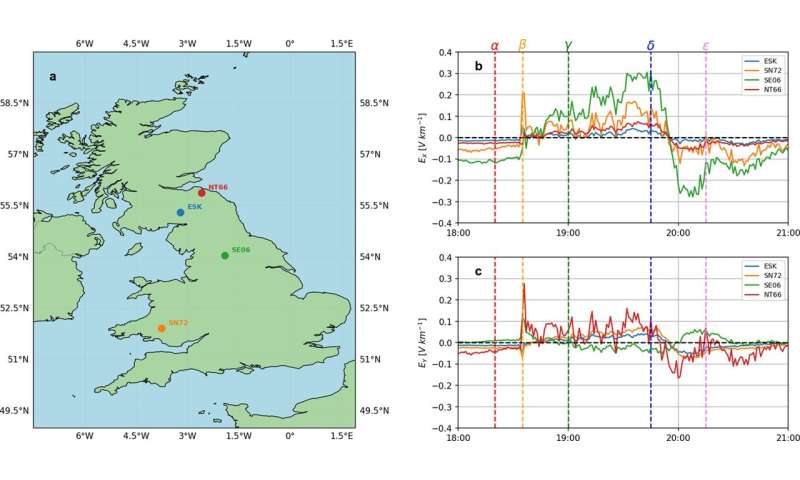
Modeling the ground impact in the United Kingdom with magnetotelluric modeling. On the left (a), a map of the United Kingdom with the four locations (HT66, ESK, SE06, and SN72 marked). On the right, panels (b and c) show the modeled geoelectric field at the four locations across the UK, in the north and east directions, respectively. As above, five epochs (α, β, γ, δ, and ϵ) are marked throughout the storm. Credit: Space Weather (2026). DOI: 10.1029/2026sw005032
A dawn surprise
At about 3 a.m. local time on June 22, 2015, the South Island’s power grid began to hum with a creeping current. New sensors logged a slowly increasing geomagnetic disturbance in the dawn sector—far from the usual storm-time trouble spots. The paper reports that the network “experienced long duration, steadily increasing GICs… up to 20 A and lasted approximately 90 minutes, manifesting in the mid-latitude dawn sector.”
About 20 amps of extra current flowed for an hour and a half. It was a surprise: The storm was classified as only moderate, yet the grid felt an effect usually reserved for superstorms.
Careful analysis traced the culprit to high overhead. The researchers point to an unusual dawn-sector ionospheric “current wedge”—a chunk of ring current energy deflected into the ionosphere. Satellite data on field-aligned currents support this idea. The solar wind didn’t blast the grid with a sudden jolt; it slowly pumped energy into a dawn-side current system, which in turn crept along Earth’s wires below.
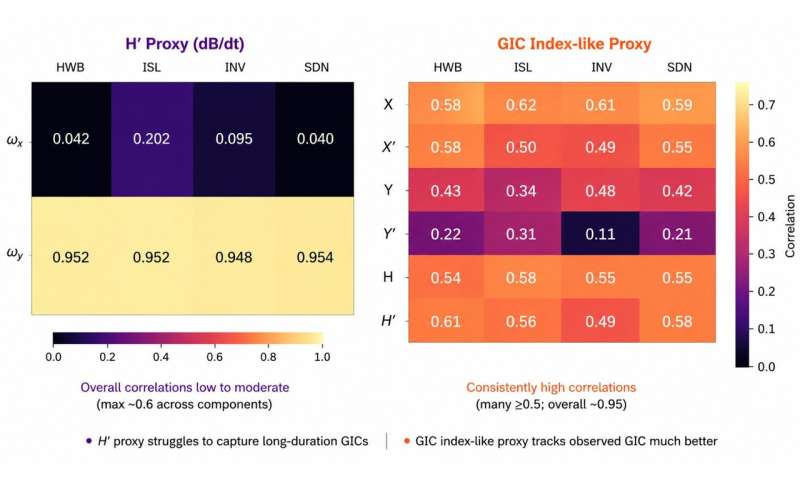
Comparison of two methods used to predict geomagnetically induced currents (GICs) during the June 2015 storm. The traditional H′ proxy showed only modest agreement with the observed currents, while a physics-based GIC index-like proxy matched the measurements much more closely, suggesting it could improve space weather forecasting. Credit: Space Weather (2026). DOI: 10.1029/2026sw005032
When standard warnings fail
This sneaky storm also fooled many forecasters. Conventional space-weather proxies—like the one-minute magnetic change index H′—barely rang any alarm (correlations with the actual GIC peak were only around 0.6). But a physics-based GIC index tracked the rise almost perfectly (correlation ≈0.95). Even global geomagnetic storm indices showed minimal disturbance. As the authors warn, these “rare mid-latitude phenomena” can “contaminate” our usual gauges; looking only for big spikes or high-latitude activity can miss a slow, regional charge.
Grid modeling underscored the problem. When the team ran its New Zealand power grid model against the June 22 measurements, it nailed the result in well-mapped areas: One substation’s modeled current matched 97% of the observed value. But where the network details were uncertain, the models struggled. This highlights a key point: Forecasting GICs requires up-to-date maps of both the ground’s conductivity and the grid’s wiring. A misaligned network or forgotten transmission line can make a once-peaceful storm turn dangerous without notice.
Beyond New Zealand: A new outlook
The quiet NZ storm reshapes how we think about space-weather risk worldwide. If a G4 class solstice storm can hide in the dawn sky, other mid-latitude regions, like the U.K., could face similar impacts. Preliminary “what if” tests on British geology suggest sizable geoelectric fields are possible from such a dawn-time current system. The study emphasizes that infrastructure resilience “depends on local factors beneath our feet (geology) and how the grid is wired.”
For power companies and space-weather services, the lesson is clear: Don’t only chase the spikes. Moderate, long-duration storms can stress equipment unnoticed. Grid operators may need new alert triggers, focusing on persistent currents. Researchers must also scour records for these stealthy events.
Ultimately, this case is a wake-up call. Even a quiet solar storm can pack a sneaky punch, revealing a “known pathway to equipment damage and long-lasting power failure” that we’re just beginning to understand. The danger lies as much in the ground beneath us as in the sun above.
Publication details
A. W. Smith et al, Large, Long‐Lasting Mid‐Latitude Geomagnetically Induced Currents During a Moderate Geomagnetic Storm, Space Weather (2026). DOI: 10.1029/2026sw005032
© 2026 Science X Network
0 share
Send feedback to editors
Add as preferred source
Citation:
Moderate geomagnetic storm pushed 20 amps into New Zealand grid while alarms stayed quiet (2026, July 9)
retrieved 9 July 2026
from https://sciencex.com/news/2026-07-moderate-geomagnetic-storm-amps-zealand.html
This document is subject to copyright. Apart from any fair dealing for the purpose of private study or research, no
part may be reproduced without the written permission. The content is provided for information purposes only.