
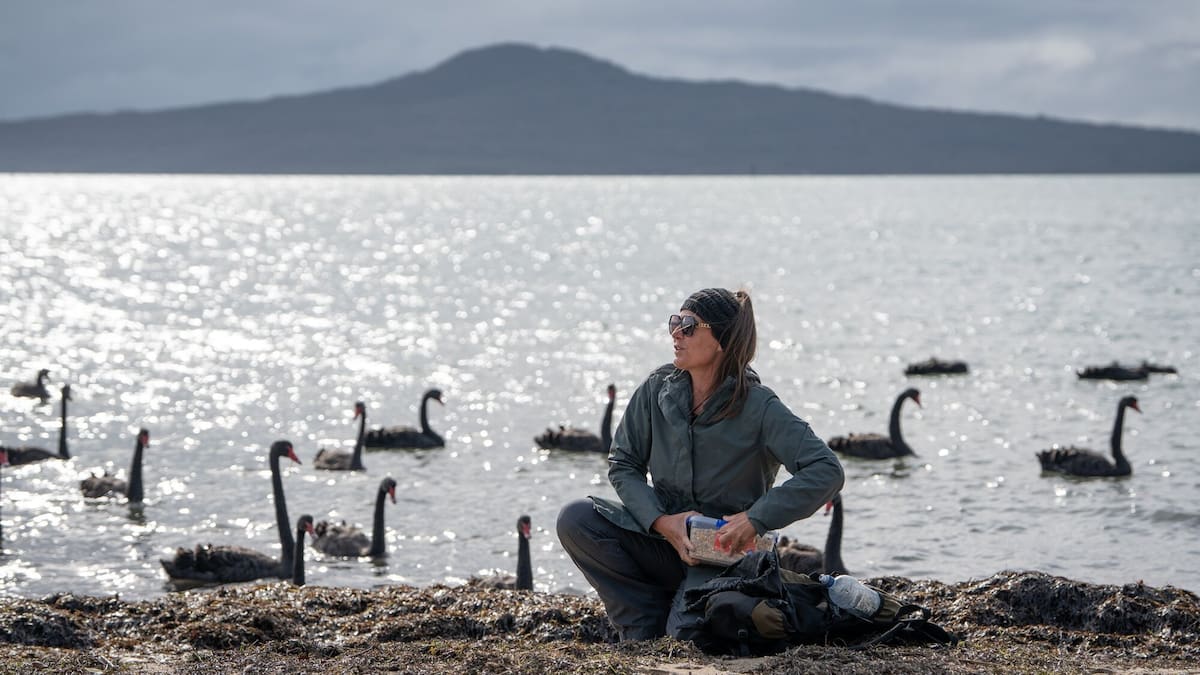
It’s here that she spends several hours a day feeding the swans, checking on the cygnets and politely pointing to the “no fishing” sign when local lads turn up on their bikes with fishing rods.
She spends about $100 a week feeding the birds, returning home 2-3 times a day to refill her 12kg backpack with containers of Chook Chow, a grain mixture to which she adds defrosted peas and sweetcorn. And she’ll lug litres of fresh water to make sure the birds get a decent drink.
“I love it,” she says. “It brings me great joy.”
Kate Johns feeding black swans at Tahuna Toroa Nature Reserve in Glendowie. Photo / Cameron Pitney
After noticing a marked improvement in the condition of the Tahuna swans, Johns started feeding the birds at St Heliers and Kohimarama beaches, a workload that can now take her six hours a day. The moment she appears, the birds come running, feeding out of her hand and jostling for their share of the grain and fresh water.
But not everyone feels joyous about the arrival of the swans on the eastern beaches. Some locals want them gone. Comments on community Facebook pages are divided, with swans being blamed for everything from water pollution to eating all the small fish. (They don’t eat fish and they don’t have teeth). Some just don’t like the look of them and are affronted that the birds have settled on the beaches. Others say they enjoy seeing them and want them left alone.
One residents’ group has gone as far as asking Auckland Council to cull the swans, partially blaming them for polluting the water at St Heliers Beach. Earlier this month the chairman of the St Heliers & Glendowie Residents Association, Bob Smith, spoke out against the swans at a meeting that left Johns “shaking and upset”.
Smith says one of the association’s top priorities is to make St Heliers a clean, safe beach for locals and visitors to swim at. Currently, because sewage and stormwater overflows from pipes at either end of the beach, St Heliers is listed as one of the dirtiest beaches in Auckland, often being black- or red-flagged to warn swimmers away.
Smith also blames the swans for the pollution because they defecate in the bay. The association has asked both Auckland Council and the Ōrākei Local Board for help in cleaning up the beach, including culling the swans to manage the growing population.
So far there’s been no response, he says.
“We’re not anti-swan, I want to make this point very clear,” Smith told the Herald.
Some locals have come out in the swans’ defence, saying they should be left alone. One woman posted about “Swan Heliers” on Facebook, saying she enjoyed watching the swans on her morning walks.
“I have never seen them come ashore and be aggressive to people.”
She questioned if there was any official evidence of the swans polluting the water, considering that tidal action flushed out the bay.
“I am open to seeing actual data on this which could change my mind … but my feeling is that it is the stormwater drains and the sewerage overflow that is creating the real issue on our beaches and I would like to see this resolved rather than mass murders of swans as the solution.”
Given the divided local opinions, Auckland Council is unlikely to organise a cull any time soon. Council staff have noticed increasing numbers of swans in various parts of the region and an increase in public inquiries.
Black swans on Kohimarama Beach. Photo / Kate Johns
However, Dr Imogen Bassett, head of the council’s natural environment specialist services, says swans are not causing an ecological issue and there are no current plans to control their population.
“Even from a water quality perspective, the tide would be washing away their faeces, and water quality would not be affected,” she says.
Fauna advice manager for the Department of Conservation (DoC), John Lyall, also says DoC would not consider culling the swan population on the eastern suburb beaches.
Bassett points out that swan populations tend to fluctuate as the flocks move around.
“Sometimes they can build up in numbers when conditions are favourable, and at other times can have significant population crashes, for example, if storms or other weather events damage their food sources.”
Earlier this year a large number of black swans were shot in the Manukau Harbour after Auckland Airport authorities became concerned about the birds flying into the path of aircraft landing or taking off.
An airport spokesperson says Civil Aviation Authority (CAA) rules required the airport to manage wildlife hazards. The airport has a dedicated wildlife team that continually monitored bird activity and used non-lethal measures to deter and disperse wildlife away from the airfield.
“Because of their size and flocking behaviour, black swans are considered a significant wildlife hazard in the event of a bird strike.”
Professor James Russell, who specialises in conservation biology at the University of Auckland, says decisions about culling need to be evidence-based.
“When an animal is going to be killed, the evidence needs to be real. And there needs to be a high standard for that [evidence].”
The wider community would also need to be consulted before culling was considered, he says.
“Does everyone think that, or is there a large sector of the community that think ‘no, it’s beautiful that these large, gracious birds are now gracing our beaches and I’m more than willing to accept a bit of poo for that’?”
Russell says accusing swans of taking food from other seabirds can be a form of “scapegoating”.
Those who care deeply about seabirds should probably start concentrating on ways to solve climate change – “how much we drive our fancy cars and take our fancy holidays” – and overfishing, he says.
“Even if the swans were taking some of their food, they’re all fighting over such a diminished, collapsed ecosystem so we should probably be turning that finger back at ourselves.”
John Dyer, a retired wildlife officer with Fish & Game, agrees the collapse of water quality in lakes and ponds in the North Island has driven swans to search for food sources in harbours and at beaches.
Studies have repeatedly shown that swan faeces had little effect on fresh-water quality. Eutrophication is more likely caused by farm run- off and pollutants like septic tanks.
David Klee, chief executive of Fish & Game in the Auckland and Waikato region, agrees, saying the collapse of lakes like Whangapē and Waikare in Waikato meant thousands of swans – herbivores that eat submerged water plants like seagrass (Zostera) – have to search elsewhere for food.
The irony, he says, is that after years of pollutants running into the Manukau, the harbour had been cleaned up, which has attracted the swans back to a food source.
“If there is food, they will come, basically.”
Klee says Fish & Game, which represents the interests of hunters and anglers, will respond to complaints if bird populations are causing a problem.
“We often are responding to farmers, for example, if there’s a whole lot of birds on their crops or on their grass.”
The rib eye of the sky
Currently, swans can be legally hunted, with a permit, during the May and June season. Hunters can bag up to 20 a day, with around 17,000 shot each year in the North and South Islands.
Klee says if cooked correctly, young birds make good eating.
Fish & Game’s website describes swan meat as “delicious”, with a similar taste to roast beef. Klee has his own recipe for “the ribeye of the sky”: rub the meat with a barbecue seasoning, grill medium rare, rest and slice thinly.
“If you like steak, I’d say you’d like swan.”
However, older birds are a little on the tough side.
“If you get a long-lived one that’s been flying around for 30 years you might want to put it in the salami or the sausage mix.”
Quite why black swans (kakīānau) get such a bad rap is probably because the big birds are the subject of myths that just won’t go away. They’re accused of eating baby flounder, which they don’t. Some say they eat twice their body weight in a day and that their daily droppings weigh the equivalent of a pound of butter. Others fear their children will get nipped if they swim or play nearby.
Nonsense, says Johns, who has observed their behaviour closely for two years. They’re birds of flight and will take off when a human or dog approaches on a beach.
“I guarantee if you walk towards a swan in St Heliers it will leg it. They don’t want to be anywhere near you when you’re swimming, so that is not an issue.”
Some Eastern Bays residents are concerned about the growing number of black swans settling on local beaches. Photo / Cameron Pitney
Swans fall under the Wildlife Act 1953, designated as native but can be hunted. Although they have adapted to seawater, thanks to salt glands above their eyes that help to excrete excess salt through their nostrils, they still need fresh water to drink.
Quite how swans arrived in New Zealand is still open for discussion. Most believe they were introduced from Australia in the 1860s by immigrants and organisations like the Acclimatisation Society. Some believe a few flew over from Australia, became naturalised and earned their place as a native bird.
However, the Ministry of Primary Industries (MPI) says although single black swans have been known to arrive from Australia, it is unlikely swans will bring H5 bird flu – detected recently in ocean-going seabirds in Australia – to New Zealand.
Genetic research by Dr Nic Rawlence, from the University of Otago, showed a species of black swan existed in New Zealand but, like the moa, was hunted to extinction soon after humans arrived in the 13th century.
Johns is appalled that black swans can be legally shot and eaten, describing them as “intelligent, emotional and incredibly social“ birds.
“They’re incredibly complex. They’re extraordinary so it’s just horrible that they can be hunted.”
She describes Tahuna Torea as “paradise” for the swans – no dogs allowed, few people and a freshwater pond at which to raise cygnets. When the Herald visits with Johns, the swans rush out to meet her, clustering round for their daily food and drink.
She’s named some of them, watched them grow up and move to the nearby beaches. Johns introduces Titan and Ma, who took a young white goose under their wings – the trio are now inseparable.
A swan cygnet drinks, watched by Titan and Ma, the birds who have adopted a white goose at Tahuna Torea Nature Reserve. Photo / Kate Johns
When Titan and Ma approach the container of food to eat, “Goosie” hisses a warning at the other swans to keep away until her adoptive parents have finished.
What’s not to love about swans, Johns wants to know.
“Here is the majestic swan, right here in our backyards, wild and harmless, who we can build bonds with if we know how to be with them in a way that is unobtrusive, safe and compassionate.”
Jane Phare is a senior journalist based in Auckland. Her roles at the Herald have included assistant editor of NZ Herald, editor of the Weekend Herald, founding editor of Viva, features editor and deputy print editor.
Sign up to The Daily H, a free newsletter curated by our editors and delivered straight to your inbox every weekday.