
It issued renewed versions of those same notices again this year, before buying the property on June 22.
Demolition started a week later.
The damage
The council released the building notices in response to a Local Government Official Information and Meetings Act (LGOIMA) request for records of prosecutions, enforcement actions, or internal decisions not to prosecute.
The earlier notices revealed extensive fire damage in the second storey of the occupied home. This included “charred” structural framing, “buckled” roof cladding, smoke damage and broken windows.
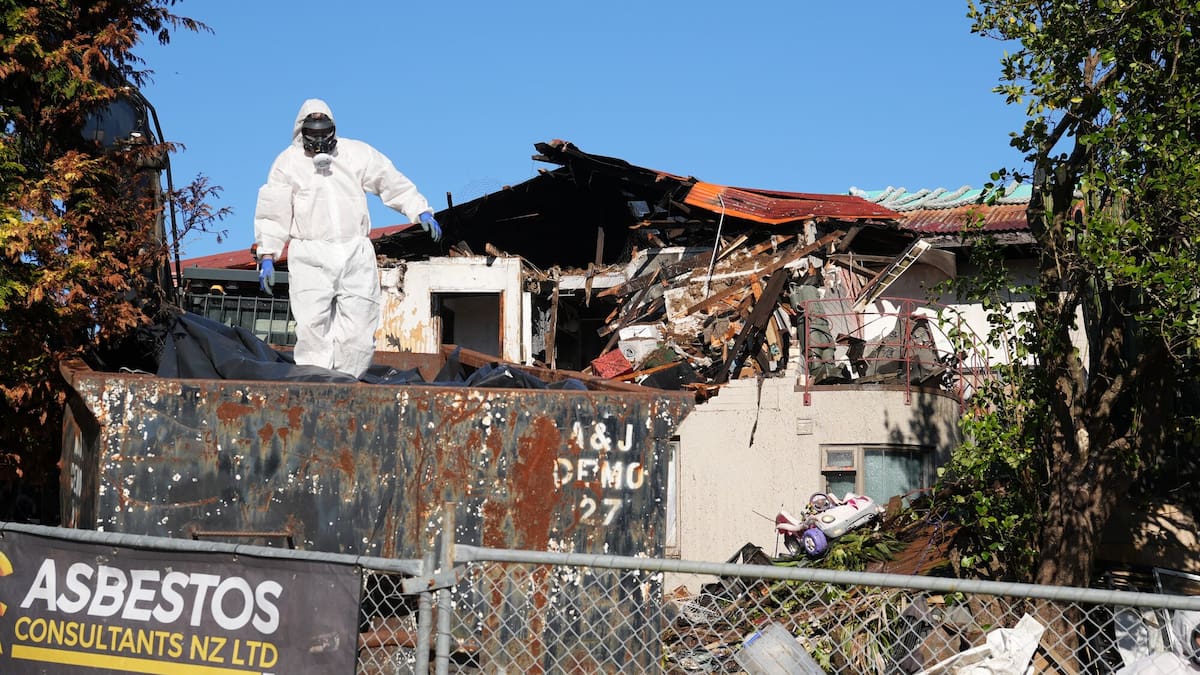
An assessment found the west portion of the house was “at risk of collapsing”, with potential risks to the wider neighbourhood from roof materials dislodging and exposed asbestos fibres “being dispersed through the air”.
The kitchen was destroyed, and a downstairs sink used to wash dishes was separated from the toilet and bathroom by only a half-partition.
Each notice outlined required remediation actions with deadlines and consequences for non-compliance.
Firefighters extinguishing the house fire at 34 Kiteroa St in 2010. Photo / John Borren
The next information provided in the LGOIMA response – which withheld some information on privacy grounds – was for late 2025.
The council revisited the home after receiving complaints about it.
New assessments identified further unconsented and “piecemeal” remediation work. Dangerous and insanitary building notices, and a notice to fix, were again issued.
These repeated several issues flagged a decade earlier, including “significant” fire damage, risk of roof dislodgement that could cause “injury or damage”, and visible asbestos.
The dwelling also had insufficient means to bathe. A bathroom and kitchen sink had been added in an unconsented detached dwelling, among other illegal building works.
After accessing parts of the main house “not previously available for inspection”, the council’s compliance officer found fire-damaged areas of the second storey should be demolished.
The property owner was required to take temporary risk reduction measures by April 29 and either remove and replace the illegal building work or demolish the house by June 22.
Failing to comply could lead to fines of up to $1.5 million.
‘Worried sick’
Residents the Bay of Plenty Times spoke to in the neighbourhood said they believed the council took far too long to take real action on the property.
One, whose name the Bay of Plenty Times agreed not to publish, said they were “petrified” living near the house, and “worried sick” about the health and safety risks it posed.
In their opinion, the council’s slow response showed “gross negligence and evidence of total disregard” for surrounding residents.
“I was falling apart … Your home is supposed to be your safe place. The council took that away from us.”
The resident said they engaged the council several times and made complaints.
Ironing boards, mattresses, and towers of boxes seen inside the fire-damaged 34 Kiteroa St building during the demolition. Photo / Bijou Johnson
They claimed the council was “dismissive and neglectful”, and failed to enforce or monitor remediation.
“How much risk to my family does it take?”
Another local, Lynn Marra, said the council had not provided a sufficient explanation for why it appeared there had been no enforcement action for almost a decade.
She was especially concerned about potential asbestos exposure, and said the council should conduct tests.
”It could be in our roof, it could be in people’s [tank] drinking water, on our door handles – it could be everywhere.”
In her opinion: “The council gave no thought to community safety at all.”
Asbestos crews managed the demolition of the fire-damaged 34 Kiteroa St building, which contained detected asbestos. Photo / Bijou Johnson
Marra said a real estate agent had valued her property at $100,000 less because it was near 34 Kiteroa St.
Another anonymous resident said the neighbourhood’s concerns grew as the amount of rubbish at the property increased.
They said the property had deteriorated since 2019.
“It was bad before that, then it got worse, and nothing has been done.”
Residents also raised issues about other behaviour at the property that contributed to their feeling unsafe, including police callouts.
The council responds
The council declined the Bay of Plenty Times’ request to interview its general manager of regulatory and community services, Sarah Omundsen, about the property.
It responded to written questions with an unattributed statement.
The statement said the community had been affected by the property for many years.
The structural issues were a “complex matter spanning more than a decade” involving damage from the 2010 fire, “ongoing compliance issues, and significant welfare and legal considerations”.
The council’s role under the Building Act was to assess risk and respond in a “proportionate, evidence-based and lawful” way, the statement said.
Several agencies were involved, and privacy and legal obligations limited what the council could share.
It said repeatedly that public safety was paramount throughout.
The council said “subsequent work and partial remediation” was done after the 2015-2017 notices were issued.
It did not answer follow-up questions about what remediation was done, why partial remediation appeared to have been seen as sufficient, and whether the notices were lifted. The council said these would need to be submitted as an LGOIMA request.
The statement said the council inspected the home again after “renewed complaints” in late 2025.
Finding the property still met criteria for an insanitary and dangerous building, the council issued new notices with a compliance deadline of June 22.
The Building Act required the council to act reasonably and consider the circumstances of each case, it said.
Exposed asbestos was found at 34 Kiteroa St in 2017 and in 2026. Photo / Bijou Johnson
“Initially, a staged and compassionate approach was taken in recognition of the owner’s personal circumstances.
“As non-compliance continued, together with updated risk assessments and increasing concerns raised by neighbours and the wider community, [the council] progressively escalated its response.”
Buying the property was determined as “the most practical and cost-effective” option for a timely resolution and to remove ongoing risks.
The council paid $500,000 plus demolition costs.
It said pursuing enforcement action could have taken “many years” at “significant costs to ratepayers”, while the risks remained.
The council would decide what to do with the land once the works, including the safe removal of asbestos, were done.
The property at 34 Kiteroa St on July 2 as the demolition neared completion.
“We recognise that this situation has been difficult for neighbouring residents and the wider community, and that the activities associated with the property have had a lasting impact over many years,” the statement said.
“We also acknowledge that many people have been seeking a resolution for some time.”
The council thanked residents for their “patience, understanding, and co-operation” as it navigated a “complex, sensitive, and lengthy” process.
“We hope this marks an important step towards restoring safety, certainty and peace of mind for neighbours and the wider community.”
The Bay of Plenty Times was unable to contact the property’s former owners.
Bijou Johnson is a multimedia journalist based in Bay of Plenty. A passionate writer and reader, she grew up in Tauranga and developed a love for journalism while exploring various disciplines at university. She holds a Bachelor of Arts in Classical Studies from Massey University.