
From a Māori economic perspective, I believe the answer is yes.
That might surprise some people.
During the parliamentary debate, the impression was left in some quarters that Māori have little reason to support this agreement because it doesn’t deliver enough for dairy and the Tiriti provisions are not comprehensive enough. Those views deserve respect, but they also tell only part of the story.
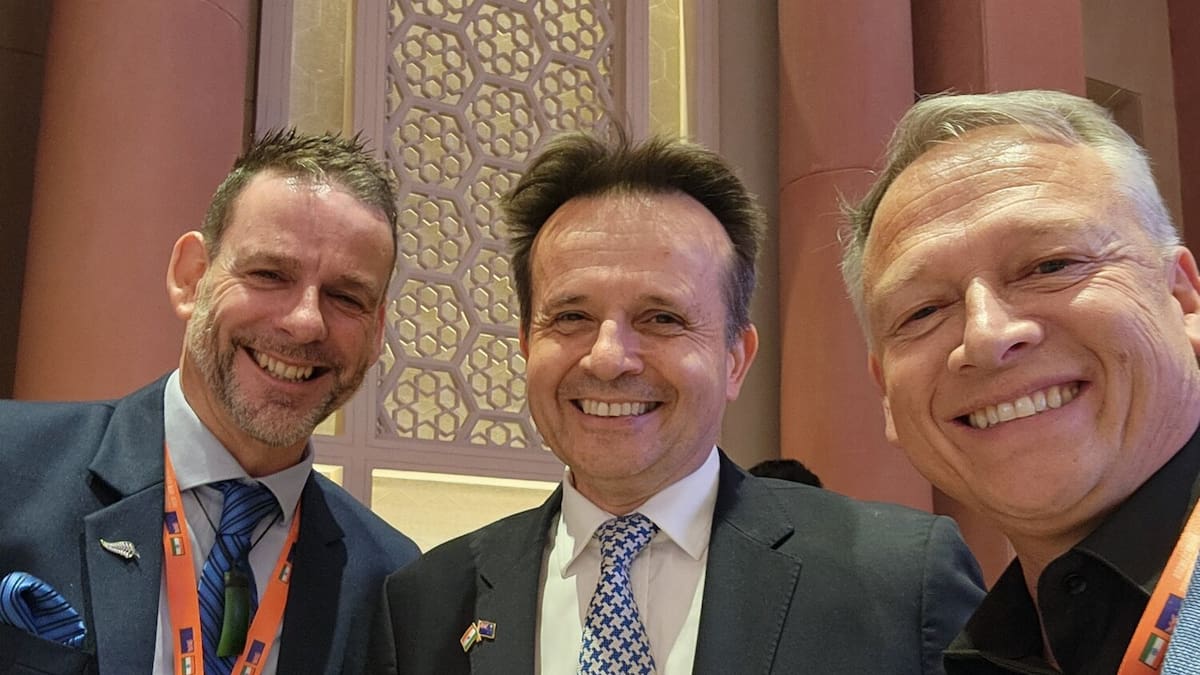
Mallika Janakirama with Hone McGregor.
Perhaps the biggest misconception is that the Māori economy is still defined by a single industry — or by commodities alone. It isn’t.
Today, Māori interests are deeply embedded across fisheries, forestry, sheep and beef, horticulture, mānuka honey, wine, food innovation, and an increasingly sophisticated digital, technology and services sector.
Those are precisely the sectors where this agreement delivers immediate or early commercial gains through tariff elimination, tariff reductions and improved market access.
For Māori exporters, this isn’t an abstract trade negotiation.
It’s practical, it’s new customers, it’s greater diversification.
It’s access to more resilient markets.
Market diversification is no longer just a growth strategy; it’s a resilience strategy. Commodity cycles come and go, but enduring commercial relationships have the potential to create value across generations. That’s a perspective Māori businesses instinctively understand.
But for me, the most interesting part of this agreement isn’t actually the tariff schedules, it’s Chapter 13.
Trade agreements normally focus on moving products across borders.
This cultural co-operation chapter also recognises the movement of culture, traditional knowledge, research, innovation and indigenous economic co-operation. It explicitly recognises Māori, mātauranga (traditional knowledge), and the importance of protecting it, while creating opportunities for collaboration in areas such as traditional medicines, SME development and innovation.
That is unusual – and potentially far more valuable over time than many people currently appreciate.
When I travelled to New Delhi earlier this year as part of the New Zealand business delegation to witness the signing of the FTAs, I spoke about something that resonated strongly with our Indian hosts.
As Māori, we don’t measure success in quarterly results.
We measure it in generations.
At Wakatū Incorporation, where I have the privilege of serving as Chair, our 500-year intergenerational plan, Te Pae Tawhiti, guides our decision-making. Many Indian Chambers of Commerce and Industry are approaching their centenary, while India’s own civilisational outlook naturally encourages thinking beyond election cycles.
That shared perspective matters.
It creates trust and patience.
And, ultimately, it creates better commercial relationships.
There are also opportunities that barely featured in the public debate.
As chair of AuOra, Wakatū’s biodiscovery company, I see significant potential for collaboration between Māori biodiscovery, natural products and wellness innovation, and India’s globally recognised AYUSH system of traditional medicine. Likewise, Indigenous knowledge, food systems, climate resilience and agritech all offer fertile ground for long-term research and commercial partnerships.
Commodity cycles come and go, but enduring commercial relationships have the potential to create value across generations. That’s a perspective Māori businesses instinctively understand.
Hone McGregor
Those opportunities won’t appear automatically because an agreement has been signed.
Trade agreements don’t create exports, people do. Relationships do. Trust does.
Which brings me to what I think is the next challenge for New Zealand.
Ratification should not be treated as the finish line, it should be the starting line.
If we genuinely want this agreement to succeed, government and business must now focus on implementation: trade missions, investment pathways, business matching and building India literacy across New Zealand.
As respected Indian entrepreneur Bharat Joshi recently observed to me, one of the best outcomes from this agreement would be a much deeper understanding of India across New Zealand’s business community. He’s right—trade begins with understanding, and understanding begins with relationships.
For Māori, the question has never been whether every trade agreement is perfect.
The question has always been whether each generation leaves more opportunity to the next than it inherited.
Viewed through that lens, the India Free Trade Agreement is about far more than tariffs.
It is about positioning Māori — and New Zealand — not on the sidelines of one of the world’s great economic growth stories, but as active partners in shaping it, with an understanding that prosperity is measured not just in today’s balance sheet, but in the wellbeing of generations yet to come.