
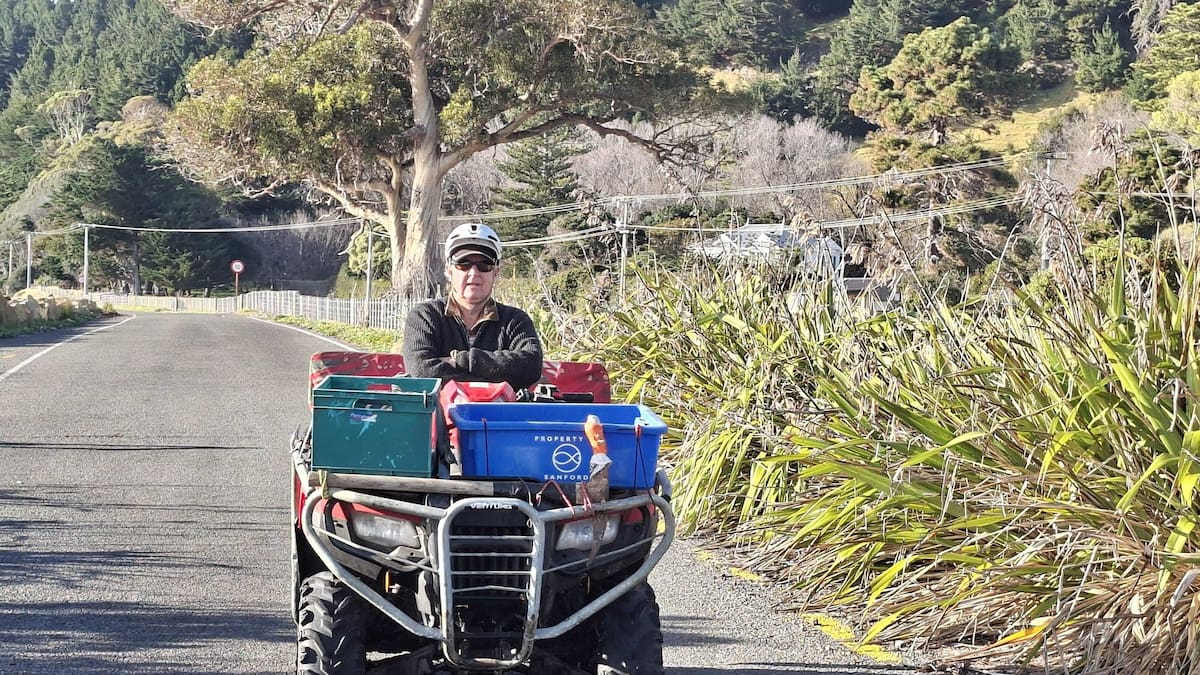
He said since retirement he had been riding to the cape on his quadbike every two or three days during summer.
“Now the council is going to put a gate across a public road and the only ones with regular access will be members of the Clifton Fishing Club, so they can get to their headquarters inside the campground.”
A council spokesperson said a temporary gate would restrict vehicle access “for now”, but pedestrians would still be able to get to the beach at the end of Clifton Rd.
But Taylor says that was no good to him and many more like him.
“I can’t walk that far now.”
Te Awanga resident Brian Taylor says the Hastings District Council’s plan to cut off quad bike access to Cape Kidnappers is not fair on people who can’t walk very far. Photo / Linda Hall
He said people on foot had to get past the rock wall the council put in at the end of Clifton Rd.
“I’m not complaining about the wall, it’s a good thing, but it’s difficult to get around it on a quad bike even at low tide.”
He said if people wanted to travel along the beach rather than the road, the changing tides could either prevent them doing it at the start of the journey, or block their access on the way back.
The changes follow the closure in February of the Clifton Motor Camp’s No 1 campground after an independent geotechnical report had found a high risk of landslides affecting “much, and possibly all of the campground”.
The closure of the 90-year-old camp came just weeks after a tragic landslide at a Mount Maunganui campground.
At the end of May, campers at Clifton Camp No 2 were also evicted because of storm surge risk.
Since the closure, Taylor has been following the boats through the barrier at the campground.
The council says it’s putting up the fence to ensure the site is safe and to prevent vagrancy, vandalism and theft at Campsite No 1, “as happened at Campsite No 2 when it closed”.
But Taylor says there’s nothing there to steal and safety is not the issue.
“We don’t have a barrier to stop us standing in the middle of the road on a foggy night. We know that’s dangerous.
“Riding a quad bike to Cape Kidnappers in good weather conditions is not.”
He said people still knew how to use common sense and that he and many others knew the place like the back of their hands and helped with the health and safety of visitors.
“We encourage people to stay clear of the rocks. When we see hoons speeding along the beach, a simple gesture or pointed reminder is enough to get them to slow down 90% of the time.
“We also help people with sprained ankles or those unable to make it back on their own, back to safety.”
He said it felt as if the region’s councils were slowly locking the public out of beaches and rivers.
A Hastings District Council spokesperson said over the next year, the council would remove buildings, services and other facilities, with work carried out in stages “to minimise disruption, keep people safe and make the best use of available resources”.
The spokesperson said the timing would depend on safety, operational requirements and funding.
It would continue to monitor the site as conditions change.
“These steps will reduce risk while council manages the transition of the reserve’s management to council from the Clifton Reserve Society.
“Taking this staged approach means council can respond to changing site conditions, manage the reserve during the transition, and work with the community to help decide its long-term future.”
Taylor says he has no problem with the council closing the camps.
“But taking beach access away from people who can’t walk far is not on.”
LDR is local body journalism co-funded by RNZ and NZ On Air.