
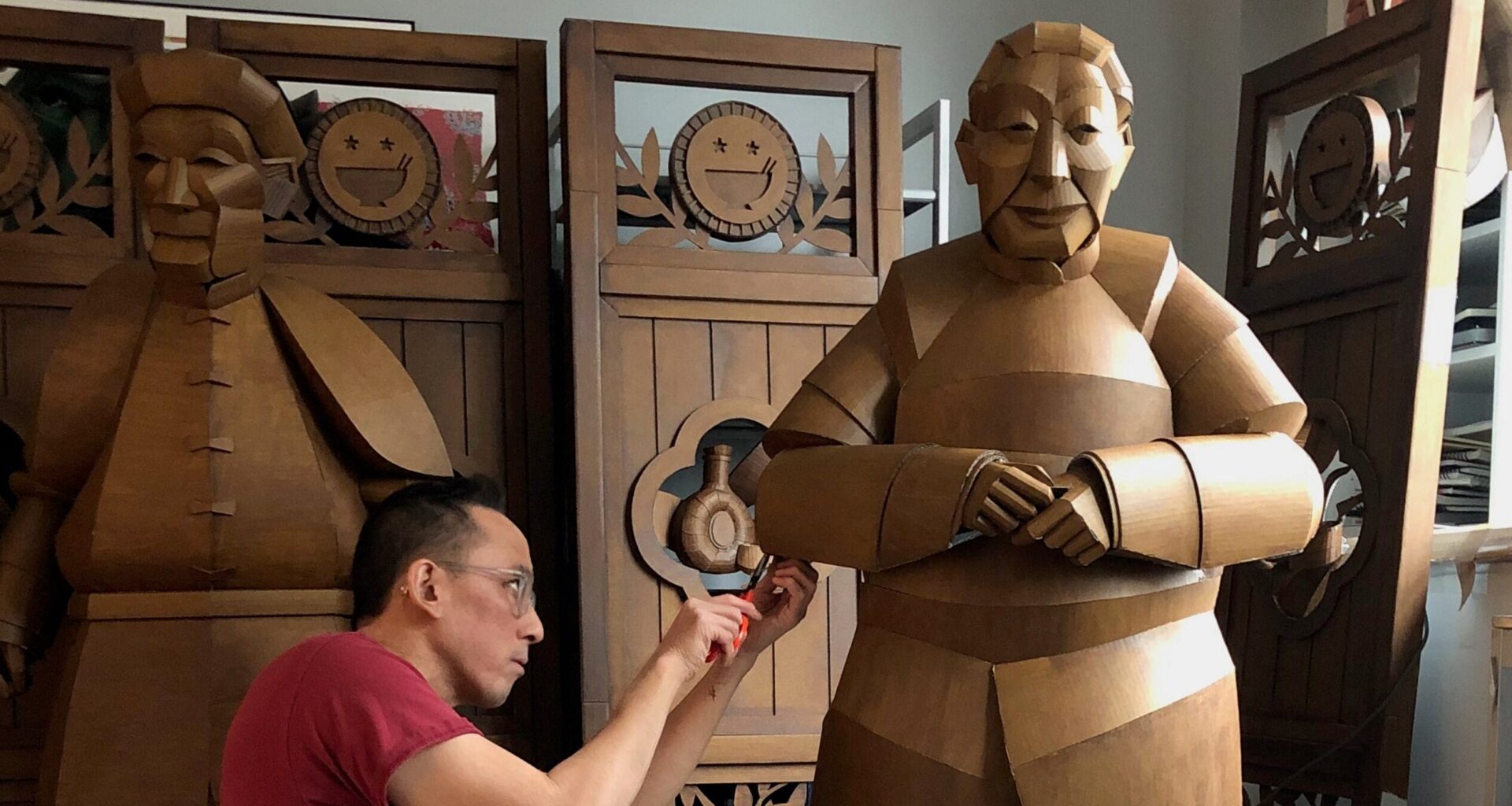
A Wisconsin native sculpture artist uses a medium that you might find in a recycling bin: corrugated cardboard.
Warren King transforms cardboard into life-sized works that explore belonging and reconnect with his family’s Chinese-American heritage. King was born in Madison, raised in Muskego and Brookfield, and currently lives in New York.
He said he aims to change the medium as little as possible.
Understanding Wisconsin, Together.
WPR’s “Wisconsin Today” newsletter keeps you connected to the state you love without feeling overwhelmed. No paywall. No agenda. No corporate filter.
“It has a grain to it,” he told WPR’s “Wisconsin Today.” The corrugations run a certain direction.”
“I have a very limited palette of shapes that I have access to. The planar geometric look of my sculptures comes from the limitations,” he said.
This is a video of an in-progress cardboard sculpture by Warren King titled “The Distance We’ve Travelled.” Video courtesy of Warren King
His work has been shown across the world, including in New York, Italy and Finland. A current display at the Lynden Sculpture Garden in Milwaukee is titled “Warren King: Homecoming.”
He joined “Wisconsin Today” to talk about working with cardboard and the stories behind his sculptures.
This conversation has been edited for brevity and clarity.
Kate Archer Kent: Talk about your process of taking a piece of cardboard and creating a beautiful piece of art.
Warren King: I come from a very techie background. I had many years of engineering and then I was in software for a long time.
Now that I’m doing art, I don’t want any of that in my art. So when I start off a piece it’s really with no technology at all. I don’t even do many sketches.
I look at some photos of people, I look at gestures and faces and expressions, and if something resonates with me, then that’s really how I start.
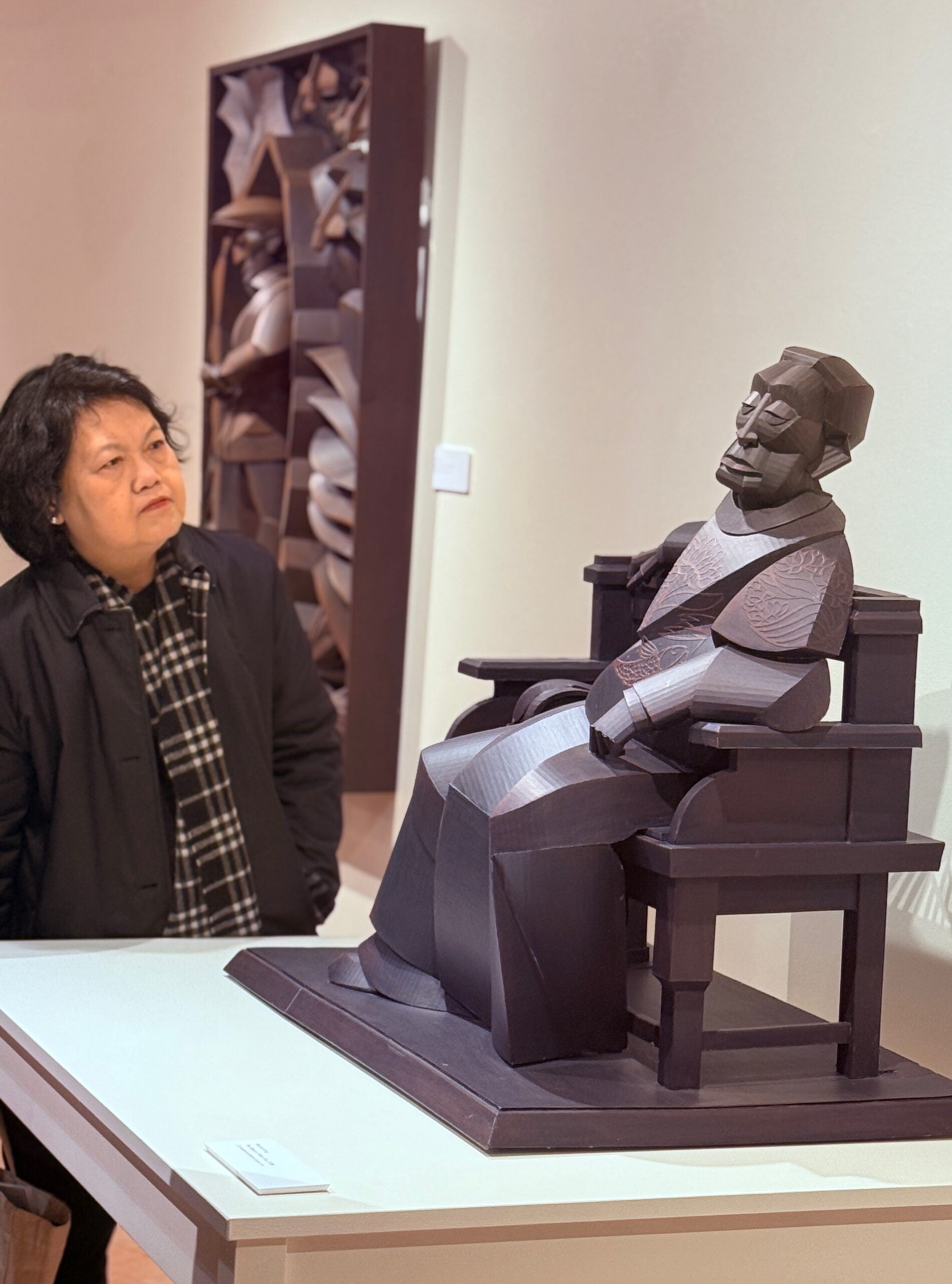 A visitor looks at a cardboard sculpture by Warren King at the James Watrous Gallery in Madison. Photo courtesy of Warren King
KAK: One of the sculptures is of your grandmother. It’s called “The Road Leads Home.” How does this particular sculpture represent her?
WK: That piece is very special to me. It’s one piece in a series of pieces, there’s 10 or 12 pieces in that series, that tell a story about growing up as a Chinese American in the Midwest.
That piece tells a story of my grandmother taking the very first steps to leave China, which eventually led her to Wisconsin. It’s like the beginning of our family’s journey to America.
The story behind it is one of my favorite stories and I didn’t learn about this until I was in my 30s or 40s. It was during the war against the communists, the Chinese Civil War. My grandmother had just been married and in her early 20s. My grandfather was a pilot in the Air Force, and they had a young son. My grandfather was stationed in another city, a few hundred miles away, so my grandmother lived with her mother and her sister. But she decided that she couldn’t take the separation. She had to rejoin my grandfather.
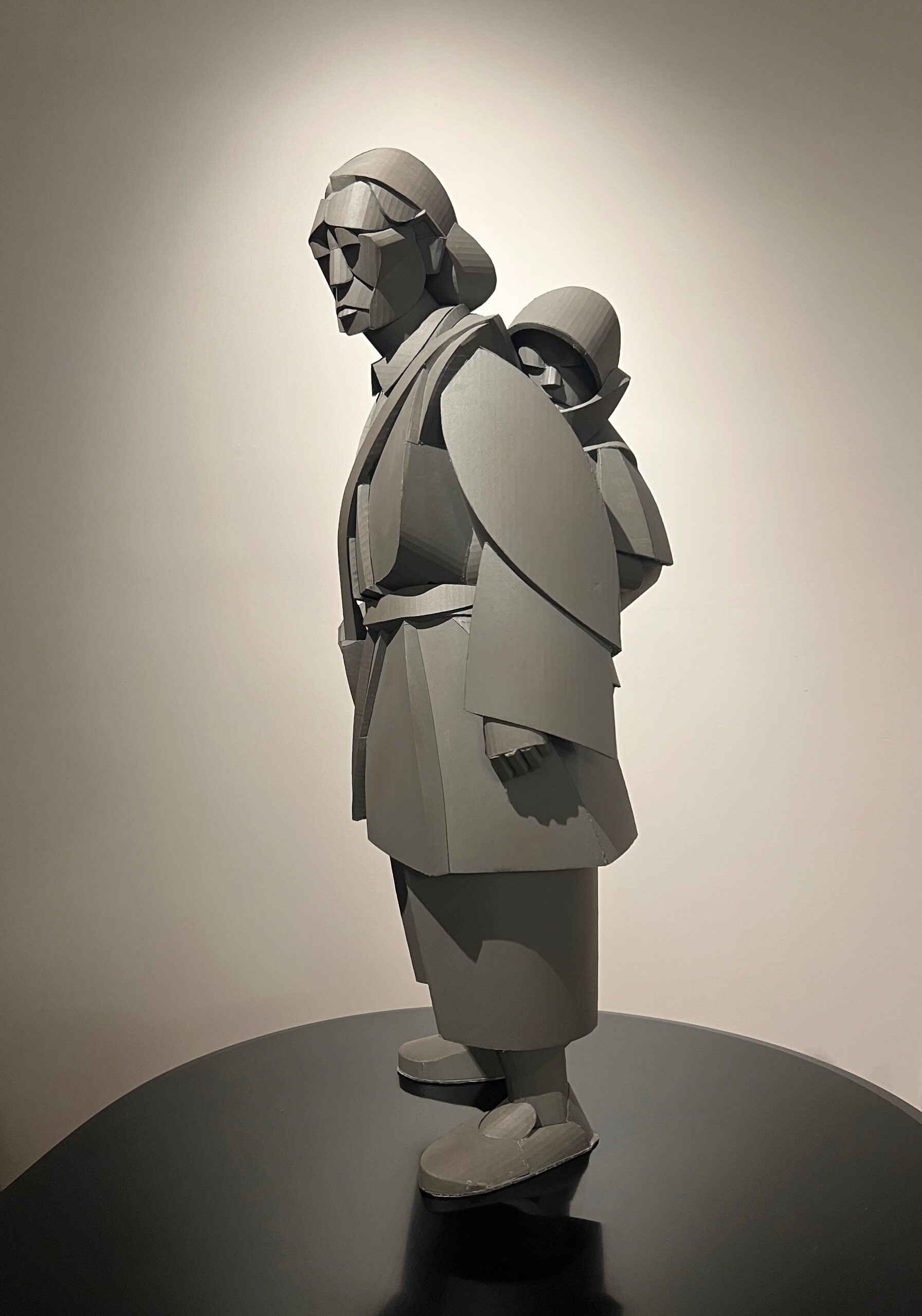 A sculpture by Warren King called “The Road Leads Home.” It is of his grandmother who traveled from China to the Midwest. Photo courtesy of Warren King
She sold all of her belongings, she got some money from her mother and converted those into a few gold coins, which she sewed into the lining of her clothes.
The journey to my grandfather was on foot, across a country that was war-torn and filled with bandits. She strapped her child to her back and basically set off, and that was the last that she ever saw of her mother and her sister. She never went home.
That was the beginning of many years of war that she described as the hardest period of her lifetime. Eventually, she and my grandfather survived the war, they made it to Taiwan. And from there, they came to America.
For me, living in Wisconsin, I see that moment as very pivotal. It’s the moment where my grandmother made a decision that ultimately led to this life that I have here in Wisconsin.
View of Warren King’s cardboard sculptures. Video courtesy of Warren King
KAK: You have said that raising sons and being an artist are intertwined. Can you explain that?
WK: This is an area that I decided to focus on for my next series. For the five or 10 years that I was discovering myself as an artist, it was the period that I was raising my young kids. So to me, art and parenting are so intertwined that they’re really inseparable. Both have been transformational for me.
With my engineering and sciences background, I’ve been programmed to think a certain way: very methodical, very detail-oriented.
But when I was embarking on my artistic journey, I had this idea that artists need to be intuitive, inspired, prolific and improvisational. So I struggled with that a lot. And having kids, I was very inspired by them because from the time that they could hold a glue gun, they were making things on their own. And watching them be completely unencumbered, uninhibited in their creations, it was just so inspiring to me and I emulated myself a lot.