

SASKATOON — Canada may be in a technical recession, but it doesn’t feel like one, says an economist.
“It’s too early yet to say we’re in a recession,” Des Sobool, deputy chief economist with Farm Credit Canada, told delegates attending Seeds Canada’s 2026 annual meeting.
A recession is defined as two consecutive quarters of decline in a country’s gross domestic product.
The Canadian economy shrunk by one per cent in the fourth quarter of 2025 followed by a 0.1 per cent contraction in the first quarter of 2026, so that meets the technical definition.
WHY IT MATTERS: The health of Canada’s economy is important because a lot of agricultural products are sold domestically.
However, Sobool said it is more nuanced than that. Economists also look at other factors, such as how many sectors of the economy experienced a downturn and how the labour force is performing.
If Canada experienced a recession, it certainly was not as pronounced as previous ones.
And it appears to have been short-lived.
FCC’s expectation is that the economy rebounded in the second quarter of 2026, growing by an estimated 2.5 per cent.
Read Also

However, there is no doubt that U.S. tariffs have caused considerable turmoil and volatility that is weighing on the Canadian economy.
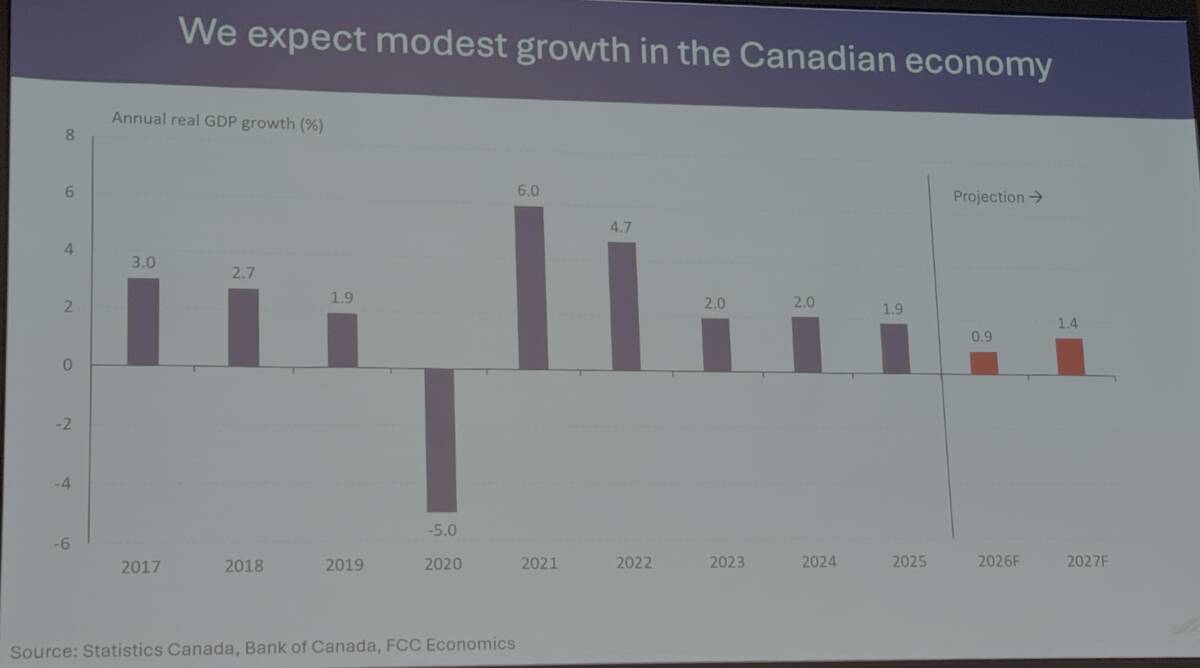
Farm Credit Canada is forecasting that Canada’s economy will grow by 0.9 per cent in 2026 and 1.4 per cent in 2027.
Photo:
Farm Credit Canada
FCC expects Canadian GDP will grow by a paltry 0.9 per cent in 2026, followed by 1.4 per cent in 2027. That would be five years in a row where growth was two per cent or less.
“That is just not sufficient,” said Sobool.
“Our growth should be above two per cent.”
Product inventories increased by 4.3 per cent in the first quarter of 2026, indicating that businesses are either anticipating a surge in future demand or that consumer purchasing has slumped.
Capital spending was down one per cent, which was a huge drain on GDP.
A mere 68 per cent of Canadian businesses polled in the second quarter of 2026 felt optimistic about the next 12 months, compared to 73 per cent before implementation of U.S. President Donald Trump’s reciprocal tariffs.
“When the tariffs hit, business sentiment just tanked,” said Sobool.
Canada’s labour productivity grew at a rate of 0.7 per cent in 2025, which is above the G7 average but well below the U.S. market.
If productivity in Canada’s agriculture and food sector simply returned to historic levels, it would generate $28 billion in labour income, create 240,000 jobs and contribute $71 billion to GDP.
“That’s massive,” said Sobool.
“This is the opportunity.”
Inflation climbed to 3.2 per cent in May. FCC expects the full-year rate to end up at 2.7 per cent.
Energy price increases have yet to flow through the entire supply chain. There is typically a six- to 12-month lag for that to happen, so inflation will likely be pronounced again in 2027.
FCC expects the Bank of Canada’s overnight rate to remain at 2.25 per cent for the remainder of 2026, but it will likely experience two hikes in 2027, climbing to 2.75 per cent by the end of the year.
That is going to drive up both the variable and fixed rate costs of borrowing. The fixed rate hinges on the five-year Government of Canada bond rate.
“Debt is not going to get any cheaper,” said Sobool.
“The bond market is not a fan of tariffs and it’s not a fan of the U.S. debt, which is approaching US$39 trillion.”
The Canadian dollar is expected to continue trading in the US$0.72 to $0.74 range, which benefits exporters but not importers.
Trade uncertainty a certainty
Sobool said Trump’s decision to not extend the Canada-United States-Mexico Agreement (CUSMA) means there will be continued market uncertainty.
The good news is the agreement remains intact for the next 10 years, and 95 per cent of Canada’s agri-food exports are CUSMA compliant, which means they are tariff-free.
That’s a blessing because the U.S. market accounts for 61 per cent of Canada’s agri-food exports.
Despite all the diversification rhetoric, Canadian exporters will have a difficult time extricating themselves from the biggest economy in the world located right next door.
However, he believes there is an opportunity for Canada’s agriculture sector to expand processing and export more value-added products.
FCC recently created an in-house venture capital team that will be deploying $2.5 billion in equity investments over the next five years to help foster innovation in Canada’s agri-food sector.
Some of that money may flow to firms in other countries with the caveat that the technology they are developing will make its way back to Canada.
Sobool said the U.S. invests $23 in agriculture technology for every $1 spent in Canada.