
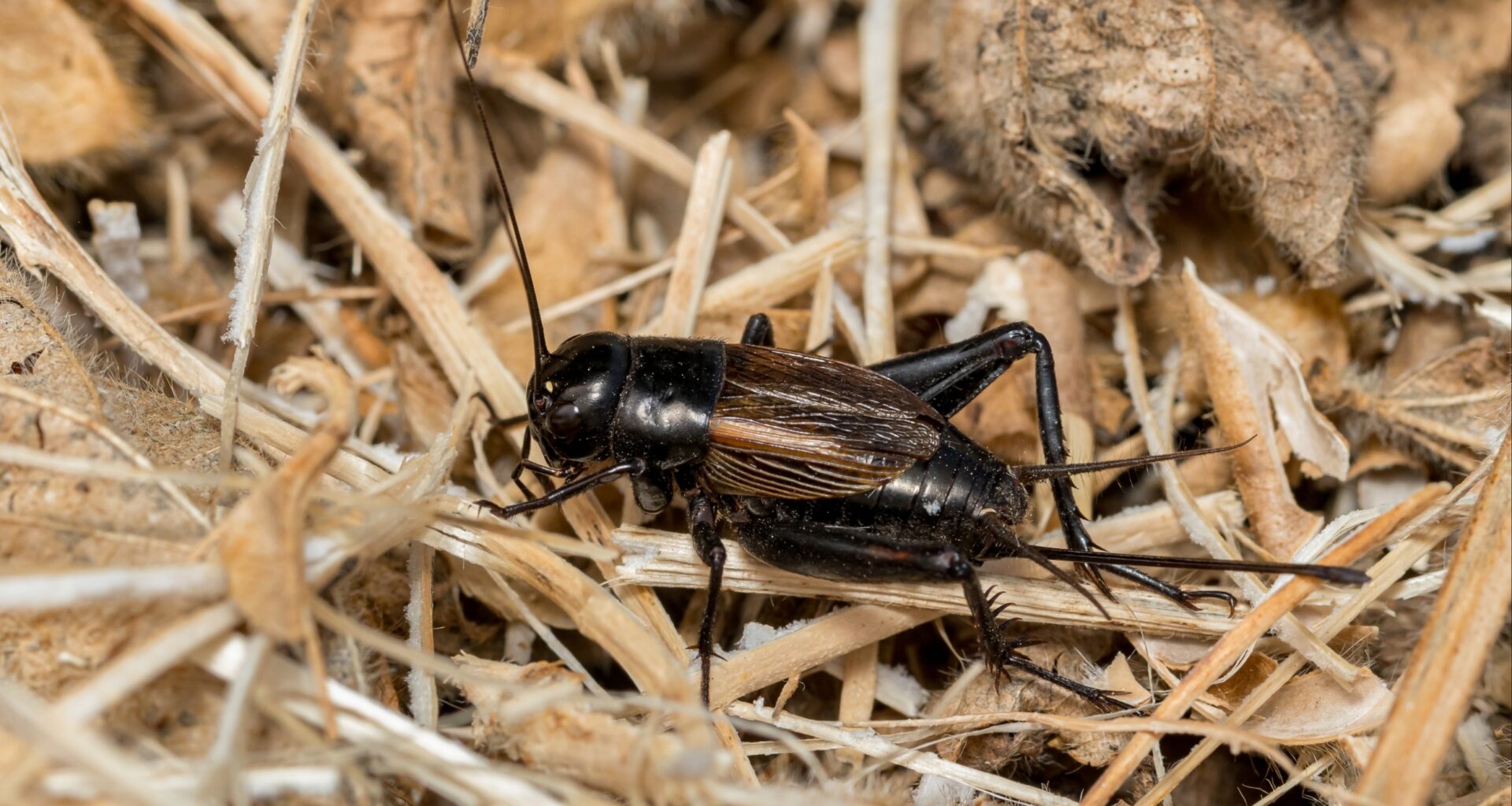
Hawaiian field crickets faced an impossible choice: keep singing to attract mates and risk being killed by a parasitic fly, or fall silent and somehow find another way to reproduce.
Evolution found an answer. Over just a few decades, silent males spread rapidly across the islands after losing their courtship song through several different wing mutations.

Now, a new study reveals another advantage that helped make that transformation possible.
Silent males reach adulthood about a week earlier than their singing rivals, giving them extra time to find mates despite losing the very song that once attracted females.
When singing turns deadly
Male crickets sing by scraping one wing against the other, and across most of the world that rasp is how females locate them in the dark. On the Hawaiian Islands, the same cricket song carries a lethal cost.
A parasitic fly hunts by ear, tracking the chirp to its source and dropping its newly hatched larvae onto the male. The young burrow inside and consume him over the following days.
That pressure rewrote the crickets fast. The silent males, known as the flatwing form, first appeared on Kauai in 2003.
Making themselves invisible
Researchers found that more than 90 percent of the island’s males had lost the ability to sing within about 20 generations, as one early study documented.
A flatwing male is invisible to the fly but silent to the very females he needs to reach.
Jae Walker, a PhD student at the University of St Andrews in the UK who led the new work on these field crickets (Teleogryllus oceanicus), sums up the escape simply.
“It’s like these crickets have the acoustic equivalent of invisibility powers!” said Walker.
Silence has since spread from Kauai to crickets on the other southeastern Hawaiian Islands.
A faster path to adulthood
Losing the song looked like a major disadvantage, and for years the obvious question was how silent males managed to breed at all.
Walker’s team found part of the answer in the crickets’ timing rather than their wings.
The researchers reared the insects and tracked their growth. They found that ordinary singing males took roughly a week longer to reach adulthood than silent males and longer than females of either type.
Finishing sooner buys a longer stretch of adult life. Those extra nights give a silent male more chances to reach a female by walking toward other males still singing or waiting nearby.
The head start appears to offset some of what he loses by going quiet.
Walker treats it as a tradeoff. “They aren’t able to attract female mates with their song, but they develop faster so have more time to seek out female mates using other methods,” he said.
The genetics behind silence
Researchers have not yet determined why the two types grow at different speeds.
Using microscopy and sequencing the genes active in developing wing tissue, the team identified a master gene called doublesex as a likely player. The gene helps direct how male and female bodies are built.
An earlier study had already linked the flatwing trait to a stretch of the genome containing that same gene. That much was known.
The new work suggests doublesex operates inside a wider web of genes that lay down the veins of the wing and that small tweaks to that web can each produce a silent male.
Silence evolves again and again
Flatwing is no longer the only way these crickets have fallen quiet. Walker’s team has been cataloging several separate silent forms, each produced by its own mutation and each disabling the male’s call in a different way.
One, called curlywing, curls the edges of the wings upward. Another, named smallwing, shrinks the wings to about half their usual size.
The newest form, called defiled, damages the very vein a male would rub to make sound. Different genetic starting points keep arriving at the same outcome.
That pattern echoes an earlier paper showing the flatwing form itself arose more than once on separate islands through distinct mutations that silenced the wing in similar ways.
Total silence is not the only escape, either. Some Hawaiian males crickets have taken up a quieter purring song that the fly largely overlooks while females can still hear it.
“This parallel evolution toward silenced song reveals similar but independent solutions to the same problem, leading us to ask how this variety of changes occurred,” said Walker. Each newly found form widens that question.
Nature changing before our eyes
What the crickets show now, and did not before, is that the retreat into silence carries a hidden gain. Silent males do not simply outlast the fly at the price of their love life.
They also grow up faster, which recovers some of the reproductive ground that falling quiet takes away.
The larger prize is the chance to watch adaptation unfold on a human timescale. Usually that is impossible.
Most evolutionary change is reconstructed from fossils or old DNA. Here, scientists watched a signal collapse and begin rebuilding itself in barely two decades, with the genes and wing structures still visible mid-change.
Each new silent form raises the same question for Walker’s team.
“This variety of song-loss morphs is found across the Hawaiian archipelago, making us wonder about the upper limit on how many independent solutions there can be to the evolutionary ‘problem’ of the flies,” said Walker.
The research was presented at the Society for Experimental Biology Annual Conference.
—–
Like what you read? Subscribe to our newsletter for engaging articles, exclusive content, and the latest updates.
Check us out on EarthSnap, a free app brought to you by Eric Ralls and Earth.com.
—–