
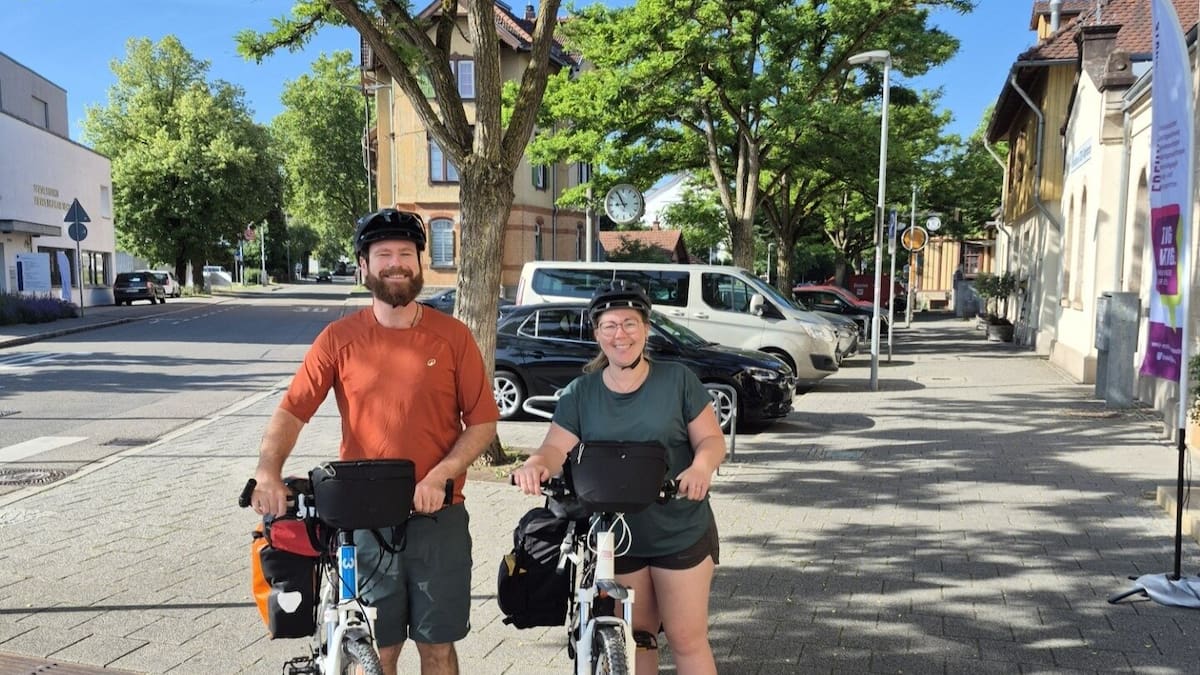
Wentsch and Armstrong will meet scientists, conservationists and local communities.
The pair are documenting the journey for a YouTube documentary exploring how the river is being restored and what lessons can be applied in New Zealand.
A view of the Danube along the nearly 3000km route the pair are cycling.
For Wentsch, the journey began with a childhood dream.
She grew up near Stuttgart in Germany and always wanted to cycle the Danube after riding part of it as a child.
“We were already returning to Europe, so we thought, why not cycle the whole river and combine it with what we’re passionate about, which is conservation.”
Armstrong admitted he agreed before realising what he was signing up for.
“Anna said, ‘I want to cycle the whole Danube,’ and I said, ‘Yep, let’s do it.’ Then I realised it was a 10-week ride.”
As they planned the expedition, they discovered the river was lined with restoration projects that offered valuable lessons for New Zealand.
“In Europe they’ve already commercialised much of their natural environment, and now they’re spending huge amounts trying to restore it.
“We still have the chance to protect what we have before we lose it,” Armstrong said.
Now a month into the journey, they stopped in Neuburg, Germany, to meet experts restoring sections of the Danube River altered in the 1960s.
Armstrong said hydroelectric dams built for shipping blocked fish migration, disconnected floodplains and disrupted groundwater, forcing decades of expensive restoration work.
“If those environmental considerations had been built in from the start, a lot of that work might not have been needed.”
The trip highlighted the different perspectives they each bring to their conservation efforts.
Wentsch, who has worked with kororā and shorebirds in the Bay of Plenty, said she instinctively looked at every landscape through the eyes of nature.
“I’m always looking for the wildlife that should be there, or isn’t there, and asking why.”
Armstrong said he focused on the people.
“In the Bay of Plenty, we’ve got incredible volunteers and community groups doing amazing conservation work.
“I’m interested in how people connect with nature and what motivates them to protect it.”
Local wildlife spotted during the conservationists’ journey.
The pair said the journey had not been without its challenges, especially in the middle of a heatwave.
They’ve had to abandon normal routines, starting each day between 5am and 6am to avoid cycling in extreme temperatures.
“Instead of fighting the heat, we’ve had to adapt,” Wentsch said.
When they return to the Bay of Plenty, the pair plan to use the expedition to launch community campaigns that connect more people with local conservation projects.
Wentsch wants New Zealanders to think about nature before development decisions are made.
“It’s much easier to protect ecosystems than restore them.”
She also hopes freshwater receives greater attention.
“Our rivers are more than blue lines on a map. They’re living ecosystems.”
Armstrong hopes to encourage New Zealanders to match the country’s clean, green reputation with action.
“We’re proud of our natural environment, but many people don’t realise the pressure it’s under.
“If nature is one of our greatest strengths, we need to protect it with action, not just words.”
Zoe Blake is a multimedia journalist at the Bay of Plenty Times and Rotorua Daily Post.