
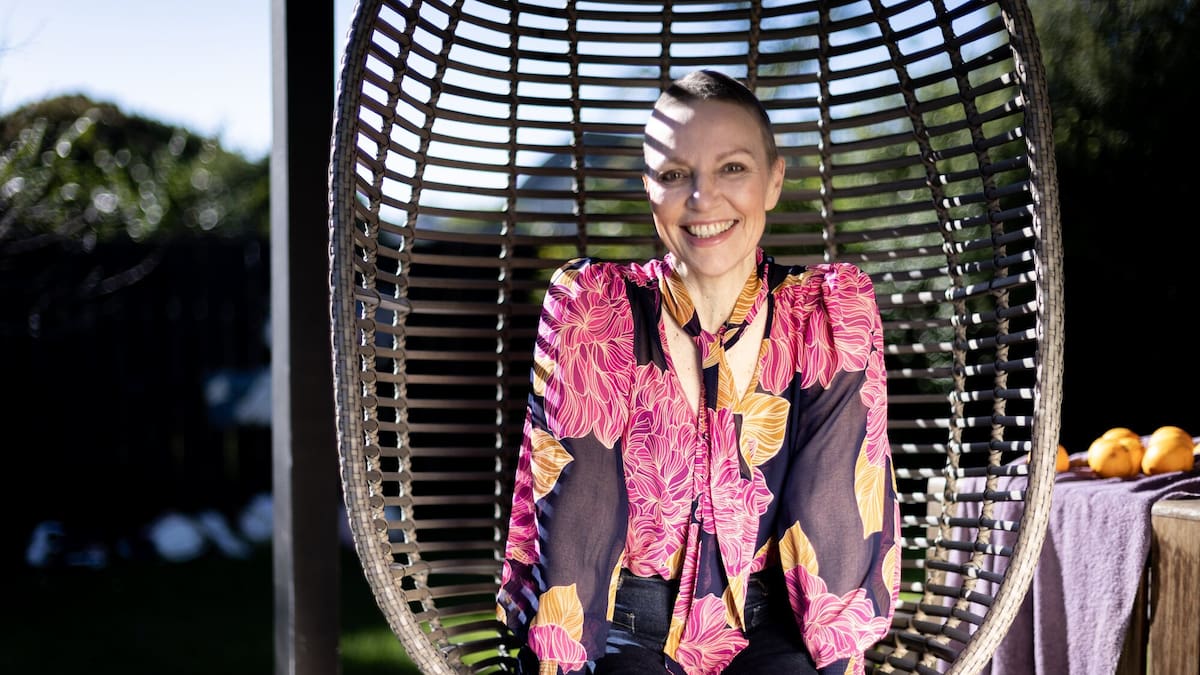
“She saved me. My outcome was not good without a donor,” Homer says.
And she might honestly be putting that lightly, because while the stem cell transplant saved her, the past 12 months did everything they possibly could to kill her.
‘I think you’ll find this is somebody else’s test’
A little over a year ago, on July 1, Homer was sitting in a routine meeting at The Breeze, where she worked as a radio host. It was an ordinary day. Until the phone rang.
Homer usually ignores calls from unknown numbers, but this time, she answered.
On the other end was Auckland Hospital, asking her to come in to discuss the results of routine blood tests ordered by her doctor.
Homer felt perfectly fine and assumed there had been a mistake. But when she arrived, and a doctor began explaining those results, it became clear something was very wrong.
“He said, ‘We think you’ve got acute myeloid leukemia’. I was like, ‘I think you’re wrong. I think you’ll find this is somebody else’s test’.
“He said, ‘No, we’re pretty sure this is what it is. And we need to admit you right now’.”
That’s when panic began to set in. Homer rang her husband Andy Pilcher, and when he arrived, she broke down, crying in his arms as worst-case scenarios went through her head.
The next day, she had a bone marrow biopsy, which confirmed what they already knew: Homer was about to go to war against aggressive blood and bone marrow cancer.
She started the first of four rounds of chemotherapy four days later. She turned 56 in the middle of it.
“I’m hoping to have a better birthday this year,“ Homer says.
She wouldn’t leave hospital for another five weeks, and in the past year, she spent a total of 17 weeks in hospital as her cancer journey took unexpected twists and turns.
Radio and TV personality Mel Homer at her home in Auckland. Photo / Dean Purcell
The hardest parts
Every year between 120-150 New Zealanders are diagnosed with Acute Myeloid Leukaemia (AML), although it is most common in people over 65. AML occurs when certain genes or chromosomes mutate in the blood and white blood cells multiply uncontrollably, crowding out healthy red blood cells. It can be fatal if not treated quickly by intensive chemotherapy and stem cell transplants.
Homer’s body, she says, reacted against almost everything doctors used to treat the disease.
She developed mouth ulcers, which left her unable to speak, eat or swallow as a side effect of the chemo and medications.
She was given a feeding tube, but she vomited it up, which led to its own complications.
She experienced bleeds behind the eyes, concerns of potentially losing her sight, countless infections, allergic reactions, extreme fevers and shakes, fainting and endless nausea and vomiting.
There were also fears she might have a brain tumour, after she developed extreme pain in her head – scans quickly ruled that out.
Homer gets emotional thinking about how her children saw it all. Watching them see her sick was one of the hardest parts.
“They’re 19, 22 and 25 now and they were just amazing. They were just so supportive. I was worried about how they were coping because it was not pretty and I was so sick. I couldn’t talk a lot of the time.
“But I didn’t die and I never s*** the bed,” Homer says with a laugh, though she admits the second part was a close call that helped her come to understand the “in sickness and in health” part of marriage.
“We’ve been married for 26 years. [Andy] didn’t even miss a beat, being quietly supportive all the time. But it must have been so difficult for him watching me go through some of the things.”
At one stage, she was unable to even drink water because of the pain in her mouth and throat.
“He said watching my face and the realisation of what was going on was really difficult for him. But he never was dramatic about things. He just quietly helped.”
‘I thought we were carrying you out of here in a coffin’
While Homer can’t remember the exact moment that she thought she wasn’t going to survive, she says the people around her have stories they’ve begun to share with her.
During one blood transfusion, she needed a lot of platelets (tiny cells that help blood clot) and only two people in New Zealand were a match to donate to her.
“They [used] special platelets. But there was something in the mix of the bag of platelets. We don’t know what it was, something rogue. It could have been anything, and my body reacted to it.
“I went into full anaphylactic shock almost instantly; my lips and my eyes and my face started swelling. I got the full body rash. I couldn’t breathe, my throat started closing up.My mum was with me when it was happening, watching me.”
Hospital staff quickly realised what was happening and acted fast to save her.
“Mum said to me later, ‘I thought we were carrying you out of here in a coffin’. She thought I was going to die.”
Despite being considered a high-risk cancer patient because of a series of rare mutations, Homer tried to stay positive and not think about the “what ifs”.
“You do go down those little rabbit holes now and again like, ‘Who’s going to be at my funeral? What songs am I going to play?’ But I tried not to think too far about what could go wrong.”
While she was told her cancer was likely curable, that cure wouldn’t come from chemo alone. Homer needed a stem cell transplant, a treatment with a long waitlist, no clear finish line and no obvious matches.
“With the stem cell transplant, a donor’s cells get put into my blood, and they go into my bone marrow, and take over my immune system and create a new one. You get a new blood type – your donor’s blood type – and hopefully it kills all the cancer,” Homer explains.
While matches are usually found in the wider family, none of hers were a full match – and her mutations meant she needed a very specific match. So, doctors turned to a global donor register of more than a million people. Two people in America were a match but couldn’t be tracked down. Homer had to wait and hope for more than seven months.
While she was waiting, her cancer markers moved back to positive, indicating the disease was returning.
Finally, a match was found: a young woman in France who was able, and willing, to help.
Once that donor’s stem cells arrived in New Zealand, via a medical chaperone, the transplant was quick, only taking 30 minutes through an IV line. It was harder on her body than Homer expected, but doctors reassured her recovery from a stem cell transplant was gradual and tenuous and could take up to a year.
“[That woman] has donated something that saved my life. She’s just a random woman who at some stage said she’d be on the register, and that saved me,” Homer says.
“But I also need to thank all of the people that donate blood. I had so many transfusions, and I just appreciate people who donate just because they can. Because it kept me alive and kept me going when things got really bad during treatment.”
A new normal
Homer has spent much of her career in front of the camera. She admits, before getting cancer, she cared deeply about her looks and ageing. But she’s come to learn that none of that really matters.
“No one cares. No one’s looking and going, ‘Oh my God, more wrinkles’. No one cares except us, and it holds us back from really enjoying things. But now, I look back on photos now, and I go, ‘Wow, I’m awesome’.”
Homer says her trademark locks formed part of her identity. Photo / Facebook
She lost her hair during her treatment. She came to terms with it quickly, cutting off her trademark long locks herself, wanting to get ahead of the disease for once.
“It does seem really shallow, but hair is also your identity. And I had long hair so I could hide behind it and play with it. So I do miss it.”
It’s starting to grow back now and she proudly displays her fresh tufts on what she was thrilled to find out “wasn’t a misshapen head” under all that hair.
It’s a bookmark to the end of her active cancer treatment, and she’s desperate to get back to some sort of normality. She’s slowly figuring out what returning to “the real world” looks like.
Part of that comes at a financial cost. One of the drugs she may need for ongoing treatment is unfunded in New Zealand, and could cost her up to $100,000 over the next few years.
“I’ve got more of a chance of getting a second cancer or this one coming back. So we need to monitor that, as I try to start my life.”
But today, there is no sign of cancer in her body and Homer is embracing that as best she can, determined to move forward.
She says being on “the other side” of cancer has felt isolating at times, and she still struggles to wrap her head around what she has been through over the past 12 months.
“I’m seeing the psychologist at the Cancer Society. They offer cancer patients free psychology sessions, which is good to help me figure out how to deal in this sort of in-between stage.”
She’s gradually regaining physical strength too, though progress has been slow, even 1kg dumbbells exhaust her. And she is preparing to begin what she describes as her “baby vaccines”, after her immune system was reset to zero during the stem cell transplant.
It means she still has to wear a mask in public places because she has no immunity and the smallest thing could make her very sick. The fear surrounding that is real – she doesn’t want to do this again.
“I have that anxiety around crowds. It’s like a real PTSD, because if I get a cold, it could be really serious. Which is why you’ve just got to be balanced in trying to live a life again and not just sitting at home on your own and also being cautious.”
Mel Hoomer has been battling acute myeloid leukemia. Photo / Dean Purcell
She also wants to return to broadcasting – her old role is gone after she was medically terminated from MediaWorks, but she says when she’s ready, there will be a role waiting for her. She is grateful for that.
“And I really want to do a cancer podcast – but a fun one that’s talking to interesting people,” she says.
While Homer stops shy of being grateful for the lessons cancer has taught her, she admits she has learned a lot about herself and who is really in her corner.
“I’ve learned you’re stronger than you think you are. And you’re probably more loved than you think you are. Finding this level of love for me has been really overwhelming. I’m so appreciative of everyone. It’s meant the world to me.”
Just don’t call her brave.
“I don’t feel brave,” she says.
“I feel like I was on a road and there was a fork in the road and one side said ‘This way to a long and painful process with an uncertain outcome and lots of grief and heartache’.
“And the other sign said ‘Certain death’. There was no choice. You’ve got to go the one way.”
Jenni Mortimer is the New Zealand Herald’s chief lifestyle and entertainment reporter. Jenni started at the Herald in 2017 and has previously worked as lifestyle, entertainment and travel editor.