
Your support helps us to tell the story
From reproductive rights to climate change to Big Tech, The Independent is on the ground when the story is developing. Whether it’s investigating the financials of Elon Musk’s pro-Trump PAC or producing our latest documentary, ‘The A Word’, which shines a light on the American women fighting for reproductive rights, we know how important it is to parse out the facts from the messaging.
At such a critical moment in US history, we need reporters on the ground. Your donation allows us to keep sending journalists to speak to both sides of the story.
The Independent is trusted by Americans across the entire political spectrum. And unlike many other quality news outlets, we choose not to lock Americans out of our reporting and analysis with paywalls. We believe quality journalism should be available to everyone, paid for by those who can afford it.
Your support makes all the difference.Read more
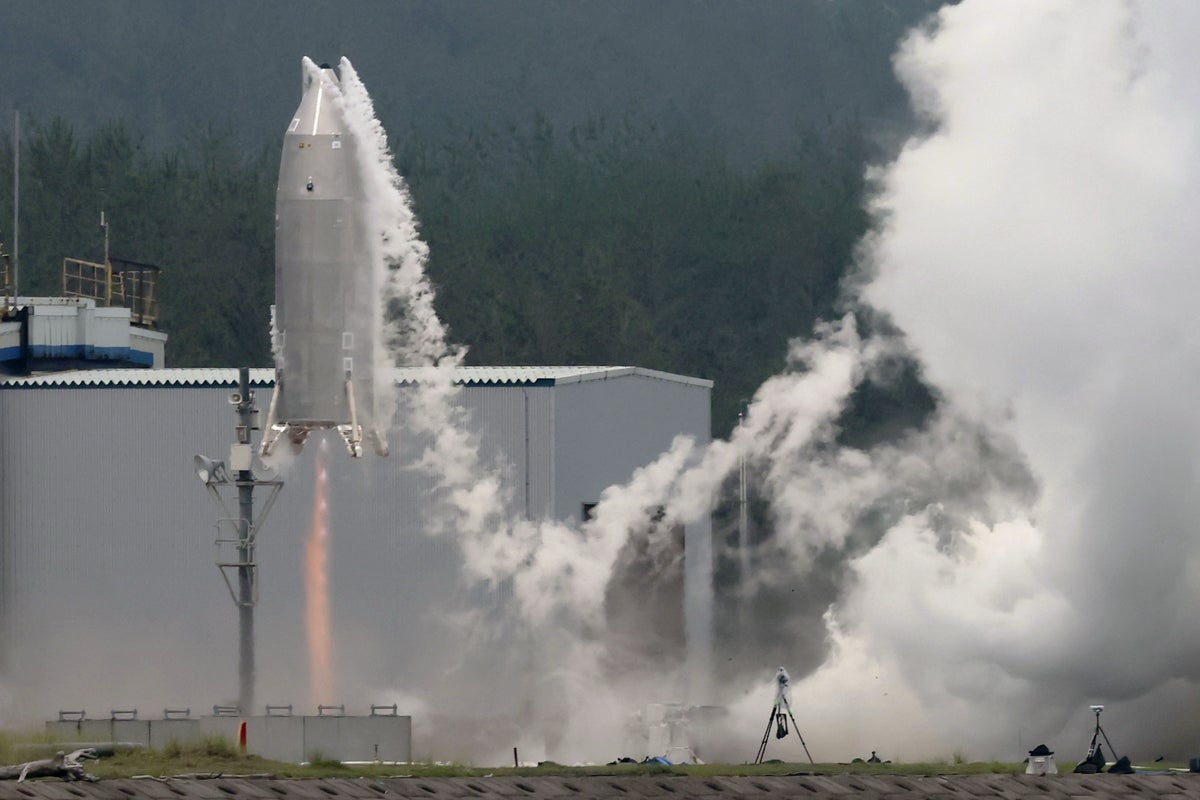
Japan‘s experimental reusable rocket took off and safely landed in a first test flight Saturday as the country seeks to achieve the technology key to cut launch costs and compete in the global space market dominated by SpaceX.
The RV-X rocket lifted off, hovered and moved horizontally before landing during its less than one-minute flight at the Japan Aerospace Exploration Agency’s Noshiro Testing Center in northeastern Japan, which was livestreamed by the NVS, a group of space fans.
JAXA is expected to explain the results in an online briefing later Saturday.
Japan seeks to catch up with the technology Elon Musk’s SpaceX has been using for several years to cut launch costs of delivering payloads into space.
Saturday’s flight is a step forward for Japan in achieving the technology needed to develop a lower cost successor to the country’s current mainstay, single-use H3 series.
The flight comes one day after state media in China reported the country achieved its first successful recovery of the first stage of a rocket after a liftoff.
Japan’s H3 rocket is designed to be more cost effective than its predecessor H-2A series, which had a near-perfect success record, but still needs further cost cuts to compete in the global space market.
The Japanese government says a stable, commercially competitive transport capability is key to the country’s space program and national security.
JAXA and Mitsubishi Heavy Industries have been co-developing the RV-X, which is 1.8 meters (5.9 feet) in diameter and 7.3 meters (23.9 feet) long and equipped with engines with enhanced durability and four shock-absorption landing gear.
JAXA, which is jointly developing reusable rockets with France and Germany, plans to send the RV-X rocket to a higher altitude of about 100 meters (218 feet) in future test flights.