
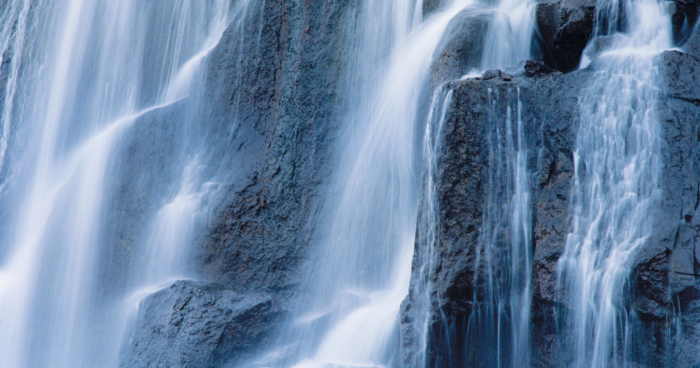
The largest waterfall on Earth has no viewing platform, no mist rising into sunlight, and no tourist boats waiting below it. It cannot be seen from the coast. It cannot be photographed in the ordinary sense. It is a movement of cold water through deep ocean darkness.
The place is the Denmark Strait, the stretch of ocean between Greenland and Iceland. There, cold, dense water from the Nordic Seas flows southward and meets warmer, lighter water from the Irminger Sea. The dense water sinks beneath it, spills over a major drop in the seafloor, and descends toward the deep North Atlantic.
NOAA’s National Ocean Service describes this as the world’s largest waterfall. Its infographic puts the height of the Denmark Strait cataract at about 11,500 feet, or 3.51 kilometers. By NOAA’s comparison, the largest waterfall on land is 3,212 feet, or about 0.98 kilometers. In other words, the undersea drop is more than three times the height of Angel Falls.
What it means for water to fall underwater
The first question is obvious: how can there be a waterfall in the ocean, where everything is already water?
The answer is density. Seawater is not all the same. It changes with temperature and salinity. Cold water is denser than warm water. Saltier water is denser than fresher water. When two water masses meet, the denser one can slide beneath the lighter one, much as cold air can drain downhill through a valley.
In the Denmark Strait, that density contrast is paired with topography. The seafloor is not flat. It has ridges, basins, sills and slopes. Dense water that has built up north of the Greenland-Iceland ridge crosses the sill and then descends along the ocean floor. The process is not a clean sheet of water falling through empty space, but a deep current spilling downhill under the sea.
Oceanographers usually call this kind of motion an overflow, not a scenic waterfall. The popular word “waterfall” works because the water is moving over a drop. The technical word matters because the physics is different from Niagara or Victoria Falls. There is no air-water boundary, no visible plunge pool, and no vertical wall that a person could stand beside and watch.
The numbers are hard to picture
NOAA estimates the downward flow at well over 123 million cubic feet per second, roughly 3.5 million cubic meters per second. Oceanographers often use the unit sverdrup for large ocean flows; one sverdrup equals one million cubic meters per second.
A 2012 paper in the Journal of Geophysical Research: Oceans by Kerstin Jochumsen and colleagues analyzed moored instrument records from 1996 to 2011 and reported a mean Denmark Strait overflow transport of 3.4 sverdrups. That is broadly consistent with NOAA’s public explanation and gives a useful sense of scale: the “waterfall” is not a trickle on a hidden ledge. It is one of the main routes by which dense northern water enters the deep Atlantic.
But the number also needs care. It is not a fixed flow like water from a tap. The 2012 paper described variability on timescales from days to years, with mesoscale eddies accounting for much of the short-term change. In the real ocean, even a giant current is not a single smooth stream.
Why the Denmark Strait matters
The Denmark Strait cataract is often presented as a piece of trivia, but it belongs to a much larger ocean circulation system.
Dense water leaving the Nordic Seas helps form North Atlantic Deep Water, part of the deep limb of the Atlantic overturning circulation. That circulation moves heat, salt, carbon and nutrients through the ocean. It is one reason the Denmark Strait is scientifically interesting even if no one can stand in front of its “falls.”
A 2020 paper in the Journal of Physical Oceanography by Atousa Saberi and colleagues described Denmark Strait Overflow as an important contributor to the lower limb of the Atlantic meridional overturning circulation. The study also stressed that the sources and pathways feeding the overflow are complex, with several branches contributing from the north and additional pathways from south of Iceland in the model they analyzed.
That complexity is part of why the “world’s largest waterfall” label is both useful and limited. It gives a reader a handle on the scale. It does not capture the full system of currents, mixing, eddies, density layers and seafloor shape that make the flow work.
Invisible, but measured
No one sees the Denmark Strait cataract the way visitors see a waterfall on land. Its motion is inferred and measured with oceanographic tools: moorings, current meters, temperature and salinity sensors, ship surveys, floats, and numerical models.
The invisibility is not a small detail. Many of the ocean’s largest motions are hidden from ordinary human perception. Surface waves give the impression that the ocean’s action is mostly at the top, but much of the planet’s water is moving slowly and heavily at depth. The Denmark Strait overflow is one of those deep motions made legible by instruments.
It also changes how “largest” should be understood. Niagara Falls is large because of its visible width, force and flow. Victoria Falls is large because of its immense curtain of falling water. Angel Falls is famous for height. The Denmark Strait cataract belongs to another category: an undersea overflow whose scale is measured in kilometers of descent and millions of cubic meters per second.
A waterfall without spectacle
The simplest version of the fact is still true. Earth’s largest waterfall is not on land. It sits beneath the Denmark Strait, where dense water spills down a seafloor drop far taller than any known waterfall in open air.
What makes the fact worth keeping is not just the ranking. It is the shift in perspective. The ocean floor has terrain. Water has layers. Gravity still acts on dense fluid even when that fluid is surrounded by other fluid. A waterfall does not always have to roar in sunlight to be real.
The Denmark Strait cataract is not a hidden Niagara. It is stranger than that: a vast, cold overflow that helps connect the Nordic Seas to the deep Atlantic, falling out of sight while the surface above it looks like ordinary ocean.
Produced with AI assistance. Reviewed by the ScienceBlog.com editorial team before publication.