
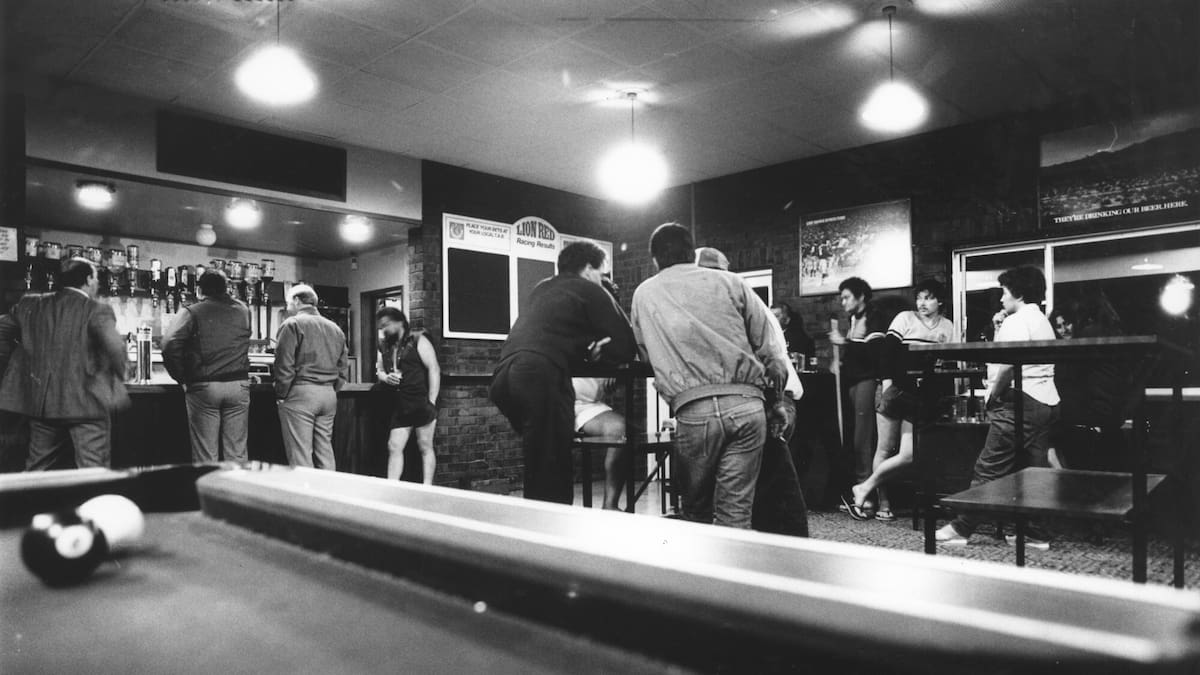
A Supreme Court ruling this week meant James Henry Wilson could finally be unmasked as one of the accused men – ultimately acquitted – in one of New Zealand’s most infamous murders that remains a mystery. Two masked men entered the Red Fox Tavern on Labour Weekend in 1987, one
of them shooting and killing Chris Bush, triggering one of the longest and most complex police investigations in New Zealand history. Jared Savage and Derek Cheng piece together this special report from Herald archives, evidence gathered in the police investigation, as well as interviews with key detectives who worked on the cold case over four decades.
Detective Gary Lendrum arrived at the Red Fox Tavern in the quiet farming settlement of Maramarua just a few hours after bar owner Chris Bush was shot dead. The young detective from Papakura had joined the CIB three years earlier and was the officer second-in-charge of the scene. His first task was to search the crime scene.
Bush was killed while having a few drinks with his staff after they closed the bar on the Saturday night of Labour Weekend, October 24, 1987. Lendrum started taking notes at about 3.45am. It wasn’t his first time at the Red Fox; he’d had a few drinks at the pub after rugby trips. Lendrum played for the senior Papakura club and turned out several times against the Maramarua team at their home ground, just a stone’s throw across State Highway 2 from the Red Fox.
Oddly, if the shooting had occurred on the other side of the road, Lendrum wouldn’t have been called out to investigate. SH2, the main route between Auckland and the Coromandel or Tauranga, was the boundary line between the South Auckland and Waikato police districts. Really, the exact geographical location of the Red Fox Tavern is in the middle of nowhere. It was about to become home to a bunch of gritty South Auckland cops used to a weekly diet of burglaries and bashings, rapes and robberies.
Lendrum jotted down every detail he could see. Afterwards, he typed up his notes into a 23-page statement, complete with sketched diagrams of the tavern’s layout, and handed it to his supervisor.
Incredibly, this was only the beginning of an investigation that was to continue for nearly 30 years. Lendrum refused to give up hope, eventually seeing the arrest of two men for the murder of Chris Bush. He did not live to see the start of their trial, but his parting advice to his colleagues seems apt in light of the Supreme Court tossing out the pair’s convictions: you can only play the cards you’ve been dealt.
The detective started outside at the back of the Red Fox. Shining his torch on the grass, Lendrum noted heavy dew. There wasn’t enough moisture to leave footprints, although he also noticed clippings from the grass being mowed recently.
A camera crew from Television New Zealand turned up. Bad news travels fast. Lendrum enlisted the crew in his investigation: he borrowed their lighting equipment to illuminate the driveway and Red Fox carpark, as well as grass verges along SH2.
When he finished looking, he went inside to the lounge bar. The body of Chris Bush was face down on the floor near the middle of the room. His face was turned to the right, and his arms hung down by his side. Blood had seeped into the carpet near his torso.
The Red Fox Tavern near Maramarua where publican Chris Bush was murdered in 1987. 1 Photo / Jason Oxenham
To the right of his body was a length of yellow cord; it looked like one strand of what should have been two or three strands woven together into a single rope.
In front of the bar counter was a “leaner” rail where patrons queued for service. Two more strands of the same yellow rope were tied to the rail. On the floor was a single $1 note and a lead shot pellet, 4-gauge size.
There were four drinks on top of the bar: two Brown Cows (Kahlua and cream), a half-pint of beer and a glass of gin. There was also an ashtray with six cigarette butts and a copy of the Best Bets horse racing mag.
Lendrum’s gaze was drawn to shards of glass scattered on the carpet by a door at the other end of the bar. The door led to a service area where the two masked men, one wielding a baseball bat, the other a sawn-off shotgun, burst through to yell: “This is a hold-up.”
Among the glass on the floor was a shattered beer handle, as well as fragments from a broken picture frame hanging beside the door. The carpet was wet and smelled like stale beer. It looked like someone had thrown a pint of beer at the intruders, missing them and smashing into the framed photograph of the racehorse Imajason.
By the same doorway, between the service area and the bar, were footprints. Someone had trod through wet grass clippings on the lawn outside, and one had left grassy impressions on the floor as they came in: size 8½ shoes.
The lounge bar at the Red Fox Tavern, including the yellow rope that was used to tie up bar staff. The area immediately in front of the door is where the shoe prints were allegedly found. Source: Supreme Court
Lendrum moved from the lounge bar, into the foyer hall and towards Bush’s office. The locked door had been forced open, with obvious damage just below, and to the left, of the handle. The door jamb was splintered.
Inside the office, the safe was in the far right-hand corner. The safe was old-fashioned and heavy, sitting on the floor, with the door flung open. The key was in the lock. Coins in a plastic bank bag sat in a wooden tray on the top shelf. There was nothing on the bottom shelf, just a pile of paint flakes. All the cash and cheques were gone, later calculated as roughly $36,350 (equivalent to almost $100,000 in today’s terms).
The handle of the safe was missing; police had taken it away to be dusted for fingerprints. They didn’t find any, although the examiner was able to lift an impression from a pair of gloves the robber was wearing.
Putting aside the drama of the armed hold-up, and the awfulness of a man shot dead in the middle of the floor, the crime scene was unremarkable.
Lendrum gave his 23-page report to his supervisor, Detective Sergeant Dave Henwood. Better known as “Chook”, Henwood was one of the many seasoned investigators from South Auckland drafted in to solve the case. The sudden and shocking death of Chris Bush had rocked Maramarua, but the impact of the murder reverberated much wider. The Red Fox could have been any pub in small-town New Zealand, and everybody knew someone like Bush. The inquiry was a classic “whodunit”, and it soon became clear that a huge amount of police manpower was needed to track down every lead.
In the early stages of the inquiry, there were at least six detective sergeants, including veterans Henwood, Paul Barrowclough, Jim White and Graeme Skeet, with around 40 detectives at their disposal.
Sitting above them were John Gott and Peter Mitford-Burgess, two highly regarded detective senior sergeants, and overseeing everything was Detective Chief Inspector Bryan Rowe.
A divisive character in the police, Rowe was convinced Bush’s killer was a villain in the upper echelon of Auckland’s criminal underworld.
Detective Gary Lendrum’s 1987 sketch of the Red Fox Tavern’s floor plan. The lounge bar, where the staff were tied up, is Area 2. Source: Supreme Court
Tips were coming in from everywhere, with criminals nominating one another as suspects. Some were based on hearsay, prison gossip or whispered conversations overheard in a bar. More than 230 people were nominated as suspects, and detectives travelled the length and breadth of the country to follow up each one.
Two of the leading suspects were Lester Hamilton and Peter Francis Atkinson. The pair were well-known in the Auckland criminal fraternity, fitting with Rowe’s hunch, and they had form.
Most recently on their long criminal records, at the beginning of 1987, was the aggravated burglary of a Manurewa pharmacy. Responding to the silent alarm triggered in the middle of the night, a pair of uniformed police officers turned up to find two men climbing out of the back window. They challenged the shadowy figures, who ran off, then fired shots back at the chasing officers. The following day, Detective Sergeant Paul Barrowclough arrested Atkinson and Hamilton with the help of the Armed Offenders Squad.
When their names cropped up in connection to the Red Fox, the investigation took an unusual twist. The police were tipped off that Atkinson and Hamilton, as well as Atkinson’s lawyer Ashok Patel, were working together to smuggle a shipment of drugs into New Zealand. They plotted to buy powdered morphine in India, which was valuable as the principal ingredient in “homebake” heroin. Atkinson and Hamilton couldn’t travel overseas because of their bail conditions, so another well-known crook, Phillip Tukuafu, was roped in as back-up for Patel.
They flew to India together, but the trip soon descended into farce. Patel was tricked into buying a brick of sugar, not morphine. Realising he’d been duped, Patel tried again. This time he came back with pure heroin, which just about killed Atkinson’s wife Sue, who had been brought along to test the goods. They started freaking out. Getting caught bringing morphine into New Zealand was one matter, importing a Class-A drug like heroin another. They decided to discard the drugs in Sydney, while in transit, where Tukuafu hid the package in the garage of a relative.
Not that it saved them. Waiting for them in Auckland was Barrowclough, who had been busy piecing together their travel movements. Tukuafu ended up helping the police by admitting everything and taking Barrowclough and the Australian Federal Police to where the drugs were stashed in Sydney. He was convicted of conspiracy to import heroin, along with Atkinson and Hamilton, their respective partners, and the now-disgraced lawyer Patel.
But Hamilton and Atkinson had what were considered good alibis for the night of the Red Fox killing, though in court, decades later, Hamilton’s alibi would come under intense scrutiny.
It was back to the drawing board for the investigation team. On Christmas Eve 1987, some new names were added to the growing suspect list.
Police diagram of the lounge bar at the Red Fox Tavern, prepared for the 2021 High Court trial based on the initial police sketches from 1987. Source: Supreme Court
Philip Dunbier had just been released from Kaitoke Prison, near Whanganui, where he had served time with two inmates called James Henry Wilson, better known as Little Willy, and Mark Joseph Hoggart, who went by the name “Mog”.
He called them “vicious c***s”.
Hoggart was inside for assaulting two Tauranga policemen. Wilson was in prison for committing an armed robbery of the Birkenhead Inn in 1983. Both were freed a few weeks before the Red Fox robbery.
After falling out with Wilson, Dunbier approached the front counter of the Auckland Central police station. He claimed to detectives that, while he, Wilson and Hoggart were in prison together, Wilson talked about robbing an “out-of-the-way pub”.
Taking a closer look at Wilson’s history, the police realised the armed robbery of the Birkenhead Inn was similar to that of the Red Fox: the use of particular disguises, a sawn-down, double-barrelled shotgun, and the targeting of a licensed premise after closing time, but when staff were still on site to open the safe.
Dunbier agreed to wear a wire to record conversations with Wilson. Despite persistent attempts over several weeks in January 1988, when Wilson was living at a Napier vineyard, the quality of the recording was so poor that the police could rely only on Dunbier’s version of events.
“I actually asked him if he did it,” Dunbier told police. “We were sitting on the beach having a smoke, and Willy turned to me with a cheeky sort of a grin on his face and said, ‘That’s hard to say.’
“I also asked him if two [shotguns] would have been better and he said ‘No, one and a bat was enough.’ That’s all he would have said about the shooting; the rest of the time we talked about pinching cars and crime in general.”
Dunbier also claimed that Wilson got a sawn-off shotgun from his friend Charlie Ross, which he threw “into the sea” after Labour Weekend. Wilson was angry that Ross would not give him an alibi for his movements over that weekend, Dunbier said.
In 2021, James Henry Wilson was found guilty of the murder of Chris Bush at the Red Fox Tavern. Five years later, he has been aquitted of the crime. Photo / NZME
Despite the lack of a clear confession, a new phase of the Red Fox investigation was now in full swing down in Napier. Barrowclough travelled down to interview Charlie Ross, who robbed the Birkenhead Inn with his friend Wilson and had also recently completed his prison sentence. Ross flatly denied having anything to do with the Red Fox, but Barrowclough slowly wheedled more and more information out of him. While they were in prison together for the Birkenhead robbery, Ross claimed Wilson regularly talked about doing another robbery and mentioned the Red Fox “might be a good one to look at”.
The Red Fox frequently came up in these conversations, Ross told Barrowclough. “[Wilson] couldn’t stop talking about it.”
On his release from prison, Wilson moved to Napier to live on the vineyard owned by a relative, and visited Ross, who lived in the region.
Wilson, Ross told Barrowclough, asked him what he was doing for money. When Ross said he was getting by week to week, Wilson replied he “was putting an earn together up north”.
A few days later, Ross says Wilson visited again, this time asking to see his sawn-off shotgun. The friends took the firearm to the back of the vineyard and test-fired the “shottie” at an old set of drawers. Wilson took the gun home, and Ross never saw it again.
On hearing the news about the Red Fox shooting, Ross told the detective he thought Wilson might have been involved because it was so similar to the Birkenhead Inn robbery.
A week after Chris Bush was shot dead, Ross saw Wilson back in Napier.
“I see someone got shot at the Red Fox. We’ve got to get rid of all the stolen gear, plates and papers,” said Wilson, according to Ross. “I’ve already got rid of the shotgun.”
Not long after the Red Fox robbery, and despite being unemployed, Wilson and “Mog” Hoggart each bought new British motorcycles costing thousands of dollars.
The team of detectives decided it was time to talk to them.
Mark Hoggart in the early 1990s. Photos / NZ Police
Hoggart was interviewed by Detective Colin Scarlett in the Hamilton police station on January 22, 1988. He was unsure about his movements around the Labour Weekend period.
He thought he had picked up Wilson from Taupō late one evening to take him to Hamilton, with a side trip to Ngāruawāhia to visit Hoggart’s girlfriend sometime during the week before the Red Fox robbery.
Hoggart also recalled driving to Cambridge, where Wilson tried unsuccessfully to reconcile with his ex-girlfriend.
But he was adamant that he and Wilson had nothing to do with the Red Fox, claiming that his friend started hitch-hiking back to Napier on the Saturday afternoon. That was hours before the robbery.
Hoggart’s girlfriend had a different story.
She told police that Wilson and Hoggart turned up in Ngāruawāhia sometime between 11pm and 2am on the night of Saturday, October 24, 1987. This was backed up by her friend, who was also staying at the address. If true, that put Wilson and Hoggart relatively close to Maramarua, just 65km away. Wilson and Hoggart didn’t stay long before leaving, although neither woman knew where they went.
On the same day as Hoggart’s interview, Wilson was brought in for questioning. On the other side of the table were Graeme Skeet and Jim White, two detective sergeants who took turns questioning Wilson and taking notes.
Wilson said he hitch-hiked to Taupō on October 24, as Hoggart said. He then slept under a tree on the side of the Napier-Taupō road until dawn, then hitch-hiked back to the vineyard in Napier. His arrival shortly before midday on Sunday was later corroborated by members of his family gathered at the property for a reunion.
Wilson was questioned for hours, over several days. White and Skeet poked and prodded, looking for holes in his story about his movements with “Mog” and Ross in October 1987.
A historical photo of Gaye and Chris Bush.
Wilson adamantly denied being at the Red Fox. White kept asking where he was over Labour Weekend.
Q: First you tell me you are in Tauranga, then in Cambridge, now you can’t remember what you were doing?
A: I don’t know, man.
Q: I just feel you are hiding something.
A: Nah.
Q: Well, there are a lot of strange occurrences. You have possession of a shotgun five days before the robbery. You were in that area, you can’t account for the vital 24-hour period. So I have to start thinking you were involved.
A: Nah, I’m sure it was Saturday. I got home on Sunday, and I told Mum how I had seen [his girlfriend] and how it looked pretty good, her and me. I’m sure that was Saturday.
Q: Did you do the Red Fox that night, Willy? I just feel you have something to hide.
A: [Laughs and shakes his head].
Q: Do you want to tell me about it?
A: F*** off. It wasn’t me.
After three months of ruling out suspect after suspect, White, Skeet and Barrowclough felt as if they were on to something, despite the lack of hard evidence. But to their surprise and disappointment, they were called back to Auckland.
Former top cop Bryan Rowe was in charge of the initial police inquiry into the Red Fox Tavern murder. Picture / Brett Phibbs
The officer in charge of the inquiry, Detective Chief Inspector Bryan Rowe, had been told by one of his criminal informants that someone else was the killer. The focus switched to Kimball Brisco Johnson, who mixed with some serious underworld figures and had a reputation as a violent enforcer. Nothing came of the Johnson tip, however, nor any of the other suspects that the other teams of detectives were looking into at the same time.
The momentum of the investigation started to fade. Police in South Auckland were struggling to cope with new murders and other serious crimes on their patch. The number of detectives on the Red Fox was gradually pared back so they could return to normal duties.
The police felt they needed something solid to stick to the circumstantial case, but there was no obvious way to move forward. Allegiances change over time, so the hope was that someone close to the pair would come forward with something concrete to chase. The case wasn’t closed, just dormant, and the police felt a foundation had been laid to build on later.
Much later, as it happened.
Wilson and Hoggart moved to Tauranga, where they joined the ranks of the Filthy Few motorcycle gang.
Though small in stature, Little Willy soon earned a reputation as a tough and unpredictable villain. He had a wild temper and a vicious streak. Both were evident in the infamous “acid torture” case.
In 1992, Wilson and his best friend David “Shades” Barnett, a fellow member of the Filthy Few, were jailed after breaking into the home of a couple who lived on a remote property near Ōpōtiki. Wilson and Barnett were masked and brandishing guns, knives and a baseball bat, demanding money and drugs from the couple.
Bound with rope and blindfolded with pillow cases, the man and woman were bashed and beaten mercilessly. The woman was indecently assaulted with a knife, while her partner was strung up on the rafters as if they planned to hang him. Acid was dripped onto their flesh to make them talk.
For the sadistic torture, Little Willy and Shades were given jail sentences of nine and seven and a half years respectively. In prison, they met Atkinson, who was still inside for the heroin conspiracy.
Police mugshot of Peter Francis Atkinson in 2014.
Atkinson was nicknamed “Pete the Terrorist” for blowing up his lawyer’s car and setting fire to the home of another. He and Wilson became close friends.
On learning they had both been suspects in the unsolved Red Fox homicide, they would jokingly call each other “Mr M” for Maramarua.
Atkinson, older and more established in the criminal world, took Wilson under his wing in prison, teaching him how daily routine can help someone cope with serving time. They kept in touch after being released, and their friendship turned into a business partnership.
Methamphetamine was virtually unheard of in New Zealand at that stage, but like an investor looking for the next profitable company, Atkinson moved from robbing banks to manufacturing drugs. The career change carried less risk of getting caught, or shot, and was far more lucrative.
He became one of the first, and best, meth cooks in the country, establishing himself at the forefront of a methamphetamine epidemic which continues to plague society more than 20 years later.
Atkinson went into business with Wilson and Kelly Raymond Robertson, a senior member of the Highway 61 gang. Traditional gang rivalries were put aside in the pursuit of money.
The trio of crooks were arrested in Operation Asphalt in 1998, a covert investigation by the Auckland drug squad, which had them under surveillance.
Atkinson was kept in custody pending trial, but Wilson was released on bail. It cost a young woman her life.
Jo-Anne Maree van Duyvenbooden, whose body was found in August 1999.
On August 18, 1999, Jo-Anne van Duyvenbooden was found dead in a creek with three bullet wounds in her head.
She had sometimes worked in the sex industry and dabbled in drug dealing. She lived on the periphery of Tauranga’s criminal underworld.
The 32-year-old had also been in a brief relationship with Little Willy, now the president of the local Filthy Few chapter. They had parted bitterly. Wilson suspected she was working with rival drug dealers and had spread rumours about his sexual proclivities.
He quickly became the number one suspect in van Duyvenbooden’s murder. The police in Operation Creed were able to link Wilson forensically to the crime scene through some mucus he spat on the porch and a piece of his pink arm cast that had broken off.
Some of his criminal associates were so disturbed by Wilson’s behaviour that they broke the code of silence. “Shades” Barnett was one of them. He had been in a relationship with van Duyvenbooden and still loved her.
Wilson told his friend Barnett what he had done: callously executed van Duyvenbooden with his prized .22 pistol, then destroyed the pink cast on his broken arm in a furnace to burn any traces of blood. Shades told all of this to the police, which cost him his gang colours.
Another to turn on Wilson was Ken Richardson. He was van Duyvenbooden’s landlord and also owned a massage parlour frequented by Wilson, with the pair spending quite a bit of time in each other’s company.
He was able to describe Wilson’s hatred of van Duyvenbooden, his friend’s paranoid and unpredictable behaviour, as well as a partial confession in which Wilson pointed two fingers at his own head and pretended to fire two shots. “I asked [Wilson] if he was certain that she was dead and he said, ‘Oh, she’s dead all right,’” Richardson said. “He asked if I was cool with it and I shook his hand and said ‘Yes’ – I thought giving a positive reaction would allow me to live a bit longer.”
Sergeant Dave Henwood, who set up the criminal profiling unit. Photo / Brett Phibbs
Wilson was arrested at his home in Pāpāmoa in early September 1999 and charged with murder. The news had not gone unnoticed by Dave Henwood and Peter Mitford-Burgess. In the 12 years since the Red Fox murder, the detectives had been at the forefront of solving some of the most high-profile criminal cases in the country, including catching two serial rapists who had terrorised dozens of women in Auckland for decades: Malcolm Rewa and Joseph Thompson.
In identifying Rewa and Thompson, the duo had pioneered criminal profiling techniques in the New Zealand Police. Their success convinced the police hierarchy to allow the pair to establish the country’s first specialist profiling unit.
At the top of the cold case list was the Red Fox Tavern murder.
Twelve years on from the shooting, Mitford-Burgess and Henwood set about reviewing the file and tracking down all the original witnesses from 1987, who were now spread across the country. Importantly, they still stood by their statements, and a few more had come forward after the murder of Jo-Anne van Duyvenbooden.
These new strands of evidence were included in a new report on the cold case, which Mitford-Burgess presented to his boss, Detective Inspector Steve Rutherford.
Mitford-Burgess remained worried about how the witnesses, who were mostly from the fringes of the criminal underworld, would come across in court under cross-examination by a clever defence lawyer.
Henwood supported that conclusion: they still needed something concrete to pull all the circumstantial evidence strands together.
Also sitting at that meeting was Gary Lendrum. The young detective who had scoured the scene of the Red Fox had risen up the ranks to detective senior sergeant. The unsolved case was stuck in the back of his mind; he’d think about Chris Bush whenever he drove past the pub on the way to his family bach in the Coromandel for holidays.
While the decision was made not to lay charges at the end of the 1999 review, Lendrum left the meeting with a copy of the Mitford-Burgess report.
The following year, Mitford-Burgess left the police to take up a job at The Hague, investigating war crimes, and the Red Fox file was handed to “Chook” Henwood for safekeeping until he retired in 2007.
The baton was then handed to Lendrum. Twenty years after Chris Bush was shot dead, he was the only one left in the Counties Manukau CIB with any connection to the case.
It would be nearly another decade before the case stirred again.
The Filthy Few gang patch.
In October 2016, Lendrum received a phone call. He was now a detective inspector, in charge of detectives in the Counties Manukau district, and could call the shots. The mysterious phone caller wanted to meet; he was hanging around Mark “Mog” Hoggart and claimed Hoggart had made some strange comments about the Red Fox.
Lendrum and Detective Senior Sergeant Albie Alexander travelled to the Bay of Plenty to meet the informant and find out more about what he knew. They also needed to suss out his motivations. He wasn’t in trouble with police at the time, so he didn’t need any favours, and didn’t ask for money.
It was enough to give Lendrum an excuse to dust off the file again. He told Alexander to put a team together. A big burly cop who has spent his entire career working big cases in Manukau, Alexander had a connection to the Red Fox too. He vividly remembered getting sunburnt to a crisp as a young uniformed cop searching the side of State Highway 2 in 1987.
He picked Detective Sergeant Mike Hayward to be his right-hand man, with a squad of five detectives working for him.
Hayward found it fascinating to pore over job sheets from such a notorious case, written by detectives considered to be legends. There were a lot of familiar names in the file, in particular one Detective Sergeant D. Henwood. In 1987, Hayward knew him better as “Mr Henwood”, his coach in the Manurewa under-12 rugby league team.
Chris Bush (inset) was fatally shot at the Red Fox Tavern in 1987. Photo / NZ Herald
The next task was to connect again with the witnesses from the original inquiry in 1987, such as Charlie Ross, and the others who came forward in 1999. Would they speak to police? Did they stand by their original statements? Did they have anything else to say?
To the surprise of the Operation Lion team, only one or two were reluctant to be dragged back into the investigation, but they still agreed to co-operate.
If anything, the passage of time helped rather than hindered the investigation. The police jokingly referred to them as the “Dirty Dozen”: 12 or so associates of Wilson who claimed he made incriminating comments to them.
Among them was Ross, who divulged more information to Hayward than in his original interview with police. For the first time, Ross mentioned that Wilson asked him for an alibi for Labour Weekend 1987.
Ross had robbed the Birkenhead Inn with Wilson in 1983. The similarities between the Birkenhead and Red Fox robberies were remarkable. Even Wilson had admitted that to police way back in 1988.
Crucially, changes to the Evidence Act in 2006 made it easier for the prosecution to introduce similar facts, or “propensity evidence”, at trial.
Other little strands of evidence emerged from the detectives spending more time with the “Dirty Dozen”. One thing that always stumped detectives, all the way back to 1987, was the gloves worn by the two masked robbers.
The traumatised bar staff gave detailed descriptions including “orange or tan gloves with fishnet vinyl pads across the knuckles. Pads were blue on the edges – some red and white fishnet cover”.
The fingerprint dusting of the safe handle revealed a diamond print impression left by the gloves. Despite the best efforts of police to track down the manufacturer, nothing came close except perhaps for a golf glove with a snakeskin palm.
The Red Fox Tavern in Maramarua in 2017. Photo / Jason Oxenham
Thirty years later, the thought crossed Mike Hayward’s mind that the gloves might be working gloves. When speaking in 2017 to the owner of the vineyard where Wilson stayed, Hayward asked, “Out of interest, what sort of gloves did you use back in the 80s?”
“Wait right there,” the vineyard owner said, “I’ll get them.”
He returned with de-budding gloves, with a thick rubber grip, which are used to protect hands when stripping the grapevines.
Hayward looked at the gloves in disbelief. They matched one of the descriptions from 1987.
The vineyard owner explained to Hayward that staff had always used these gloves for de-budding, which happened in September and October. He kept up to a dozen pairs at any time because they wore out quickly, due to the nature of the work. And to his knowledge, the pattern, shape and design of the “Lynn River” glove had never changed.
Hayward sent a photo of the gloves of Gary Lendrum. An expletive of sheer delight escaped from his lips.
The team managed to trace the gloves to the manufacturing plant in Slovenia, where staff confirmed the diamond pattern on the rubber palm had not changed since 1985.
Of course, police could not conclusively say these were “the” gloves worn by the killer. But it was yet another strand of the circumstantial case potentially linking James Henry Wilson to the crime.
It was now June 2017, coming up to the 30-year anniversary of Chris Bush’s death.
Police obtained two new pairs of gloves in 2017, which a witness said
looked “pretty much exactly the same” as the gloves supplied in the late 1980s to the winery where James Wilson had been staying. Source: Supreme Court
According to the informant whose phone call restarted the cold case inquiry in 2016, Mark Hoggart had made some strange comments about the Red Fox.
In a last-ditch attempt to capture any incriminating conversations Hoggart might make, the final phase of the investigation was to plant listening devices in his home and car. Police contrived a journey in which Hoggart and the informant drove from Tauranga to Auckland. The journey took them through Maramarua.
Hoggart asked his friend to pull into the carpark of the Red Fox Tavern. The informant mentioned he had never been inside.
“Neither have I, neither have I,” replied a laughing Hoggart, “or at least that’s what I tell you.”
Lendrum then appeared on the Police Ten 7 show to appeal for anyone with information to come forward. The show generated plenty of chatter in Hoggart’s home, according to the intercepted conversations, but no admissions of guilt.
The following month, August 2017, police announced that two men, aged 57 and 58, had been arrested and charged with the murder of Chris Bush and the aggravated robbery of the Red Fox Tavern.
Hoggart was arrested at his home. Wilson was even easier to find: he was in Spring Hill Prison just north of Hamilton, a stone’s throw from Maramarua.
It was decided that Lendrum, as the officer in charge, should be the one to tell Wilson.
Ever the optimist, Lendrum was hopeful that Wilson might speak to him and “cough” – police-speak for a confession. Alexander and Hayward, between laughs, told him he was dreaming.
The three detectives entered the interview room. Lendrum sat down at the table, with Wilson on the other side.
“I want to talk to you about the Red Fox,” Lendrum trailed off, as Wilson abruptly got up and walked to the locked door.
“F*** off,” said Wilson, knocking on the door to get the guards’ attention. “I’m not talking to these c***s.”
James Wilson, top left, and Mark Hoggart, bottom left, have been acquitted of murdering Red Fox Tavern publican Chris Bush.
The arrests triggered three and a half years of legal battles which twice delayed the trial, expected to last 12 weeks. On one side was Natalie Walker, the Crown Solicitor for Manukau, her husband Ned Fletcher and Anna Devathasan, another senior prosecutor from their firm. On the other side, fighting every step of the way, were Wilson’s lawyer Christopher Stevenson and Craig Tuck, representing Hoggart.
Stevenson, well-regarded for his abilities as an appellate lawyer, mounted challenge after challenge to nearly every witness or piece of evidence the Crown intended to call at trial.
The propensity evidence of the Birkenhead Inn robbery, the statements of dead witnesses, the glove evidence, the intercepted conversations, the transcript of Wilson’s 1988 interview with police, and the evidence of the so-called “Dirty Dozen” – Stevenson challenged all of it.
When his arguments were dismissed, he appealed. When the Crown lost, it appealed.
There were more than 50 legal arguments heard across a dozen pre-trial hearings in the High Court, Court of Appeal, then finally the Supreme Court. The majority of the decisions went in favour of the police, but there were casualties along the way. Some key witnesses were ruled out, and others died before they could give evidence.
The trial was originally scheduled to start in February 2019, but the number of pre-trial hearings, the weeks or months spent waiting for the judges’ rulings, then the inevitable appeals meant the trial was adjourned until February 2020. Then February 2021.
On top of losing key witnesses, the two-year delay meant the Crown suffered another heavy blow.
Gary Lendrum was diagnosed with an aggressive form of cancer, and needed time off work for his treatment. Sometimes the test results were encouraging; at others they were devastating. While Lendrum was confident of making a full recovery, his doctors prepared him for the worst.
Each time the trial was delayed made it less likely that the detective who measured up the Red Fox crime scene on day one of the investigation would see the case through to the end.
Detective Inspector Gary Lendrum in 2017. He died in 2020. Photo / Nick Reed
Gary Raymond Lendrum died on December 30, 2020, just a few weeks before the Red Fox trial was set to begin in the High Court at Auckland.
More than 1000 mourners gathered at the Pukekohe War Memorial to celebrate his life and his immense contribution to the communities of Counties Manukau.
A few months before his death, Lendrum told the Herald, “This cancer has changed my whole outlook on life. At the age of 62, I finally know what life is all about: family and friends. With the Red Fox, it would be nice if there was a conviction at the end of the day, but I don’t get engrossed in the outcome anymore.”
He shared a similar message to Hayward and Alexander, and the other members of the Operation Lion team, in a recording played at his funeral.
One of his favourite songs, The Gambler, was also played and echoed the advice Lendrum drummed into his detectives: you can only play the cards you’ve been dealt.
Those cards represented threads of circumstantial evidence, some of which were the testimony of fraudsters, gangsters and crooks. That’s not surprising given that Wilson, in particular, had been immersed in the criminal world for decades.
When the trial eventually started in February 2021, Alexander and Hayward pinned a picture of a smiling Lendrum on the wall in their office at the High Court.
At times, when things didn’t go their way or key witnesses were ruled out, it felt like their old boss was gently laughing that it was their problem to deal with now. They had to remind themselves of Lendrum’s parting words: he was proud of the work they had done. Whatever the result, the Red Fox file was no longer sitting in a box gathering dust.
Those were the cards they’d been dealt.
‘Every hand’s a winner, and every hand’s a loser,” Kenny Rogers sang in Lendrum’s favourite tune.
When the case eventually came to trial in the Auckland High Court in 2021, only two of the “Dirty Dozen” witnesses, Dunbier and Ross, ended up giving evidence.
But the jury saw enough in the totality of the evidence to find Wilson and Hoggart guilty of murder.
The Court of Appeal agreed, in 2023, saying the overall case against Wilson and Hoggart met the threshold of “beyond reasonable doubt”.
However, Wilson’s indefatigable lawyer, Christopher Stevenson, now a King’s Counsel, was undeterred.
Christopher Stevenson, KC, successfully argued the case for Wilson. Photo / NZME
He appealed again to the Supreme Court, which, five years after the trial, acquitted both men in a bombshell ruling released this week. Given all the evidence, the court found by majority that no jury could have found them guilty beyond reasonable doubt.
The first issue was not whether Wilson and Hoggart might have been at the tavern on the night in question, but whether their presence could be shown beyond reasonable doubt.
“At its highest, it [the circumstantial evidence] showed Messrs Wilson and Hoggart were in the region but there was no reliable evidence that they were at Maramarua, or at the scene of the robbery and murder,” four of the five of the Supreme Court judges said.
Nor was there any evidence that they were more likely to have been the offenders than another suspect in the case, Lester Hamilton, who had died in 2003; Wilson’s lawyer argued that Hamilton and an unknown associate had committed the murder, and the judges said the Crown had to eliminate that as “a reasonable possibility”.
“He [Hamilton] provided police with three different alibis as to his movements. None persuade us that Mr Hamilton lacked opportunity and was not involved,” the court said by majority. “The first two were certainly false, Mr Hamilton himself having resiled from them. The final alibi was likewise replete with inconsistencies.”
Hamilton had also admitted to police, during an interview in 1987, that he had planned to rob the Red Fox with a shotgun and a baseball bat or metal bar, but said he’d called it off because it was too risky.
“In at least one respect, the case against Mr Hamilton is significantly stronger: being the detailed planning that he had already put into committing a robbery of the tavern, and that he had visited the scene approximately two weeks prior to Labour Weekend,” four of the five judges said.
“The presence of Mr Hamilton, rather than the appellants [Wilson and Hoggart], at the scene remained a reasonable possibility. For these reasons, we conclude that no jury could reasonably have been satisfied of Messrs Wilson and Hoggart’s guilt beyond reasonable doubt.”
A drawing of the gloves worn by one of the offenders, described as “orange
or tan” with “cream netting, blue or red braiding around the edge”. In 2017, a witness provided to police a glove typically used in the winery where Wilson was staying. Source: Supreme Court
And what of the apparently incriminating glove? A forensic expert was brought in to test two pairs of gloves that police obtained in 2017, which a witness had said were “pretty much exactly the same” as the gloves in the winery in the late 1980s.
“The forensic expert concluded, following ESR testing of these gloves, that the possibility could not be excluded that a glove of that style made the impression on the safe handle. But the possibility could not be excluded that other gloves with textured components of the same general appearance could also have made the impression in question.”
The judges added that there were discrepancies in the eyewitness descriptions of the offender’s gloves, from 1987. “Vitally, neither matches the winery gloves, except for the colour orange, which does not suffice in itself to suggest the gloves were ones to which Mr Wilson had access. Further, there is no evidence of Mr Wilson actually accessing any such gloves, and the extensive search of the winery undertaken in 1988 did not reveal any gloves of interest.”
The jury had been entitled to consider the similarities between the Red Fox Tavern robbery and Wilson’s 1983 hit on the Birkenhead Inn, but the judges said its use as propensity evidence was questionable given its generic and undistinctive nature. In any case, the similarities were no more compelling as propensity evidence than Lester Hamilton’s hit on a Manurewa post office in 1980, which had involved two accomplices, heavy disguises, gloves, a sawn-off shotgun and a baseball bat.
The fifth judge, Justice Susan Glazebrook, agreed the guilty verdicts should be tossed out, but not because the jury’s decision was unreasonable. She said four pieces of Crown evidence were improperly admitted, which created a miscarriage of justice.
She read the cards differently, saying the jury could reasonably have seen a “proverbial smoking gun” in the totality of the admissible evidence. This included Wilson telling Ross of his plan to “earn up north”; the shotgun he acquired for this purpose, acquired five days before the murder; his lying about disposing of it; his interest in hitting the tavern, also expressed to Ross while in prison; his whereabouts at the time in the region with Hoggart. Both of them had also inexplicably come into money after that weekend, as evidenced by them acquiring expensive motorbikes, and Wilson had also hinted at his involvement to Ross and Dunbier.
Supreme Court Justice Susan Glazebrook is also the president of the International Association of Women Judges. Photo / NZME
“A reasonable jury could legitimately have put particular weight on the evidence as to the height differential between the two offenders being the same as the height differential between Mr Wilson and Mr Hoggart,” Justice Glazebrook added.
The jury was entitled to consider it “an extraordinary and unbelievable coincidence” that Wilson and Hoggart “just happened to have the bad luck to be together and in the vicinity” at the same time as two other offenders, identities unknown, who robbed the Red Fox Tavern and who happened to have the same height differential. Wilson and Hoggart’s actual whereabouts at the time of the robbery also just happened to be unknown, while Wilson’s reasons for being in Waikato just happened to be “dubious”.
Wilson’s obtaining of the shotgun, “presumably for a different ‘earn up north’ despite the interest he had shown in the Red Fox while in prison”, and his and Hoggart’s unexpected boost in cash after that weekend further “contributed to the implausibility of this coincidence”, Justice Glazebrook said.
“I consider that a reasonable jury could have concluded not only that the appellants had the classic trinity of opportunity, means and motive to commit the Red Fox robbery but that, taken in combination, there was sufficient evidence tying them to the Red Fox.”
Lester Hamilton had also made a confession of sorts, supposedly telling a neighbour shortly after the Red Fox murder: “Well, the stupid bastard shouldn’t have moved.” The original trial judge found this was inadmissible because Hamilton might well have been referencing media reports about Chris Bush standing up before he was shot. The neighbour also hadn’t disclosed this Hamilton comment when police interviewed him a month after the crime. He’d told it to a private investigator – in 2021.
Justice Glazebrook said the evidence should have been admissible given that, among other things, the neighbour was not a criminal, didn’t know Wilson or Hoggart, and “had no incentive to be anything but truthful”. While Hamilton’s death meant he couldn’t be questioned about it, the neighbour was still alive and the jury could have judged what merit to give to his testimony following cross-examination, including questions about why he hadn’t brought it up until 2021.
The night before the 1987 Red Fox crime, a local saw a big brown/green car stop (position 1) and the driver strain to get a view of the Red Fox, before moving the car (position 2) to apparently get a better view. The witness produced this diagram for police. Source: Supreme Court
Other admissible evidence, however, made Hamilton’s involvement in the murder questionable. This included that his car, a Mini, did not match what was believed to be the offenders’ car, nor had a co-offender been identified who might have had the large brown-green car in question; Hamilton’s claim he was in Mt Albert at the time of the murder; the tight timeframe, if the jury doubted his Mt Albert alibi, between his confirmed presence in Mt Roskill between 10pm and 11pm and the start of the robbery, a 55-minute drive away in his unreliable Mini, at 11.30pm; the likelihood or unlikelihood of Hamilton hitting the Red Fox Tavern at the same time he was importing heroin.
Glazebrook said the jury might well have reasonably found that Hamilton had been excluded as a suspect. The High Court jury in 2021 did in fact decide this, but may have been unfairly persuaded after hearing the opinion of one of the leading police investigators, which Glazebrook said was inadmissible; the jury had been told that Lester Hamilton had been eliminated as a suspect, and that his varying confessions to the crime were unreliable. “The jury should have been left to assess the reliability or credibility for themselves,” Justice Glazebrook said.
She thereby favoured a retrial, though with the acquittals this is now unlikely without new evidence emerging.
Detective Superintendent Dave Lynch said in a statement that police respected the court’s decision and would carefully review the judgement.
“The differing conclusions reached by the High Court, Court of Appeal and Supreme Court illustrate the complexity of the evidential issues considered throughout these proceedings.
“The offending at the Red Fox Tavern on 24 October 1987 was a tragic event that resulted in the death of Mr Bush and had a profound impact on his family, friends, staff members who were present, and the wider community. We recognise that [the] decision will be difficult for many people connected to the case, particularly Mr Bush’s family, who have lived with the consequences of this crime for almost four decades.”
He called the investigation “extensive”, and said police were proud of the investigators “who worked tirelessly to seek answers on behalf of the victim, his family, and the community”.
“The Supreme Court’s decision does not diminish the seriousness of the offending or the commitment shown by investigators over many years. Police undertook the prosecution based on the evidence available and in accordance with our obligations under the criminal justice system.”
The scores of detectives who worked on the case across nearly four decades would have hoped for the cards to fall another way.
But as Rogers put it, and Gary Lendrum knew all too well, “You never count your money when you’re sittin’ at the table.”
Jared Savage covers crime and justice issues, with a particular interest in organised crime. He joined the Herald in 2006 and has won a dozen journalism awards in that time, including twice being named Reporter of the Year. He is also the author of Gangland, Gangster’s Paradise and Underworld.
Derek Cheng is a senior journalist who started at the Herald in 2004. He has worked several stints in the press gallery team and is a former deputy political editor.
SaveShare this article
Reminder, this is a Premium article and requires a subscription to read.
Copy LinkEmailFacebookTwitter/XLinkedInReddit
Tags:
- 1987
- accused
- acquitted
- Archives
- bush
- case
- cheng
- chris
- cold
- complex
- could
- court
- decades
- decadeslong
- derek
- detectives
- entered
- evidence
- finally
- four
- fox
- from
- gathered
- Henry
- herald
- history
- infamous
- inside
- Interviews
- investigation
- investigations
- james
- jared
- killing
- labour
- longest
- masked
- meant
- most
- murder
- murders
- Mystery
- New Zealand
- News
- NewZealand
- NZ
- over
- piece
- police
- red
- remains
- report
- ruling
- savage
- shooting
- special
- supreme
- tavern
- that
- the
- them
- this
- together
- triggering
- ultimately
- unmasked
- unresolved
- week
- weekend
- well
- why
- wilson
- with
- worked
- zealand
- zealands