
The seeds of abstraction
In the late 1860s in Paris, a spirited group of painters, fed up with rejection by the conservative Paris Salon – the official French art exhibition of the Académie des Beaux-Arts – hatched a plan to divert institutional critique and formed a partnership to exhibit their, perhaps more flamboyant, paintings that had not been well-received by the establishment.
The breakaway artists in question were Paul Cézanne, Edgar Degas, Claude Monet, Camille Pissarro and Auguste Renoir. Their first exhibition in Paris in 1874 formed the basis of a new movement in art that evoked the feeling of the landscape rather than uber-realistic qualities. Having had trouble deciding on what to call their first exhibition, Monet is said to have off-handedly glanced at one of his paintings and said, “Why don’t you just write ‘impression’?” Art critics soon adopted the term ‘Impressionists’. And so it was to remain.
La Ferme au Jas de Bouffan. Paul Cézanne, Public domain, via Wikimedia Commons
By 1886, after their eighth and final exhibition, lacklustre sales prompted the painters to part ways. Yet the idea of Impressionism was to last, signifying a style that bypassed traditional ideas and hierarchies and became the catalyst to many increasingly abstract movements.
One of the key ideas from the Impressionist movement was the depiction of outdoor light. Changing light conditions would naturally affect the atmospheric quality of a painting made outside over many hours. This type of painting was dubbed in French, plein air (in the open air).
The plein air exodus can also be attributed to the invention of collapsible oil paint tubes in 1841 – far more suitable to take into the field than carting around delicate pig bladders that could easily dry out or burst. Because the oil tube colours were pre-mixed, it led to paintings with purer, more vibrant hues.
The subject matter of paintings shifted, too. Rather than imposed religious and political themes dictated by patrons or religious leaders, scenes from the artists’ lives and experiences became central to the work. Many paintings from this period feature people strolling in parks, their outlines mere squiggles of paint, colleagues conversing in cafes or going about their business on bustling city streets.
Varying and free brushwork depicted motion and emotion, the marks had a beauty in their own right and unconventional crops and compositions led viewers in new directions.
Frances Hodgkins, Summer, c.1912, watercolour and charcoal on paper. Collection of Dunedin Public Art Gallery. Purchased 1913 by public subscription.
New Zealand expatriate painter Francis Hodgkins’ (1869-1947) early work shows deft impressionistic influences, unsurprising as she spent most of her artistic life abroad. Her painting Summer, 1912, is a lyrical watercolour and charcoal work made in France, the subject a joyous encounter of two children minding a bonny baby. The work was purchased by the Dunedin Public Art on the artist’s last trip home before relocating permanently to Europe and the United Kingdom.
Laren Gutsell, curator at Dunedin’s Public Art Gallery, says Summer continues to resonate with audiences today.
“The work reflects Hodgkins’ response to the Impressionist movement – her fluid and rapid application of watercolour, a loose and experimental approach to form and the depiction of seemingly fleeting, dappled light.”
Lauren says many visitors seek out Summer because of its popularity with Timaru-born painter Colin McCahon, who wrote of the work:
“There was one painting in the gallery I loved above all else, Frances Hodgkins’s Summer. It sang from the wall, warm and beautiful, beautiful faces beaming from summer blossoms. It was strong and kind and lovely.”
Post-Impressionism
Tweaks to Impressionism
The Post-Impressionist period encompasses changes to Impressionist ideas after 1886, including less naturalistic colour schemes and novel ways of applying paint.
Paul Cezanne, known as the father of Post-Impressionism, started slathering on patches of vivid colour, leading to geometric fields of paint. Georges Seurat’s pointillist (colour dot) paintings of unmixed colour were another fresh approach. Meanwhile, Vincent Van Gogh’s thick impasto application of paint brought attention to the feeling behind the brushstroke – at times turbulent, other times tender.
M T Woollaston, Mount Arthur, Nelson, 1945, oil on card, Auckland Art Gallery Toi o Tāmaki.
Taranaki-born painter Toss Woollaston (1910–1998) was a pioneer of modernism in New Zealand and was keenly inspired by Post-Impressionist master Cezanne, with his own energetic abstractions of the Nelson and West Coast regions.
Julia Waite, curator of New Zealand Art at Auckland Art Gallery, explains that Cezanne introduced a new mode of perception to painting.
“His compositions were tied less to the exactitudes of Renaissance perspective, and more to the individual’s experience of objects in space.”
Woollaston experimented with flying brushstrokes and flatness of spatial depth by painting hues in the distance with the same luminosity as foreground colours – relying less on nature’s cues, lending a more abstract impression that led the viewer to take more notice of his mark-making and colour choices.
In his memoir The Faraway Hills, Woollaston wrote, “I painted the sunlight after it had been absorbed by the earth.”
Waite adds: “The influence of Cézanne is apparent in Woollaston’s sweeping and immediate painting, Mount Arthur, Nelson, 1945. We gain a sense of the artist moving his eye across the hills and quickly blocking in the contours and colours that touch the retina.”
Expressionism
The feelings of the artist laid bare
The Expressionist movement took place in both art and literature between 1904 and 1940. Expressionism literally means expressing feelings. During this period, artists and writers attempted to express their inner thoughts or experiences, relying on the subconscious to respond to their environment, rather than depicting reality.
Strict painterly rules were abandoned. Artists employed bold, surreal colours to accentuate emotion, while traditional perspective was intentionally bypassed and human figures were represented in a flat, two-dimensional way.
Pat Hanly (1932-2004) was a New Zealand expressionist painter who depicted bright light, flat forms and intense colours with joy and wit. After returning from a stint overseas in 1962, Hanly made a series of hard-edged works in enamel paints using bright Pacifica colours in his series Pacific Icons and another series, Figures in Light.
Pat Hanly, Figures in Light 17, 1964, oil on canvas, Auckland Art Gallery Toi o Tamaki, gift of the Friends of the Auckland Art Gallery
In a frank interview with veteran arts writer and curator Hamish Keith for Art New Zealand, Hanly explained he’d gone as far as he could with the “physical thing of the landscape, the bush, the sky. I’d run out of steam…I was groping around for something else to do. This ‘event on the beach’ clarified it. I knew immediately it was a very real source of energy I could develop. The idea of the Figures in Light was a bolt out of the blue. It was there clearly when walking along the beach. Something that was not just worthy of a picture, it was a whole condition – the nation sitting around on its bum doing nothing.”
Thus, Hanly began to paint light as a symbol of the bareness of our relatively new nation.
According to Waite, Hanly offered a new vision for New Zealand art in the early 1960s based on the expressive potential of individual creativity.
“In the painting Figures in Light 17, 1964, abstracted figures cohabit the space, lazing or crouching against a field of deep orange. They are free to bask in the heat of the sun and represent Hanly’s liberatory spirit,” she says. “His art was not constrained by doctrine or tradition; it blazes with the message of freedom and energetic potential”.
Cubism
More than one good angle
The Cubist style is generally agreed to have emerged in 1907 with Picasso’s controversial painting Demoiselles D’Avignon – a work portraying nude female prostitutes. The distortions of the figure from multiple angles perhaps represent an all-around intrusion. While the painting was disliked by many at the time for its subject matter and primitiveness, it is considered a pioneering work of Cubism, which was then developed by Picasso and his contemporary painter, the Frenchman George Braque.
The term Cubism is said to have come from art critic Louis Vauxcelles, who described George Braque’s paintings as works that reduced everything to geometric outlines and cubes.
New Zealand painter Richard Lovell Smith’s Oasis, 1958, currently on show at Auckland Art Gallery, is an earthy-hued, Antipodean example of the Cubist style and is likely based on the artist’s impression of Canterbury’s parched hills during the dry of summer, says Waite.
Richard Lovell-Smith, Oasis, 1958, oil on canvas, Auckland Art Gallery Toi o Tāmaki.
“Oasis reveals the impact of cubism through the fragmentation of the landscape into small facets and shards of brown and ochre. The pool’s choppy surface and the horses’ tails, blown by the wind, indicate a breeze, adding to the overall feeling of strangeness.”
New Zealand painter Colin McCahon also experimented with the style in many of his abstracted landscapes, often adding splashes of deep green and red. His work, Houses in Trees, Titirangi, 1953, offers a distinct New Zealand bent to the Cubist style.
Colin McCahon, House in trees, Titirangi, 1953, oil on cardboard, Auckland Art Gallery Toi o Tāmaki, gift of Una Platts, 2003.
Surrealism
Just like a dream
Surrealism was yet another movement spawned in Paris, this time by a group of poets and artists led by French poet Andre Breton. The concept of surrealism suggested ideas beyond reality. The paintings that emerged from the movement appear to be conjured by strange dream-worlds or the uncontrolled subconscious.
Salvador Dali and René Magritte are two of the most celebrated names in surrealism, and both produced fantastical and sometimes absurd works that challenged how viewers interpret language, imagery and physics.
In Aotearoa, one can find examples of Surrealism in works by Gordon Walters, Waite explains. While he’s best known for his minimal paintings that fuse Māori motifs with European abstraction, the artist delved into surrealism during the 1940s after studying reproductions of works by artists such as Dali from the magazine Minotaure.
Gordon Walters, Waikanae Landscape, 1944, conte on paper, Auckland Art Gallery Toi o Tāmaki.
Walters took photographs of this coastal landscape in preparation for his drawing Waikanae Landscape, 1944, using a camera loaned from his mentor, European-trained artist Theo Schoon, who exposed him to painters like Paul Klee and Piet Mondrian, says Waite.
While Waikanae Landscape, 1944, may not be an immediately obvious example of surrealism, it hints at the genre “in a desolate nocturne in which the hills recede, heightening the sense of emptiness,” says Waite.
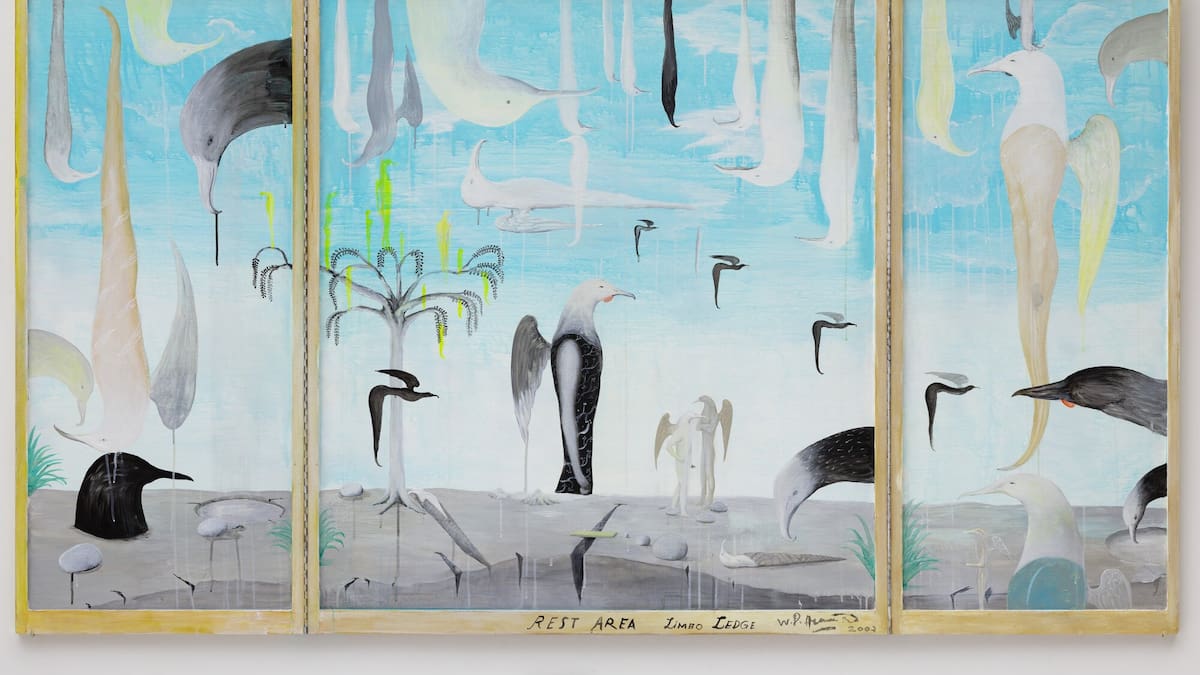
W D Hammond, Rest Area Limbo Ledge, 2002, acrylic on board, Auckland Art Gallery Toi o Tāmaki.
With strange hybrid bird-human figures set in mythical, other-worldly environs, the work of Lyttelton-based painter Bill Hammond (1947-2021) also comes to mind when considering surrealism. That being said, Hammond’s work evades the pigeon hole of a singular movement and typically blends multiple styles in order to, in Hammond’s mind, conjure up an ancient New Zealand where birds still ruled and the land was yet to be denigrated by humanity.