
In the pioneering days of Russian cinema, directors such as Lev Kuleshov, Sergei Eisenstein and Vsevolod Pudovkin emphasised juxtaposition as a central tool of storytelling. Their argument was that narrative meaning emerges not from a single image in isolation but from its collision with images placed alongside it. If a picture is juxtaposed with different images, each sequence generates a distinct interpretation, showing how meaning can be produced through context and association.
The same principle applies to exhibition-making. In an exhibition, a painting doesn’t exist in isolation: its meaning is also shaped by the works that surround it. Positioned alongside different paintings, it can be read in entirely different ways. In the Southern Highlands of New South Wales, Ngununggula gallery has just opened an exhibition, New Religion, that puts this theory into practice.
Casting a wide net across belief systems and spiritual traditions, the exhibition juxtaposes contemporary Australian art with significant historical works by William Blake, Arthur Boyd, Sidney Nolan and artists from the Cologne School. The show grew from curator Milena Stojanovska’s longstanding interest in esoteric thought and systems of belief. As she explains, “I’m fascinated with our obsession to make life mean something and how visual culture is intrinsically linked to that pursuit.”
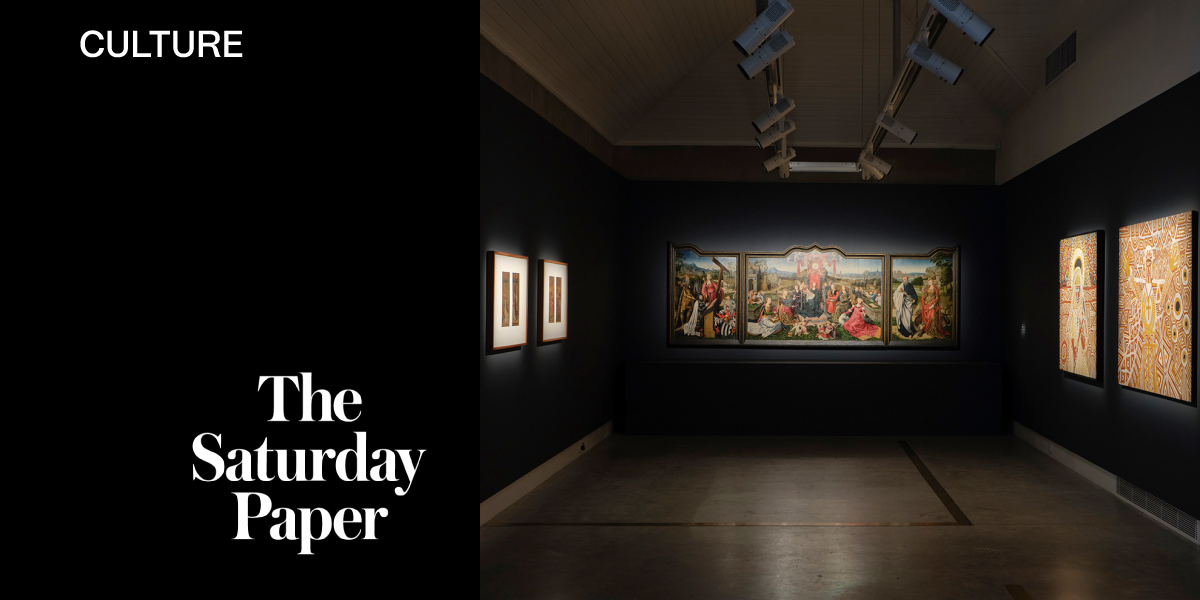
Stojanovska cites the Protestant Reformation as a key inspiration. Among the exhibition’s anchor works is a 16th century triptych from the Cologne School, produced around the time Martin Luther challenged the authority of the Catholic Church. She was drawn to Luther’s insistence on individual conviction, describing it as “a personal statement of belief against this political structure”. The notion that faith is deeply personal and often runs counter to established institutional power lies at the heart of her curatorial framework.
Spanning the gallery’s four exhibition spaces, New Religion unfolds within a richly atmospheric installation. Dark walls and concentrated lighting create a gothic ambience, allowing the works to appear as if suspended in space. In the final gallery, Gian Manik’s large-scale oil painting, Happiness and delight in these pleasures with punishments meted out to each sin (2026), takes its cue from another iconic triptych, Hieronymus Bosch’s The Garden of Earthly Delights (circa 1490–1510). His contemporary reimagining, populated by imagery drawn from pornography and orgiastic culture, is revealed behind a black curtain that simultaneously evokes the confession booth and adult cinema.
Another stand-out work is Sydney-based artist Luke Thurgate’s monumental charcoal wall drawing, Let Me Down Gently. Executed directly onto the gallery wall, the work makes powerful use of the pitched-roof architecture of the former dairy building that houses the gallery. Thurgate embraces both the material and conceptual fragility of charcoal, observing that “it’s just dust clinging to the gallery wall. It talks to an idea of ephemerality. Once the show is over it just gets washed away.” The work’s impermanence forms a striking contrast with the Cologne School altarpiece, which has survived centuries and crossed oceans.
What ultimately distinguishes New Religion is its refusal to offer definitive answers.
Multidisciplinary artist Nell is represented in a series of paintings from 2005 that contain motifs which continue to recur throughout her practice. Crosses, serpents and eggs contribute to a highly personal iconography that has been mined consistently across her career. These symbols, often juxtaposed with the lightning bolt of the AC/DC logo, speak to questions of power, devotion, fandom and belief. Her practice has long been bowerbird-like in its approach, drawing freely from Buddhist traditions and her own meditation practice. The works serve as a reminder that contemporary spirituality is often characterised by personal synthesis rather than adherence to a single prescribed system of faith.
For Drew Connor Holland, art-making began through a youthful obsession with tabletop gaming and role-playing worlds. He devoted countless hours to painting miniature figures for games such as Warhammer and Dungeons & Dragons. In New Religion, his Life work (Schembartvisier cabasset) (2026) operates as a form of neo-archaeology: a weathered golden visage from faux antiquity is presented alongside a spearhead. The work subtly recalls the moral panic that surrounded fantasy role-playing games in the 1980s, when segments of the conservative Christian right in the United States claimed these worlds of demons, knights and mythical creatures were satanic.
A particular highlight is Melbourne-based Gunditjmara, Djabwurrung and Anglo-Indian artist Hayley Millar Baker’s In Life, In Death (2024). The work comprises seven black-and-white self-portraits, each title contributing a line to an unfolding poem. Examining personal spirituality in relation to broader political realities, it functions as a form of prayer for First Nations peoples and their ongoing experiences under colonial structures. Throughout her practice, Millar Baker has used portraiture as an intimate means of revealing larger social and political truths.
Claire Healy and Sean Cordeiro’s work Talk Religion, Get Food (2026) explores the notion of manna, celestial gifts falling from the heavens, through a piece of SpaceX rocket debris sourced online by the artists. The work arrives at a moment when technology increasingly occupies cultural spaces once filled by organised religion. Questions about meaning, consciousness and humanity’s future are now routinely directed towards AI, reflecting the hopes and anxieties that surround technological progress. At the same time, the work continues the artists’ longstanding interest in extraterrestrial life and humanity’s place within a vast and potentially inhabited universe. In doing so, it invites reflection on how traditional belief systems might accommodate such profound shifts in perspective.
New Religion creates multiple points of entry for visitors, unfolding in a measured and contemplative manner. Moving through the gallery’s succession of rooms and hidden corners, works are revealed gradually rather than announced, encouraging sustained looking and reflection.
What ultimately distinguishes New Religion is its refusal to offer definitive answers. It embraces uncertainty and complexity, acknowledging belief as something constantly negotiated and reinvented rather than fixed or absolute. In bringing together significant institutional loans, historical works and ambitious new commissions, Ngununggula has mounted a project of considerable scope and intellectual ambition. Yet despite the breadth of its subject matter, the exhibition retains an intimacy, grounded in the personal stories, symbols and spiritual inquiries of the artists involved.
At a time when traditional forms of faith coexist tentatively with new secular belief systems centred on technology, politics, identity and culture, New Religion feels particularly resonant. The exhibition asks not only what we believe but why we continue to seek meaning through images, rituals and shared narratives. Stojanovska has demonstrated a deft and thoughtful curatorial hand, orchestrating a rich constellation of works that remain in productive and generative dialogue with one another.
New Religion is showing at Ngununggula, Southern Highlands Regional Gallery, East Bowral, until October 18.