
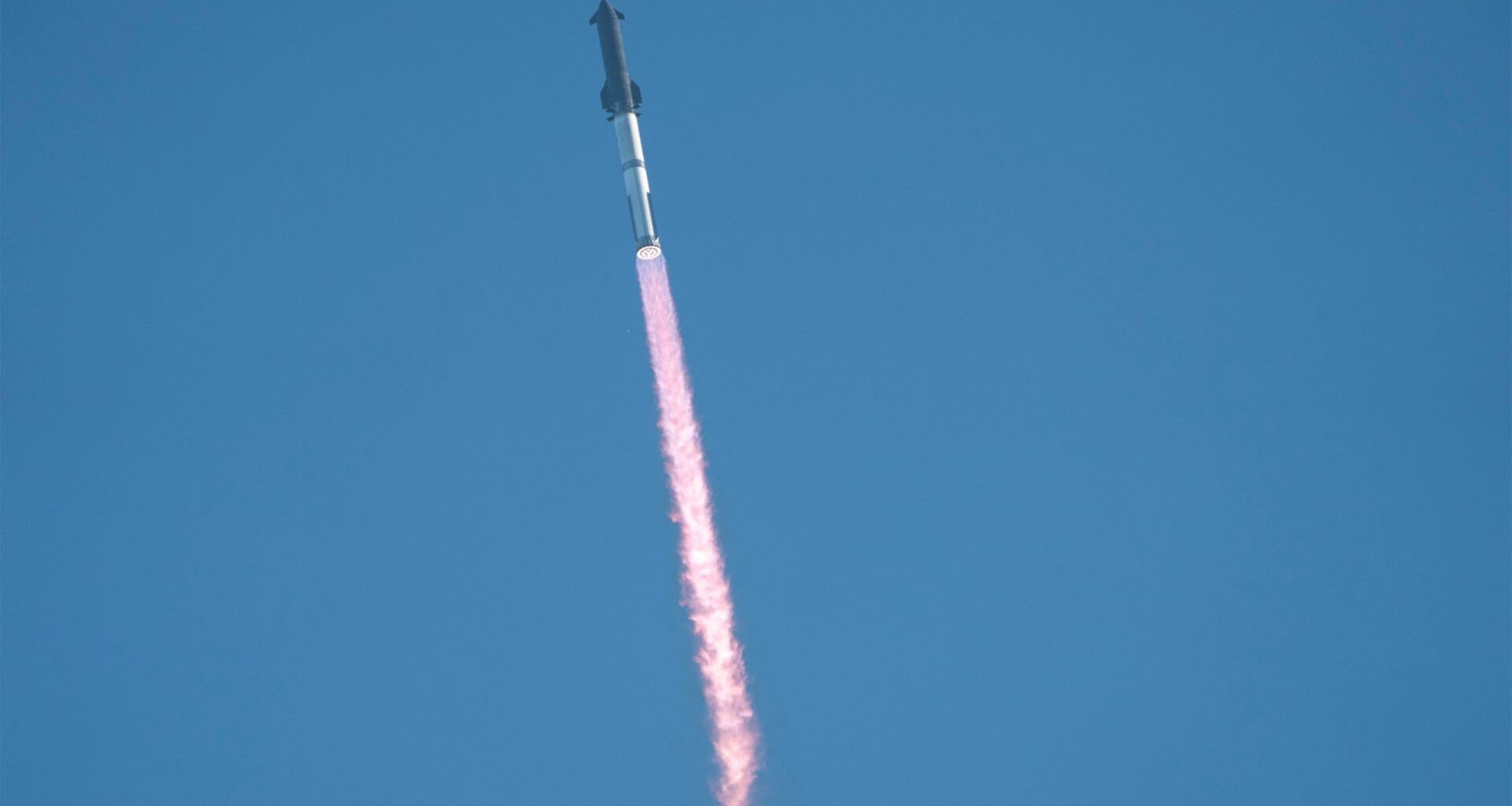
SpaceX completed a full-duration, 33-engine static fire of Super Heavy Booster 20 on Friday morning — the last major pre-flight test before Starship’s 13th integrated test flight, now targeting a launch window opening Wednesday, July 15, at 6:45 PM ET (10:45 PM UTC) from Pad 2 at Starbase, Texas. For the hundreds of thousands of retail investors who bought into SpaceX’s $75 billion IPO on Nasdaq last month, and for NASA engineers tracking a 2028 lunar landing deadline that depends on Starship reaching operational status, this flight carries a sharply defined question: did SpaceX actually fix the booster?
What Flight 12 Left Unfinished
The 12th Starship test flight on May 22, 2026, marked the debut of SpaceX’s Version 3 hardware. The results were a textbook illustration of the company’s iterative testing philosophy: impressive in places, incomplete in others.
On the Ship side, the headline anomaly was a premature shutdown of one of three vacuum-optimized Raptor 3 engines during the climb to space. Rather than triggering a mission abort, Starship’s flight computer autonomously extended the burn duration of the remaining five engines to compensate for the lost thrust, successfully delivering the vehicle to a planned suborbital trajectory. Ship 39 reached space, deployed all 22 Starlink satellite simulators — two of them equipped with cameras to image the heat shield during flight — survived reentry, and executed a controlled splashdown in the Indian Ocean.
The booster’s story was grimmer. Following stage separation, Booster 19 rolled abnormally fast and off-axis — approximately 90 degrees rather than the intended vertical pitch — likely causing propellant slosh that starved the relighting engines. A Raptor engine appears to have failed energetically during the sequence, damaging its neighbors. The booster struck the Gulf of Mexico at approximately 1,450 km/h (about 900 mph), with only a single engine managing to light during the landing burn. The Federal Aviation Administration classified the Flight 12 launch as a mishap and grounded Starship pending a SpaceX-led investigation that the FAA oversaw.
A relight of a single Raptor engine that was planned to happen in space also did not take place — the ascent engine-out prompted mission controllers to abandon that objective.
That investigation is now resolved per FAA advisory notices, and Flight 13 has its launch clearance. The booster rollback for final inspections following Friday’s static fire could push the actual liftoff to the week of July 20 in the most conservative scenario, but the current primary target remains Wednesday.
Booster 20’s Record Static Fire and What It Means
The July 10 static fire was not a routine box-check. Acoustic measurements taken 6 miles away by the LabPadre monitoring team registered 182% greater peak pressure and 150% greater root mean square pressure compared to previous static fire tests at Starbase — the strongest event ever recorded at the site by those metrics. The dominant acoustic energy also shifted to lower frequencies, a signature of higher combined thrust. The burn lasted approximately 25 seconds, simulating the duration and conditions of an actual launch.
This is the second Version 3 (V3) booster to reach the pad at Starbase. Booster 20 is equipped with 33 of SpaceX’s Raptor 3 engines — the same engine generation that debuted on Flight 12. What makes this static fire meaningful is not just its completion but what it implies about the root-cause analysis: SpaceX had seven weeks to diagnose why Booster 19’s off-axis flip set off a cascade that ended in a hard splashdown, and the decision to proceed straight to a 33-engine full-duration burn on only the second Block 3 booster reflects confidence in the hardware and software changes made since.
How Raptor 3 Makes This the Most Powerful Rocket Ever Built
The Raptor 3 is a full-flow staged combustion engine — only the third engine type in history to use this thermodynamic cycle, and the first to power a vehicle in flight. In full-flow staged combustion, both a fuel-rich preburner and an oxidizer-rich preburner drive separate turbopumps before the propellants combine in the main combustion chamber. This near-complete combustion efficiency is why Raptor 3 achieves 280 metric tons-force of thrust at sea level from an engine weighing just 1,525 kilograms — down from 1,630 kg for Raptor 2, with 21% more thrust. The resulting thrust-to-weight ratio exceeds 180.
With 33 Raptor 3 engines, Super Heavy generates over 18 million pounds of combined liftoff thrust — the most of any operational rocket in history. Three enlarged grid fins, each approximately 50% larger than Raptor 2-era fins and positioned lower on the booster trunk to avoid hot-staging heat, control the booster’s orientation during descent and will eventually interface with Starbase’s Mechazilla tower arms for catch operations.
The V3 configuration also extends the total vehicle height to 408 feet (124.4 meters), increases propellant capacity by roughly 10%, and incorporates docking ports for the in-space propellant transfer that lunar and Mars missions will require. In fully reusable mode, V3 is rated to deliver more than 100 metric tons to low Earth orbit — nearly three times the approximately 35 metric tons achievable on V2. That single figure is the engineering foundation of SpaceX’s business case: Starlink’s next-generation V3 satellites, each weighing approximately 2,000 kg and designed to deliver more than 10 times the downlink capacity per satellite of current V2 Mini hardware, cannot physically fit in a Falcon 9 fairing. They can only fly on Starship. Each Starship V3 launch carrying a full batch of V3 satellites will add more than 20 times the network capacity of a single Falcon 9 V2 Mini launch.
Five Things That Will Define Flight 13Boostback burn completion. This is the gate everything else depends on. On Flight 12, Booster 19 was unable to light all planned engines for the boostback burn and performed only a partial burn that ended early, before experiencing a hard splashdown. A clean, full-duration boostback burn on Booster 20 would demonstrate SpaceX has diagnosed and corrected the failure mode — whether the off-axis flip issue was in the grid fin software, the propellant settling behavior, or the engine relight sequence. The boostback burn comes at approximately T+3 minutes; it will be the moment that tells the story of whether the right problem was solved.In-space Raptor relight on Ship 40. A relight of a single Raptor engine did not take place on Flight 12. Ship 40 gets another attempt. This is not optional for the program’s future: a working in-space Raptor relight is the prerequisite for deorbit burns on any mission returning from orbit, for lunar transfer burns pushing the Starship-Orion stack toward the Moon for Artemis IV, and for any deep-space mission architecture. The technical challenge is genuinely hard — a cryogenic engine must cold-start in a vacuum, managing propellant settling in microgravity, with no second chance.Upper-stage engine-out resilience — ideally not needed. Flight 12 showed the flight computer can compensate for a lost engine during ascent. A clean, nominal Raptor 3 performance through ascent on Ship 40 would be a stronger signal of reliability than a successful workaround.Reentry and controlled splashdown of Ship 40. The Indian Ocean splashdown on Flight 12 went largely as planned. A second clean reentry validates the thermal protection system under real flight conditions and the flip-and-burn descent profile that must eventually work returning Ship to Starbase for catch.Cadence. According to FAA documentation and Gwynne Shotwell, SpaceX is targeting roughly one Starship launch per month, with hopes of achieving full orbital injection on Flight 14 and expanding launches from both Texas and a new LC-39A pad at Kennedy Space Center in Florida. Flight 14 is widely expected to attempt the first booster catch since the V3 program began. If Flight 13 launches on schedule and the booster performs, that cadence compresses.What This Flight Means for SPCX Shareholders
SpaceX completed the largest initial public offering in history on June 12, raising approximately $75 billion at a valuation of $1.77 trillion when shares began trading on Nasdaq under the ticker SPCX. Shares closed up 19% on their first day, and the stock added roughly $31 on the first full Monday of trading.
In its S-1 prospectus, SpaceX disclosed that its growth strategy “depends on our ability to increase our launch cadence and payload capacity, which is dependent on the successful development of Starship at scale.” SpaceX stated plans to begin deploying Starlink V3 satellites — which require Starship, not Falcon 9, for economic deployment — in the second half of 2026. The Starlink connectivity segment generated $3.26 billion in revenue in the first quarter of 2026 alone, representing 69% of SpaceX’s total quarterly revenue. That cash flow is currently what funds Starship development.
James Ratzer, partner and senior analyst at NewStreet Research, initiated coverage with a $165 price target while noting SpaceX has “at least a 10-year lead” over competitors in launch capabilities. However, Ratzer cautioned that justifying the current valuation requires looking out over “a 20-to-25-year time frame” — which underscores what a Flight 13 booster failure would and would not mean: a single test result is not a verdict on a 25-year thesis, but it is one of only a handful of near-term milestones that can move that thesis meaningfully forward or backward.
What shareholders should understand is that SpaceX’s dual-class share structure grants Elon Musk approximately 85% of voting power despite owning roughly 42% of the equity. This means public investors hold financial exposure to Starship’s test outcomes without governance recourse over the program’s direction — a structural condition that warrants factoring into any position-sizing decision.
Artemis, Mars, and What Full Success Actually Buys
NASA restructured the Artemis program in February 2026, redesignating Artemis III as a crewed Earth-orbit docking test planned for late 2027. Artemis IV, now the first planned crewed lunar landing, targets early 2028 — though an internal SpaceX document has been reported setting a September 2028 timeline given development pace. Both the Starship Human Landing System and Blue Origin’s Blue Moon remain under development and have not yet received NASA’s human-rating certification. NASA’s Office of the Inspector General flagged in a March 2026 report that Starship has not yet achieved orbital flight, conducted in-space propellant transfer, or completed an uncrewed lunar landing demonstration — all prerequisites for Artemis IV.
That context is the pressure behind Flight 13. Artemis III in late 2027 requires Starship to dock with Orion in Earth orbit; Artemis IV in 2028 requires it to push the combined stack to lunar orbit, lower two astronauts to the lunar surface, and return them. The in-space Raptor relight Flight 13 is attempting is the same technical capability that underlies every one of those objectives.
SpaceX has maintained a stated target of an uncrewed Starship flight to Mars during the 2026 launch window, though the company has not provided public confirmation of specific mission readiness, and this goal would require substantial milestones ahead of today’s status.
Flight 13 also takes place against a newly competitive backdrop: on July 10, the same day Booster 20 completed its static fire, China’s Long March 10B rocket successfully landed its first stage after an orbital launch — the first time China had achieved this, narrowing the reusable orbital launch lead SpaceX has held since 2015.
How to Watch Starship Flight 13
SpaceX will stream the launch live on its official YouTube channel and on X. The primary window opens at 10:45 PM UTC on Wednesday, July 15 (6:45 PM ET / 5:45 PM CT), with a one-hour launch window. The backup opportunity falls at the same time on Thursday, July 16. The booster rollback for final inspections could push the attempt to the week of July 20 if additional work is required — Boca Chica beach closures and FAA NOTAMs will be the most reliable real-time indicators of launch readiness.
Launch commentary typically begins 30 to 45 minutes before the window opens. The boostback burn at approximately T+3 minutes is the moment that will define this flight.
Frequently Asked QuestionsWhen will Starship Flight 13 launch, and how can I watch?
The primary launch window opens Wednesday, July 15 at 10:45 PM UTC (6:45 PM ET / 5:45 PM CT), with a backup on Thursday, July 16 at the same time. A booster rollback for post-static-fire inspections could push the attempt to the week of July 20. SpaceX will stream live on its official YouTube channel and on X. The boostback burn at T+3 minutes is the critical moment to watch.
What exactly failed on Starship Flight 12 — and what does Flight 13 need to prove?
Booster 19’s flip maneuver after stage separation went off-axis, likely causing propellant slosh that starved the relighting engines. Only a single Raptor fired during the landing burn, and the booster struck the Gulf of Mexico at approximately 1,450 km/h. Separately, an ascent engine-out on Ship 39 led mission controllers to abort the planned in-space Raptor relight. Flight 13 must demonstrate both a successful boostback burn and a working in-space relight on Ship 40 — the two specific objectives that were missed on the previous flight. Full details of the Flight 12 booster failure and FAA probe are covered in TechTimes’ earlier reporting.
Why does Starship matter for NASA’s 2028 Moon landing plans?
NASA’s Artemis IV mission, currently targeting early 2028, depends on either SpaceX’s Starship Human Landing System or Blue Origin’s Blue Moon being ready to dock with the Orion capsule in Earth orbit and push the combined stack toward the Moon. In the SpaceX architecture, multiple Starship tanker flights must transfer cryogenic propellant to the lander before it departs for the Moon — an operation that requires the in-space Raptor relight capability Flight 13 is attempting. NASA’s Inspector General flagged in March 2026 that Starship has not yet reached orbit, demonstrated propellant transfer, or completed an uncrewed lunar landing, identifying these as risks to the 2028 timeline.
What control do SPCX shareholders actually have if Starship testing keeps falling short?
Practically none over program direction. SpaceX’s dual-class share structure gives Elon Musk approximately 85% of voting power despite owning roughly 42% of the equity. This means public investors who bought SPCX through Robinhood, Fidelity, or any other brokerage hold financial exposure to Starship’s test outcomes but cannot vote to change the program’s engineering priorities, timeline, or leadership. Senator Elizabeth Warren raised this governance structure as a concern in a letter to the SEC ahead of the IPO; law professor Ann Lipton described it as “essentially closing off every possible avenue for shareholders to have any influence at all.” Understanding this distinction — between financial exposure and governance rights — is the single most important structural fact for any retail investor holding SPCX heading into Flight 13.