
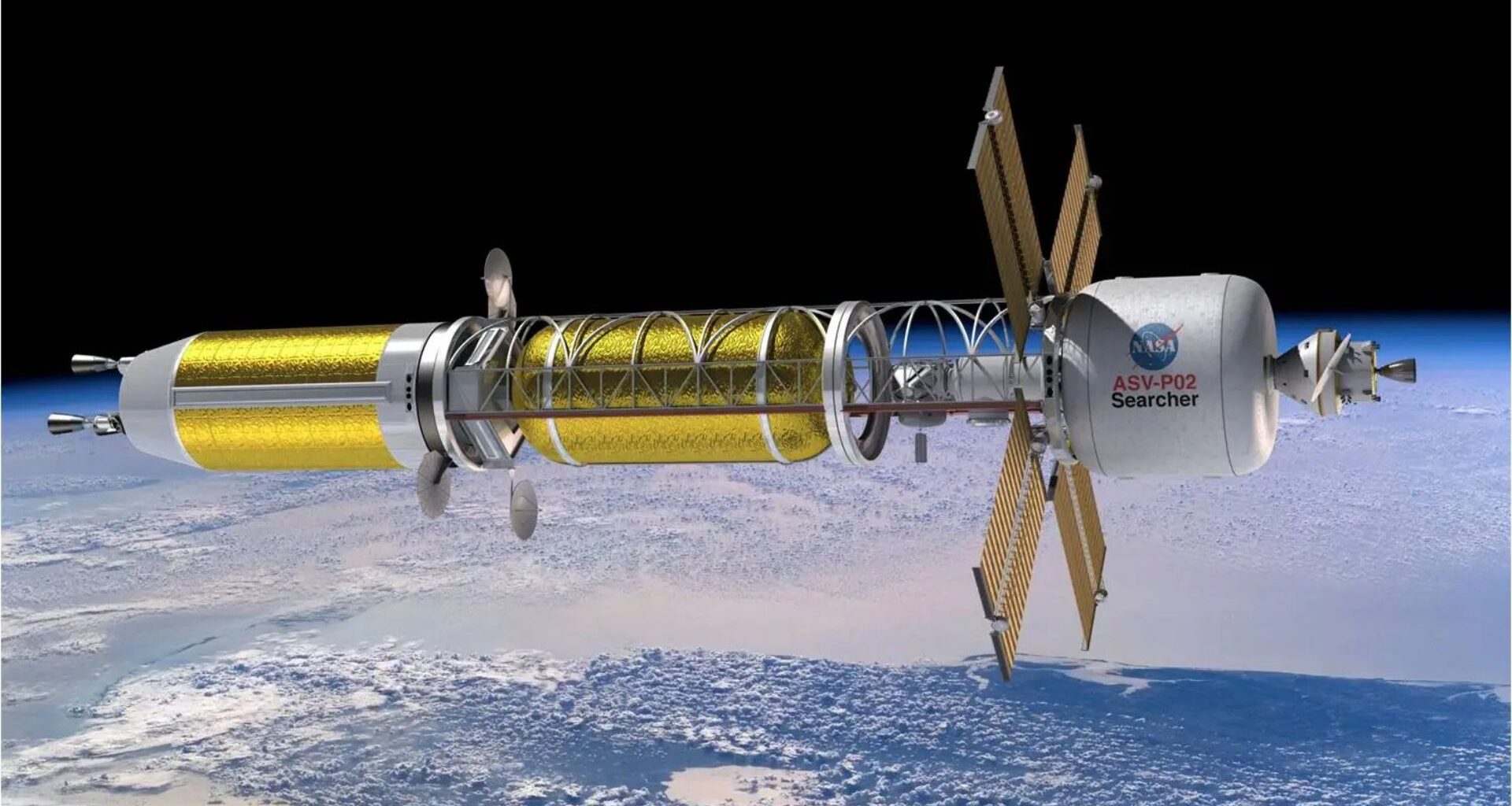
If a rocket carrying a nuclear reactor explodes on its way to deep space, how do you find the radioactive wreckage before it leaks?
A nuclear-powered spacecraft poses a high risk of environmental contamination in the event of a crash. Now, a new study introduces a Micro Black Box (MBB) concept specifically tailored for nuclear propulsion spacecraft. It would be able to record flight data and broadcast coordinates to prevent nuclear leaks.
A team of engineers at the Nanjing University of Aeronautics and Astronautics in China proposed this MBB concept.
“A micro black box was proposed, which can absorb 25,969 J of impact energy under 4.5 kg in mass and ø16.5 × 16.8 cm in size. The impact dynamic of Micro Black Box was validated by simulation and experiment,” the researchers wrote in the study paper.
Survival of electronics
Space agencies are increasingly looking to the stars with nuclear ambitions. NASA is currently developing its Space Reactor-1 Freedom spacecraft for a potential Mars-bound mission, while the China National Space Administration (CNSA) is eyeing a nuclear-powered orbiter for a mission to Neptune.
Nuclear fission offers the massive, sustained thrust required to reach the edge of our solar system. But getting that fissile material off the launchpad safely remains a terrifying engineering hurdle.
If an ascent vehicle suffers a destructive anomaly, the resulting crash forces could be mind-boggling. Spacecraft’s crash velocity may reach upto hundreds of meters per second. This would lead to massive deceleration forces that instantly pulverize standard tracking electronics, leaving search teams completely blind.
Reportedly, the issue was solved with the use of a Beidou satellite locator beacon and a flight data recorder. These two were equipped in a hardened about 9.9 pounds (4.5-kilogram) aluminum-alloy cylinder. It can tell rescuers exactly where to find the dangerous nuclear debris.
It has a tough internal architecture for survival. A tightly packed, multi-layered defensive armor designed to absorb 25,969 joules of impact energy.
“The proposed micro black box contains several buffer structures and materials to absorb impact energy and protect the inside electrical instruments, verified by a crash impact dynamic simulation and experiment,” the study stated.
The outer aluminum shell gives way to an energy-crushing aluminum honeycomb. Beneath that sits a tough magnesium alloy layer, followed by a hyper-elastic foam that deforms heavily to swallow the brunt of the kinetic shock waves. Finally, a core layer of space-age aerogel insulates the delicate electronics from intense heat.
Prototype testing
Initial testing on a 1,400-teraflop supercomputer predicted the multi-layer buffer would absorb 90.26 percent of a crash impact.
To prove it, the researchers went ballistic. The prototype was loaded into a Davis gun and blasted into earthen banks to simulate a high-speed crash. While the outer aluminum skin suffered cosmetic battle damage, the inner core module emerged completely unscathed. It didn’t deform or break but kept broadcasting.
Recognizing that rockets also fly over water, the team has already iterated on their design, proposing an upgraded version equipped with a rapid-deploy airbag. In maritime simulations, the airbag-assisted black box cut peak crash acceleration by an additional 44.3 percent. Notably, the modification allows the heavy device to float stably on the ocean surface for rapid salvage.
“The modified airbag-assisted design further reduces the peak acceleration by 44.3% percent, significantly enhancing impact resistance, and is able to float on the sea,” the study said.
A crash is the worst-case scenario everyone hopes to avoid, but if disaster strikes, the MBB ensures we won’t be left searching in the dark.
The study was published in the journal Acta Astronautica.