
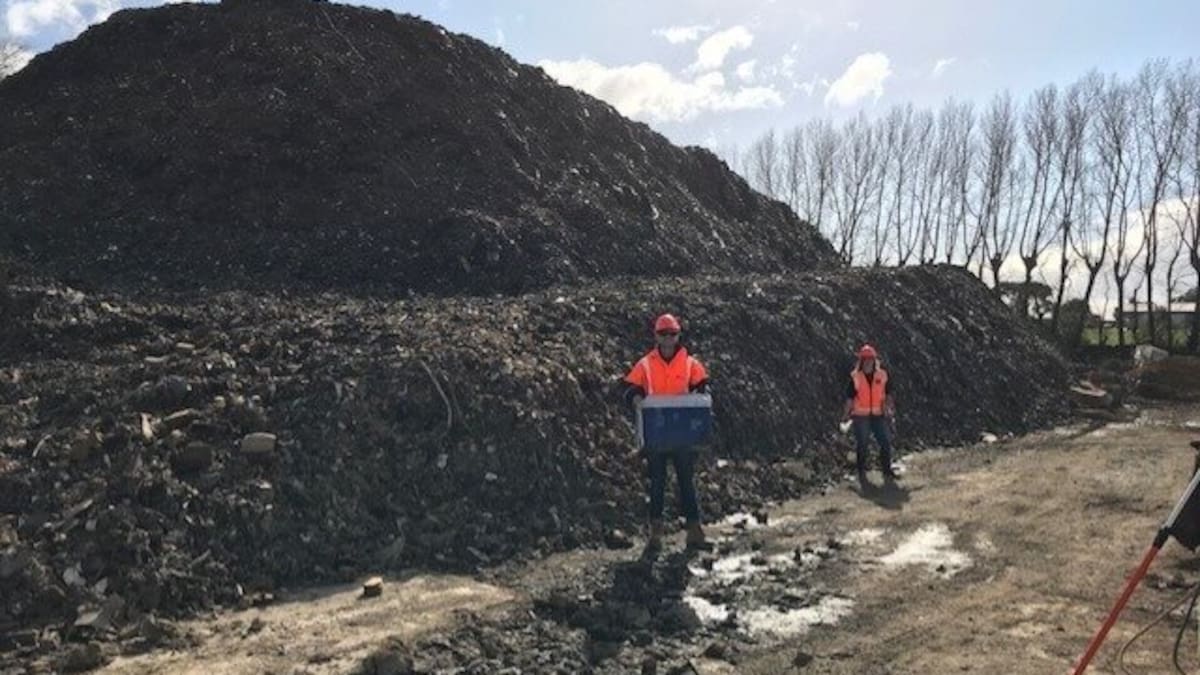
In her sentencing decision, Environment Court Judge Prudence Steven found the offending involved a “deliberate prioritisation of commercial activities” over environmental compliance.
Ofsoki was granted earthworks resource consent by Western Bay of Plenty District Council in 2013, which required all operational areas to be capped in concrete, and in 2016 he gained consent to operate a scrap metal recycling business processing end-of-life vehicles, appliances and light machinery.
Since then, neighbouring properties have repeatedly raised concerns about odour, dust, rubbish and stormwater, prompting regular inspections by regional and district council officers.
After a 2017 inspection, Metalco was fined for offensive odours and smoke.
From 2018, the defendant began stockpiling automotive shredder residue (ASR) on “unsealed areas” of the site that had no adequate stormwater controls to capture and treat runoff.
ASR is the by-product or waste remaining after the recycling of cars, following the removal of liquids and valuable components.
Metalco was warned in 2019 after heavy metal-contaminated water was found entering a nearby drain that flowed into the Ruaparapahoe Stream, which eventually reaches the lower Kaituna River.
The regional council received another complaint in July 2020 that between 25,000 and 30,000 cubic tonnes of ASR had been accumulated at the site.
Testing revealed elevated levels of zinc, copper, chromium and lead in water and sediment, and council officers warned the company that urgent action was needed.
In 2021, the company bought a large industrial-zoned property near Rainbow Mountain, south of Rotorua, and consents for a “large-scale” recycling operation were granted.
However, environmental concerns at the Te Puke site continued and led to another complaint in 2022 about contaminated water.
Metalco was required to cease the discharge immediately.
Council staff found contaminated water was still entering the drain in 2023. Metalco and Robof were each issued abatement notices again to stop the discharge of contaminants.
A pile of recycling waste at Metalco Recyclers’ Te Puke plant in January 2025. Photo / Bay of Plenty Regional Council
Later that year, the regional council carried out a further compliance inspection and directed Metalco to submit a plan to remove a substantial waste stockpile.
Metalco estimated that could take up to four years. It began moving the ASR stockpile to Rainbow Mountain in April 2023, but continued metal shredding at Te Puke until June 2025 when it completed its relocation.
Site inspections in late 2024 and early 2025 found that contaminated stormwater was discharging from the property into a drain at three separate locations, including through two PVC pipes.
Metalco tried to remedy it by disconnecting a PVC pipe outlet to prevent it from flowing into a drain, and creating two 5m by 6m deep soakage holes to drain water away.
On April 4, 2025, a council officer inspected Metalco’s bio-retention swale and took water samples.
The sample indicated the swale was reducing metal concentrations in water, but it was not big enough to avoid discharging high levels of cadmium, chromium, copper, lead and zinc.
The regional council granted Metalco a new resource consent on June 17 last year for the discharge of stormwater, subject to several conditions.
A pile of shredded waste containing residual heavy metals at a Metalco Recyclers Limited site in Te Puke. Photo / Bay of Plenty Regional Council
Judge Steven looked at evidence from independent ecological expert Keith Hamill, who said heavy metals discharged into the drain would have harmed aquatic ecosystems, including algae, aquatic plants, invertebrates and indigenous fish species.
Regional council lawyer Victoria Brewer described the offending as serious, involving “deliberate and persistent contraventions” of resource consent with obvious risks poorly managed over several years
Brewer argued Metalco had made a “conscious decision” to place commercial interests ahead of its environmental and legal obligations.
The risk of contaminants entering the adjacent drains was “entirely foreseeable”, the regional council said.
Stormwater pooling in 2024 at the Metalco Recyclers Ltd site in Te Puke. Photo / Bay of Plenty Regional Council. Photo / BOP Regional Council
The agreed facts demonstrated a “sustained period of inaction on the defendant’s part”, during which it knowingly continued its recycling operations while failing to address the risks.
Defence lawyer Kate Barry-Piceno said Metalco’s actions were the result of “carelessness in the face of known risks” rather than deliberate pollution for financial gain.
Barry-Piceno outlined various reasons for Metalco’s delay in achieving compliance, including consenting delays, the Covid-19 pandemic affecting staff and consultants, and the region’s transport logistics and supply chains.
Tauranga lawyer Kate Barry-Piceno.
Barry-Piceno said Metalco acknowledged the impact its operations had on neighbouring properties and intended to continue working with the regional council to address outstanding issues.
Judge Steven noted Metalco acknowledged it had struggled to contain water within the site due to a lack of available sealed surface area.
Judge Steven said Metalco had undertaken its metal shredding activities with a “want of care”.
“There has been a deliberateness to this offending which puts it into the moderately serious range. It is patently clear that the defendant failed to heed the advice of experts,” she said.
She fined the company $84,000 and ordered it to pay costs of $261.
Sandra Conchie is a senior journalist at the Bay of Plenty Times and Rotorua Daily Post who has been a journalist for 25 years. She mainly covers police, court and other justice stories, as well as general news. She has been a Canon Media Awards regional/community reporter of the year.