
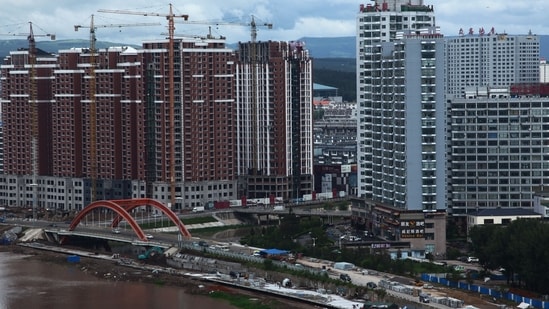
For nearly two decades, China’s property market was the engine of its economic growth and the cornerstone of household wealth. Homes were bought not just as places to live but also as investments, with real estate accounting for an estimated 70% of household assets. Then, a mix of debt-laden developers, unfinished housing projects, falling home prices, slowing population growth, weakening consumer confidence and an economic slowdown triggered a prolonged property crisis, wiping out trillions of dollars in wealth and shattering homebuyers’ faith in what was once considered the country’s safest investment.
 China’s real estate crisis has raised an important question for India: Can the country’s younger demographics, robust end-user demand and strong regulatory framework shield its housing market from the kind of prolonged downturn seen in China? (Photo for representational purposes only) (Pexels)
This has sparked a crucial question for India. Could the country face a similar reckoning, especially in investor-heavy markets, where luxury launches and speculative buying have surged in recent years? Or do India’s younger demographics, strong end-user demand, and tighter regulatory framework provide a buffer against the prolonged downturn witnessed in China?
China’s housing market in freefall
Recent data underscores the depth of China’s real estate crisis. According to data from the China Index Academy, secondary home prices across 100 major cities fell 0.42% month-on-month in June 2026, with prices declining in 88 cities. New-home sales by floor area dropped 10.8% year-on-year in the first five months of 2026, while property investment, new construction starts and project completions all continued to contract.
What triggered China’s housing market crisis?1. Years of debt-fuelled expansion
According to media reports, for nearly two decades, major developers such as Evergrande and Country Garden borrowed aggressively to acquire land and launch projects. Apartments were often sold before construction was completed, with proceeds used to fund older developments. When sales slowed, the model collapsed under its own weight.
2. Government’s debt crackdown
In 2020, Beijing introduced the ‘Three Red Lines’ policy to curb excessive borrowing by developers. The tighter financing environment triggered liquidity shortages, project delays and debt defaults, culminating in Evergrande’s collapse and a sharp loss of buyer confidence.
3. Unfinished housing projects
Millions of homebuyers who had paid for under-construction apartments were left waiting for possession. Mortgage boycotts and stalled projects eroded trust in the pre-sale model, discouraging fresh purchases.
4. Oversupply of homes
Developers built far more homes than the underlying demand, particularly in smaller cities. Local governments, heavily dependent on land-sale revenues, encouraged rapid construction, leaving behind large inventories of unsold homes, according to media reports.
5. Demographic slowdown
China’s population has been shrinking since 2022. Slower urbanisation, lower birth rates and an ageing population have weakened long-term housing demand, ending the demographic tailwinds that fuelled the property boom. The Asia Times reported this week that China’s population entered negative growth in 2022 and has continued to shrink. Experience elsewhere shows population decline is very hard to reverse, and China is likely to remain in negative growth for the foreseeable future.
6. Falling prices and weaker confidence
As prices continued to decline, buyers delayed purchases in anticipation of even lower prices, creating a self-reinforcing cycle of falling sales and declining values. According to media reports, buyers are waiting for prices to fall further. Many prospective homebuyers are delaying purchases in anticipation of lower prices, further depressing sales and prolonging the downturn. For years, Chinese households that invested nearly 70% of their wealth in real estate have suddenly lost confidence, media reports said.
7. Slowing economy
The broader economic slowdown has further weakened housing demand. Since real estate and related industries account for roughly a quarter of China’s economy, the downturn has also hit construction, banking, local government finances and household wealth. Developers continue to struggle. Although authorities have eased financing rules and offered policy support, many developers remain burdened with debt, while excess housing inventory continues to weigh on prices. Media reports quoted analysts as saying that the market still faces structural challenges rather than a temporary slowdown.
What is China doing to revive the market?
Beijing has rolled out a series of support measures, including lower mortgage rates, reduced down-payment requirements, financing support for developers to complete stalled projects, easing home-buying restrictions and programmes to help local governments purchase unsold homes, as per media reports.
India vs China real estate markets: What’s different?
According to Santhosh Kumar, vice chairman, Anarock Group, the biggest difference lies in the structure of the two markets. “In India, developers largely rely on funding from regulated banks and NBFCs, while RERA mandates escrow accounts that ensure customer advances are used for project construction. In China, developers became heavily dependent on the pre-sales model and accumulated enormous debt outside such safeguards. Speculative ownership of multiple homes was also far more widespread there, whereas India’s housing demand continues to be driven primarily by end-users and newly formed households,” he says.
Is rising unsold inventory a concern?
India’s unsold housing inventory has crossed five lakh units in top cities, raising concerns that supply may be outpacing demand.
Demographic dividend: A safety net, not a guarantee
India’s young population is widely seen as one of the country’s biggest strengths. But can demographics alone prevent a housing crisis?
Lessons from China’s property crisis
Experts say China’s experience offers important lessons for policymakers, developers and homebuyers.