
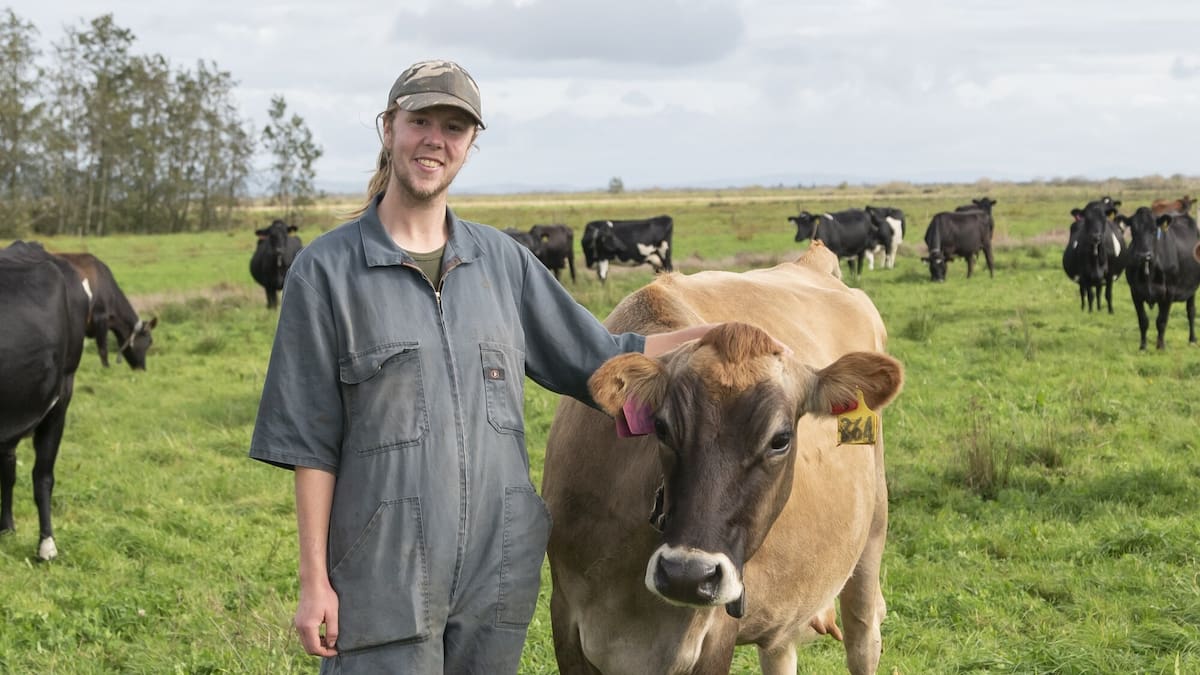
“There was a definite draw to farming, but I had very little experience.”
Wilkie enrolled at Toi Ohomai Institute of Technology in Rotorua and obtained a Certificate of Primary Industry Skills.
During that 12-week course, the concept of moving into farming developed.
“I was introduced to a bit of everything and felt that doing the course might help me find work in the industry.”
Wilkie’s job-hunting led him to his first role on a 900-cow dairy farm in Te Awamutu.
“I was shown everything from scratch, including driving a manual car and riding a motorbike.
“It was right into the deep end, but I received lots of support and encouragement and learned very fast on the job.”
He realised that farming was the ideal career for him, combining his passion for animals with the variety of tasks he gets to do every day.
In 2024, Wilkie moved to a farm assistant role at Brendan and Tessa Hopson’s 600-cow dairy farm at Paeroa.
This farm introduced him to milking in a 50-bale rotary shed and driving a tractor pulling a mixer wagon when feeding out.
The Hopsons have had previous Dairy Trainee entrants and winners working on their farm, and were themselves the Auckland/Hauraki Share Farmer of the Year winners at the 2020 NZ Dairy Industry Awards.
Wilkie is now part of a team of five and was encouraged to enter the awards by the 2025 Dairy Trainee of the Year for Auckland/Hauraki, Caitlin Snodgrass.
“I thought the skills day would be fun,” Wilkie said.
“A couple of things were new to me, but I gave them a shot.”
The prep for the nationals was full-on, but Wilkie said he really appreciated meeting and talking to a lot of people in the industry.
“Wil demonstrated excellent farming knowledge across a wide range of areas,” judges said.
“He confidently articulated a strong understanding of general farming practices and principles, including animal health, calving and mating management.
Wil is loving farm work and is eager to try new things. Photo / Catherine Fry
“In addition, he demonstrated exceptional knowledge in feed budgeting and a strong commitment to health and safety best practices.”
Wilkie also won the Franklin Vets Farming Knowledge Merit Award.
“My tasks included cull selection, fencing knots, reading drug data sheets and changing a bike tyre,” he said.
“My plant ID wasn’t so good, but I scored pretty well in most of the categories and can learn more about the weaker areas.
“I was relieved and able to relax once that section was over.”
Wilkie intends to stay in the industry, where he is quite happy working on-farm for the moment.
Wil Wilkie (left), Hugo, 2, Toby, 8, Ollie, 5, and farm owners Tessa and Brendan Hopson. Photo / Catherine Fry
He’s keen to learn as much as he can and is eager to try new things.
“I completed a LIC DIY AB [artificial breeding] course and may be able to get more involved in that area.”
In line with the maths aspect he “thrives” on, Wilkie would like to get more involved in the pasture management side on the farm.
“The farm has 200ha, and a 60ha runoff operates under a production system 3,” he said.
“We grow 17ha of maize silage and cut grass silage when the opportunity arises.
“We buy in about 600 tonnes of PK and hay in total and feed that on the feed pad.”
Wilkie enjoys anything to do with data and using it in his work.
“We use health collars to keep an eye on our colostrum cows for the first four days after calving, and we don’t send them back to the herd until they are ready.
“The rumination and activity data also tell us when cows come into heat, so we know they are ready for mating.”
Another area Wilkie would like to get involved in is fertiliser spreading.
He’s learning to read and analyse soil tests and understand why each fertiliser is used and when.
Cull selection is another area of interest, and using data from four herd tests to identify top performers and who is struggling.
“I say yes to pretty much any farm training offered where I can learn more.”
Wilkie would be happy to possibly progress to a farm manager position, but sharemilking or farm ownership aren’t among his plans.
He wouldn’t leave the industry but might consider retraining as a vet or vet tech to stay working with animals in a welfare role.