
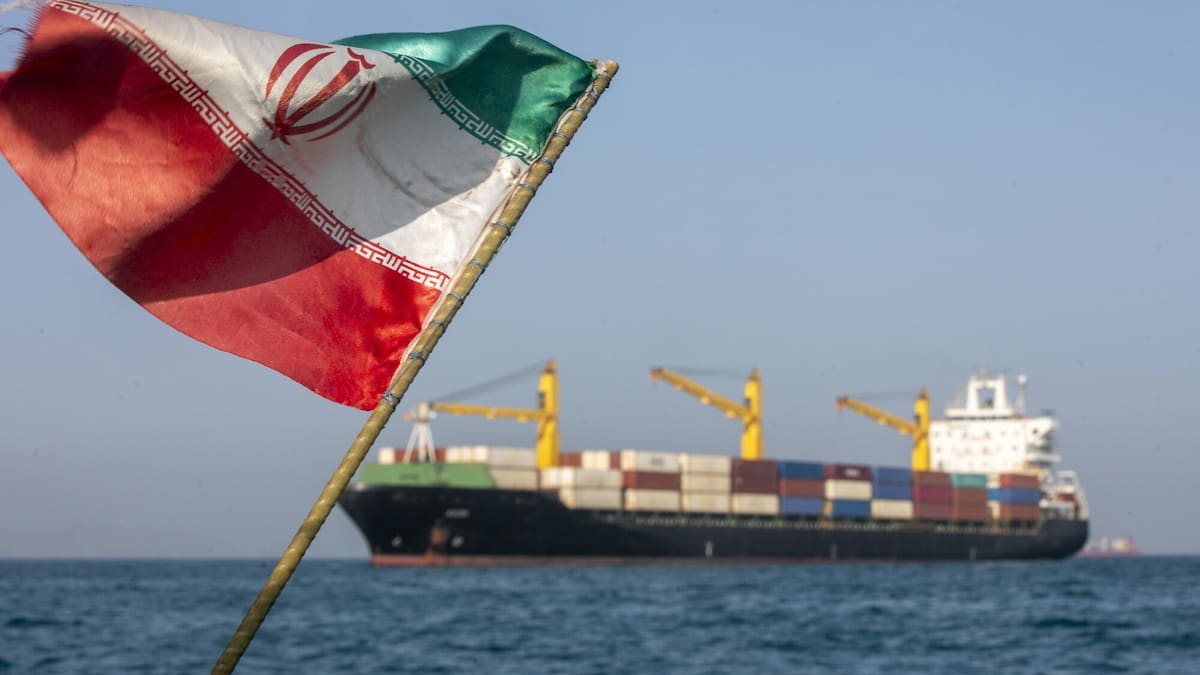
Iran’s Revolutionary Guards force had earlier said it struck and stopped a vessel ignoring repeated instructions to use an approved shipping corridor, according to state news agency Irna.
“Following this incident … the Strait of Hormuz will be closed until further notice and until the end of American interventions in this region and no vessels will be allowed to pass through,” the Guards said.
Although Iran called the strike on the ship “warning shots”, the US military said Tehran “blatantly attacked” a Cyprus-flagged container ship transiting the Strait of Hormuz.
A crew member was missing and the vessel had been disabled by fire and damage to its engine room, US Central Command (Centcom) said.
The crew abandoned the vessel and were on a lifeboat, British maritime agency UKMTO reported, adding the incident occurred around 17km east of Oman.
“In response, the United States is imposing a heavy cost by continuing to degrade Iran’s ability to attack civilian mariners and commercial ships freely transiting the strait,” it said on X.
Centcom said later the military had hit approximately 140 Iranian military targets as it finished the third round of strikes this week, carried out at the direction of US President Donald Trump.
The strikes, which began at 7.15pm local time on Saturday in Washington, were the third round carried out this week and were taking place at the direction of US President Donald Trump, Centcom said.
US Defence Secretary Pete Hegseth said: “Iran made a poor choice. Now they pay.”
Iran’s Guards later announced through state media that they had retaliated by striking US bases and radar sites in Jordan, Kuwait, Bahrain and Qatar with ballistic missiles and drones.
Critical strait
Earlier strikes by Tehran on vessels in the strait had triggered exchanges of fire between Iran and the US, sparking heated rhetoric between the adversaries.
The tensions threatened an interim agreement aimed at ending the Middle East war, which began in late February with US-Israeli strikes that killed former Supreme Leader Ali Khamenei.
A key roadblock to a final agreement is the future of the Strait of Hormuz, which Iran closed to commercial shipping during the war.
The waterway is a key conduit for oil and gas exports out of the energy-rich Gulf, and its closure has heavily impacted the world economy.
Iran insists on controlling the passage of ships and has announced plans to charge fees, saying there will be no return to the free navigation of the pre-war era – a stance Washington has rejected.
Under customary international law, states are not generally permitted to charge tolls on straits used for international navigation.
‘Vengeance’
The latest strikes came as Iran’s Supreme Leader Mojtaba Khamenei vowed revenge for the US-Israeli killing of his father and predecessor, hours after Trump threatened severe reprisals in the event of any attempt on his life.
Trump has declared their ceasefire over while leaving the door open for talks, and mediators have been trying to salvage a diplomatic solution.
“Vengeance is the will of our nation and must inevitably be carried out,” Khamenei said in a written message.
“This matter depends neither on my personal existence nor on that of other officials. Whether we are present or not, it will come to pass,” he wrote in his first message since his father’s funeral this week.
He said Iran had compiled a list of individuals to be targeted.
Khamenei has not been seen in public since before the war, and was reportedly wounded in the strikes that killed his father.
Hours earlier, Trump had posted on his Truth Social platform that any attempt to assassinate him would lead the US to “completely decimate” Iran.
With threats flying, mediators have been working to bring diplomacy back on track.
Iran’s Tasnim news agency reported that a Qatari delegation was visiting Iran to “try to reinforce Qatar’s role as a mediator”.
,
– AFP