
Roadmap 2030 charts a new course in trade, investment and human capital
Venkat Raman
Auckland, July 12, 2026
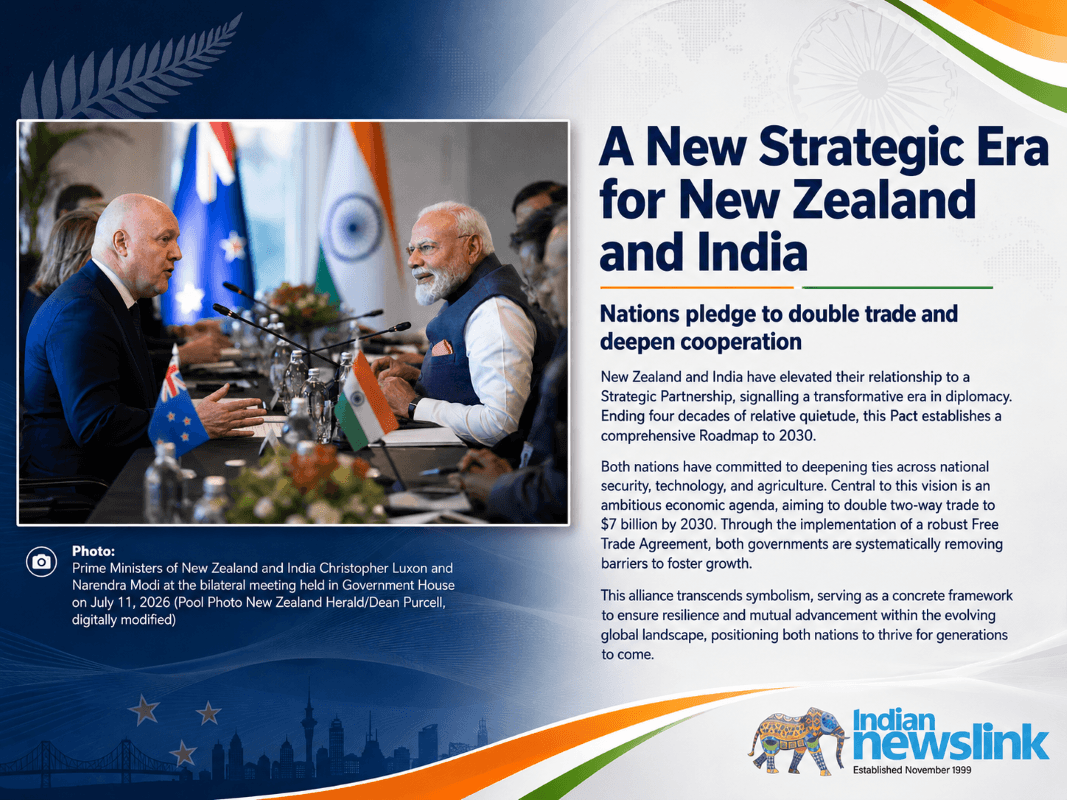
Prime Minister Christopher Luxon and Indian Prime Minister Shri Narendra Modi have elevated the bilateral relationship between their nations to a Strategic Partnership, marking a historic diplomatic milestone.
During a meeting in Auckland on July 11, 2026, the leaders unveiled the Roadmap to 2030, an ambitious framework aimed at doubling two-way trade to $7 billion and deepening collaboration across defence, maritime security, technology, and agriculture.
Mr Luxon’s delegation comprised Finance Minister Nicola Willis, Trade and Investment Minister Todd McClay, Ethnic Communities Minister Mark Mitchell, Tourism Minister Louise Upston, Defence Minister Chris Penk, while Mr Modi was joined by National Security Advisor Ajit Doval, Foreign Secretary Vikram Misri, Secretary (East) Rudrendra Tandon, Joint Secretary Randhir Jaiswal and other senior officials.
This visit, the first by an Indian Prime Minister in 40 years, solidified a shared commitment to a stable Indo-Pacific region, democratic values, and enhanced people-to-people connections, setting a trajectory for a prosperous and collaborative future.
Forging a Strategic Future
The bilateral meetings signified a transformative moment in the diplomatic history of New Zealand and India. After four decades of relative quietude in the highest levels of bilateral exchanges, this visit served as a catalyst for a deeper, more substantive engagement.
With the Strategic Partnership, both governments transcended traditional diplomatic interactions to embrace a framework characterised by shared goals and concrete actions.
This new status is not merely symbolic; it represents a commitment to coordinate policies and pool resources across a wide spectrum of areas, ranging from national security to sustainable agricultural practices, ensuring that both nations are better positioned to address the challenges of an evolving global landscape.
Mr Luxon expressed the significance of this shift, saying, “This represents a profound evolution in the connectivity between New Zealand and India, demonstrating that our shared aspirations for growth and stability are more than just rhetoric; they are actionable goals. By establishing this Strategic Partnership, we are not only looking at a short-term arrangement but laying the groundwork for a multifaceted relationship that will serve our citizens for generations to come, creating opportunities in every sector from technology to maritime security.”
Mr Modi reinforced this sentiment, adding, “Our presence here today in Auckland is a clear indication that India and New Zealand are ready to take our friendship to an entirely new dimension. We are aligning our national interests to build a future that is resilient, prosperous, and defined by mutual respect. Through this Roadmap to 2030, we have moved beyond simple diplomatic pleasantries to concrete, measurable actions that will deepen our economic and strategic alignment across all domains, ensuring both nations thrive in a rapidly changing world.”
Expanding Economic Horizons
Central to the success of this Strategic Partnership is the ambitious economic agenda, which seeks to integrate the markets of India and New Zealand more effectively.
The target to double two-way trade to $7 billion by 2030 is an aspirational goal that necessitates a robust implementation of the Free Trade Agreement (FTA).
This Pact is the backbone of the economic relationship, designed to lower tariffs, remove non-tariff barriers, and provide greater certainty for businesses seeking to operate across both jurisdictions.
As India continues its rapid development, New Zealand businesses are looking to gain access to a consumer base of 1.4 billion people, while India seeks to benefit from New Zealand’s expertise in primary industries, sustainability, and technological innovation.
“The Free Trade Agreement is the engine that will drive this new era of economic cooperation, allowing us to unlock potential that has remained untapped for too long. By reducing barriers and fostering an environment where innovation thrives, we are providing Kiwi businesses with the certainty they need to expand into a market of 1.4 billion people, effectively transforming our trade landscape and contributing to our national goal of doubling exports by 2034, which is a key priority for our economic strategy,” Mr Luxon observed.
Deepening Maritime and Security Cooperation
The strategic interests of both nations converge heavily in the maritime domain.
As oceanic countries, India and New Zealand view the stability and security of the Indo-Pacific as essential to their national prosperity.
The newly concluded Maritime Cooperation Arrangement addresses the need for greater visibility and coordination at sea. This cooperation is not limited to information exchange; it extends to active engagement, including naval exercises and logistical support, which serve to deter illicit activities such as narcotics smuggling and piracy.
By committing to these arrangements, both nations are sending a clear signal of their dedication to maintaining a free and open region where international law is respected and global supply chains remain secure.
“India and New Zealand are both maritime nations, and we understand that our collective prosperity is fundamentally linked to the security and openness of the Indo-Pacific waters. This Maritime Cooperation Arrangement is a testament to our commitment to a peaceful region where international law, specifically the United Nations Convention on the Law of the Sea, is upheld. We are dedicated to ensuring that these vital sea lanes remain open for trade, free from any constraints or illicit activities that threaten global commerce,” Mr Modi said.
Connecting People and Cultures
Beyond the hard power of trade and defence, the relationship is anchored in the strength of its people. The Indian community in New Zealand is increasingly recognised as a vital component of the nation’s social and economic fabric, serving as a conduit for cultural exchange and professional collaboration.
This Strategic Partnership seeks to leverage these existing links to foster greater understanding, particularly through joint initiatives in sport, tourism, and education. By facilitating exchanges in these sectors, both governments aim to create a lasting legacy of cooperation that transcends policy and touches the lives of their citizens directly.
“The connection between our nations is woven together by the vibrant Indian community that calls New Zealand home, acting as a living bridge that enriches our cultural and social fabric daily. As we look ahead, we are committed to strengthening these people-to-people links through enhanced cooperation in education, sports, and tourism, ensuring that the next generation of Indians and Kiwis continues to foster this deep, enduring friendship for years to come through shared experiences and mutual understanding,” Mr Luxon said.
Global Responsibility and Multilateralism
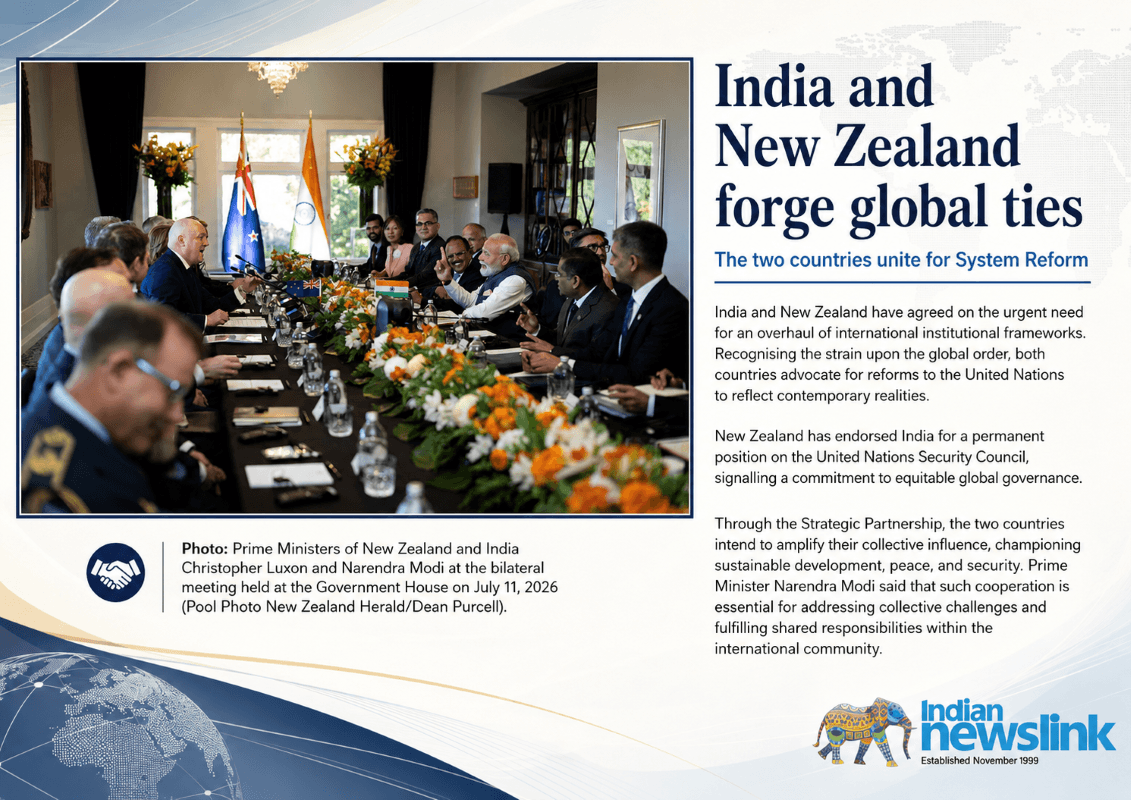
In the broader international context, India and New Zealand have aligned their perspectives on the importance of an effective multilateral system.
Both leaders acknowledged that the global order is facing significant stress, and that institutions like the United Nations require reform to reflect contemporary realities.
New Zealand’s support for India’s inclusion as a permanent member of the United Nations Security Council is a significant diplomatic endorsement, highlighting a shared vision for a more representative and balanced global governance structure. By working together in these international forums, the two countries are amplifying their influence and advocating for policies that support peace, security, and sustainable development.
Mr Modi said that in a world facing complex challenges, the necessity for a reformed and effective multilateral system has never been more apparent.
“We appreciate New Zealand’s support for India’s role in a restructured United Nations Security Council. By working together in international forums, we are not only addressing our bilateral concerns but also contributing to global peace, security, and the sustainable development goals that define the progress of humanity as a whole, reflecting our shared responsibility to the international community,” Mr Modi said.
The Roadmap to 2030 provides a clear path for the implementation of these initiatives. Through regular high-level dialogues and sectoral cooperation, the two nations are set to translate this vision into tangible results, creating a durable partnership that will define their diplomatic trajectory for the coming decades.