
The most important part of the Antarctic iceberg story is not the iceberg. It is what appeared after the ice moved away.
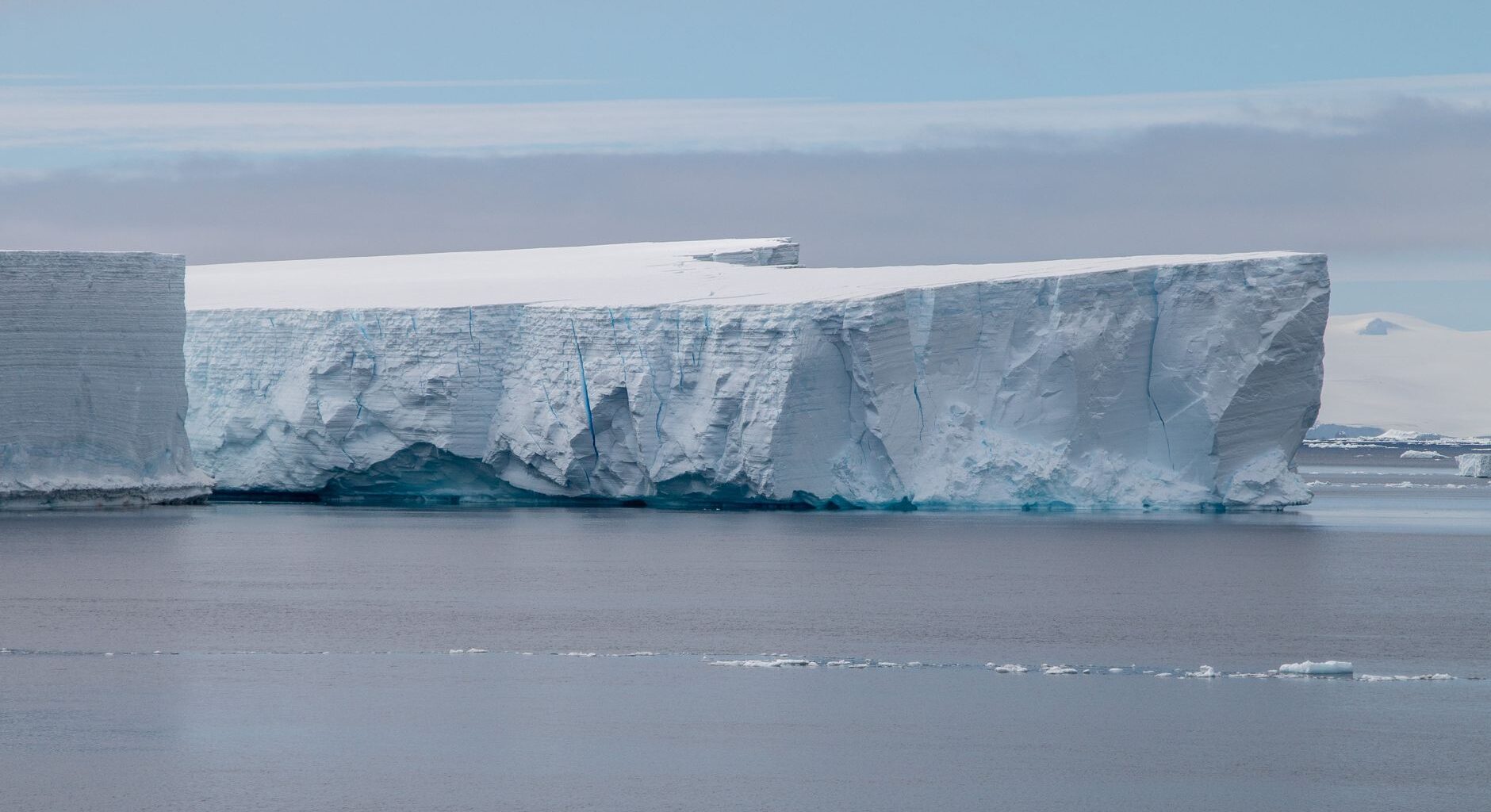
On January 13, 2025, an iceberg later named A-84 broke from the George VI Ice Shelf on the Antarctic Peninsula. NASA Earth Observatory described it as roughly 30 kilometers long and 17 kilometers wide, with an area approaching that of Chicago. For satellite observers, it was a large piece of ice beginning to move quickly along the coast.
For a research ship already working nearby, it was something rarer: a door opening over a seafloor no human team had ever directly explored.
Schmidt Ocean Institute announced on March 20, 2025, that scientists aboard its research vessel Falkor (too) changed their expedition plan after the calving. By January 25, the team had reached the newly exposed seafloor in the Bellingshausen Sea and sent the remotely operated vehicle SuBastian down into an environment that had been sealed under floating ice.
This is one expedition report, not a completed peer-reviewed species inventory. The finding is worth taking seriously, but it should not be read as the final word. Much of the biological work begins after the ship returns, when specimens, imagery and environmental measurements can be analyzed in detail.
A hidden seafloor, suddenly accessible
Iceberg calving is a normal part of ice-shelf behavior. But the timing and location of this event gave researchers an unusual opportunity.
NASA’s February 2025 Earth Observatory note said A-84 had drifted about 250 kilometers from its point of origin between mid-January and mid-February. The iceberg came from near the southern end of the George VI Ice Shelf, a floating glacier attached to the Antarctic Peninsula ice sheet. NASA noted that the George VI shelf has been losing ice over time, though its retreat has been gradual compared with some more dramatic collapses elsewhere on the peninsula.
The newly exposed area mattered because it had been physically inaccessible while the ice shelf covered it. Schmidt Ocean Institute said the calving revealed roughly 510 square kilometers of seafloor, and that the expedition became the first detailed interdisciplinary study of such a large area newly uncovered from beneath a floating ice shelf.
That does not mean nothing was known about life under Antarctic ice shelves. In 2021, British Antarctic Survey researchers reported stationary animals under the Filchner-Ronne Ice Shelf after drilling through ice hundreds of meters thick. But direct, broad-scale exploration with an ROV across a newly exposed landscape is different from seeing a few organisms through a borehole. It gives scientists a way to look at shape, abundance, habitat and community structure across a wider scene.
What SuBastian saw
For eight days, ROV SuBastian observed the deep seafloor, reaching depths as great as 1,300 meters. The images were not of a barren mud plain.
Schmidt Ocean Institute reported flourishing ecosystems of large corals and sponges, with animal life including icefish, giant sea spiders and octopus. One image caption described a large sponge and anemones at nearly 230 meters depth in an area that had very recently been covered by the ice shelf. Another noted an octopus resting on the seafloor at 1,150 meters.
The phrase “forest” is not a formal scientific category here. It is a useful visual shorthand for the way large, upright, filter-feeding animals can structure the seafloor, creating habitat for other organisms. In the same way a coral garden is not a garden in the human sense, a sponge forest is a living three-dimensional community built by animals rather than plants.
The scale of some organisms is part of why the discovery drew attention. Sponges can grow slowly. Schmidt Ocean Institute noted that the size of one specimen suggested the community had been active for decades, perhaps even hundreds of years. Expedition co-chief scientist Patricia Esquete of the University of Aveiro said the observed communities had likely been there for decades, maybe longer.
That is the careful version of the “centuries without sunlight” claim. The ice-covered environment had been cut off from ordinary surface food pathways, and at least some of the animals appear old enough to have persisted there for very long periods. The exact ages and histories of the organisms still need more analysis.
The food problem
The obvious question is how such a community eats.
Most deep-sea ecosystems depend, directly or indirectly, on photosynthesis near the surface. Tiny organisms grow in sunlit water, die, shed material, or are eaten, and some of that organic matter sinks. Over time, this falling material feeds animals on the seafloor.
Under a thick floating ice shelf, that simple picture breaks. Schmidt Ocean Institute said the newly explored ecosystems had been covered by about 150 meters of ice for centuries and cut off from surface nutrients. If sunlight cannot reach the water above the community, the normal rain of locally produced photosynthetic material cannot be the whole answer.
The expedition team suspects that ocean currents may be moving nutrients into the area. Glacial meltwater, water-column circulation, or other processes may also matter. The institute was careful on this point: the precise mechanism fueling the ecosystems is not yet understood.
That uncertainty is scientifically useful. It keeps the discovery from becoming a simple “life finds a way” slogan. The harder question is not whether life is present, but how energy and nutrients are routed through an environment that lacks direct sunlight.
Why it matters beyond one iceberg
The George VI Ice Shelf is part of a wider Antarctic system changing under pressure from warming air and ocean conditions. NASA notes that calving itself is normal, but that warming air and water and reduced protective sea ice can accelerate calving and lead to shelf collapse in vulnerable places.
A newly exposed seafloor is therefore both a discovery site and a baseline.
If researchers can describe the community soon after exposure, they can later ask how it changes once open ocean conditions arrive. Does more surface-derived food reach the seafloor? Do new species colonize? Do long-established under-ice organisms decline? Does sedimentation change? Does meltwater alter chemistry, temperature or circulation?
Those questions are not academic bookkeeping. Ice shelves do not simply sit above the ocean like lids. They shape light, food supply, water movement, sediment delivery and habitat stability. When they retreat, the ecological change is not only at the ice edge. It can extend down to animals living hundreds or thousands of meters below.
What still needs proving
Several tempting claims should be held back.
The expedition suspects it may have found species new to science, but that requires formal taxonomic work. Imagery can reveal form and behavior, but new-species claims need detailed comparison with known organisms, sometimes including anatomy and genetics.
The age of the community also needs careful handling. Large, slow-growing sponges may indicate long persistence, but not every organism in the community is necessarily centuries old. The ice-shelf history, local circulation, larval supply and growth rates all matter.
And while the discovery is linked to a changing Antarctic ice system, one calving event cannot be used by itself as a simple climate proof. The stronger point is more specific: as ice shelves change, they expose environments that have been shielded from direct observation, and those environments may contain older and more complex biological communities than expected.
A living record under the ice
The scene is striking because it reverses the usual way we imagine hidden places. The seafloor beneath the George VI Ice Shelf was not empty space waiting to be revealed. It was already inhabited.
The animals there were not waiting for sunlight. They had been living under a system of darkness, ice, currents and slow growth, with sponges and corals creating structure and other animals moving through it.
That is why the discovery matters. It is not only a catalogue of unusual Antarctic creatures. It is a reminder that some ecosystems are not hidden because they are dead, but because the conditions that sustain them are difficult for us to see.
When A-84 moved away, it gave researchers a rare look at a biological community that had been doing its work beyond daylight. The iceberg made the opening. The seafloor supplied the surprise.
Sources
Produced with AI assistance. Reviewed by the ScienceBlog.com editorial team before publication.