
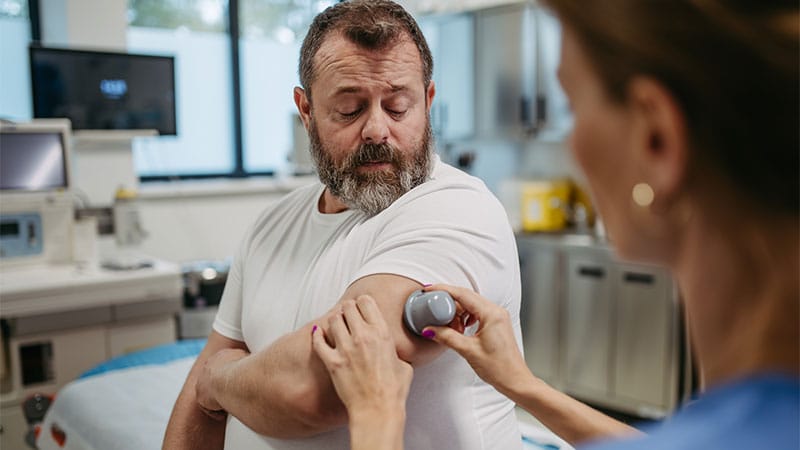
Adults with diabetes who initiated continuous glucose monitoring (CGM) in a primary care setting experienced significant improvements in A1c levels and lower rates of hospitalization and emergency department (ED) visits compared with controls, based on new data.
CGM is now the standard of care recommended by the American Diabetes Association for anyone with insulin-treated diabetes, but CGM adoption in primary care lags well behind the evidence, said Jovan Milosavljevic, MD, MS, an endocrinologist and assistant professor of medicine at Albert Einstein College of Medicine in Bronx, New York. Although most diabetes management occurs in primary care, the impact of introducing CGM in this setting remains unclear, he said.
In a study published in JAMA Network Open, Milosavljevic and colleagues compared data from diabetes patients who initiated CGM in a primary care setting with those who did not. The primary outcomes were changes in A1c levels and rates of hospitalization and ED visits.
The study population included 8502 adults aged 18 years or older with any insulin-treated diabetes who had at least one prescription for insulin and at least one primary care visit between August 1, 2022, and August 1, 2025, at one of 18 primary care clinics within the Montefiore Medical Center Health System.
The mean age of the participants was 62.3 years, and 56.0% were women; 42.6% and 33.6% had Medicare and Medicaid coverage, respectively. Approximately 46% of the patients were Hispanic and 35% were non-Hispanic Black.
Overall, 2392 patients (28.1%) were prescribed CGM by a primary care clinician. These patients tended to have higher baseline A1c levels and more microvascular complications; they also were younger and more likely to be English speakers with commercial insurance.
After 12 months, patients who initiated CGM in primary care had greater decreases in A1c levels than control participants, with a mean change of 0.66 percentage points (95% CI, 0.57-0.75) vs 0.17 percentage points (95% CI, 0.08-0.27) and a between-group difference of -0.49 percentage points (95% CI, -0.62 to -0.35).
Initiation of CGM in primary care also was associated with a 13% reduction in risk for recurrent all-cause hospitalizations (hazard ratio [HR], 0.87; 95% CI, 0.77- 0.98) and an 18% lower risk for recurrent ED visits (HR, 0.82; 95% CI, 0.74-0.91).
Although initiation of CGM in primary care remains modest (28.1% of eligible patients in this study), it is an improvement over findings from a previous study in which 17% of diabetes patients received prescriptions for CGM in primary care, the researchers noted.
The findings were limited by several factors including the use of electronic health records and the potential for residual confounding, as well as the use of CGM prescriptions rather than confirmed device use to define exposure.
However, the results support greater adoption of CGM in primary care settings as a way to expand access to diabetes management technology and reduce healthcare costs, especially in underserved and ethnically diverse populations, the researchers noted. Additional research is needed to develop strategies to increase CGM initiation, including clinician training and patient education, they concluded.
The positive impact of CGM is well known in endocrinology settings, and the similarly positive effects with initiation in primary care were not unexpected, said Milosavljevic.
“What stood out was the magnitude and durability; the HbA1c improvements were clinically meaningful and sustained through 2 years,” he said. “Most striking to us was that patients managed entirely within primary care, with no endocrinology involvement, achieved outcomes comparable to the overall cohort, which challenges the assumption that CGM initiation belongs mainly in specialist care,” he added.
More Data, Better Decisions
“Before CGMs, we often made decisions based on a single number representing one moment in time, and only when the patient came in,” said Milosavljevic. “CGMs let clinicians review data at the visit and remotely in between visits, which leads to more informed conversations and timely treatment changes. At a large scale, CGM can function as a population health tool,” he said.
More research is needed to determine the optimal implementation model to increase CGM adoption in primary care, said Milosavljevic. In a network-wide initiative being implemented at Montefiore Einstein, clinicians are trained in CGM prescribing and management, nurses are trained to apply and troubleshoot devices in clinic, and patients help co-design how CGM support is built, he said.
With diabetes rates continuing to rise and a growing shortage of endocrinologists, most diabetes care happens in the primary care physician’s office. Concrete data showing that CGM works in primary care is critical to increasing uptake and encouraging payers to cover these devices, said Milosavljevic.
Potential for Changes in Practice
The magnitude of reduction in ED visits and hospitalizations in people using CGMs in the new study was surprising, said Tyler Ryan, MD, an endocrinologist at NewYork-Presbyterian Hospital, Cornell Campus, New York City.
“Similarly impressive was that these findings held even among patients who did not see an endocrinologist, which suggests that investing in CGM care pathways is worthwhile for small and large health systems,” said Ryan, who was not involved in the study.
The new study suggests that primary care providers should feel confident that initiating CGMs in their practice will improve diabetes outcomes in their patients, he said. “Initiating CGM doesn’t require specialty-level expertise to be effective, and primary care providers need not wait to place CGMs before the patient can see endocrinology; rather, starting CGM early will accelerate the timeline to improved glycemic control,” he emphasized.
Barriers to CGM initiation in primary care persist and contribute to relatively low uptake, including time constraints during visits, unfamiliarity with device setup, and lack of established workflows for CGM education, Ryan noted. “Incorporating diabetes educators, pharmacists, and nursing into the CGM placement and education workflow will reduce the activation barrier and allow busy PCPs [primary care physicians] to focus on diabetes management,” he said.
Prospective studies that pair confirmed device usage, not only prescription information, with outcomes would sharpen the effect estimates, since prescription-based exposure likely underestimates the true benefit, Ryan said. “In addition, the study does not say why HbA1c and ED visits/hospitalizations decreased, and although patient empowerment and better glycemic data likely played major roles, qualitative studies showcasing patient and provider perspectives in CGM use would likely clarify this association,” he added.
The study was supported by the American Diabetes Association and the National Center for Advancing Translational Sciences, National Institutes of Health. Disclosure information for the authors is available in the original study publication. Ryan had no financial conflicts to disclose.