
My tour of the birthplace is full of the kind of detail that collapses the space between history and adaptation. A life-size cut-out of Jacob Elordi has become a particular favourite of Mark’s, he explains. Hidden behind doors, the 6′4 heartthrob is perfect for startling unsuspecting guests – an apparition many would perhaps long to encounter at the end of a dark corridor.
At curry house El Manzil, a few doors down, I marvel at the unique ways locals have reinvented the family’s legacy. Anna had described the sisters as “yassified”, and looking at their affectionately irreverent depictions on the menu, I’m inclined to agree.
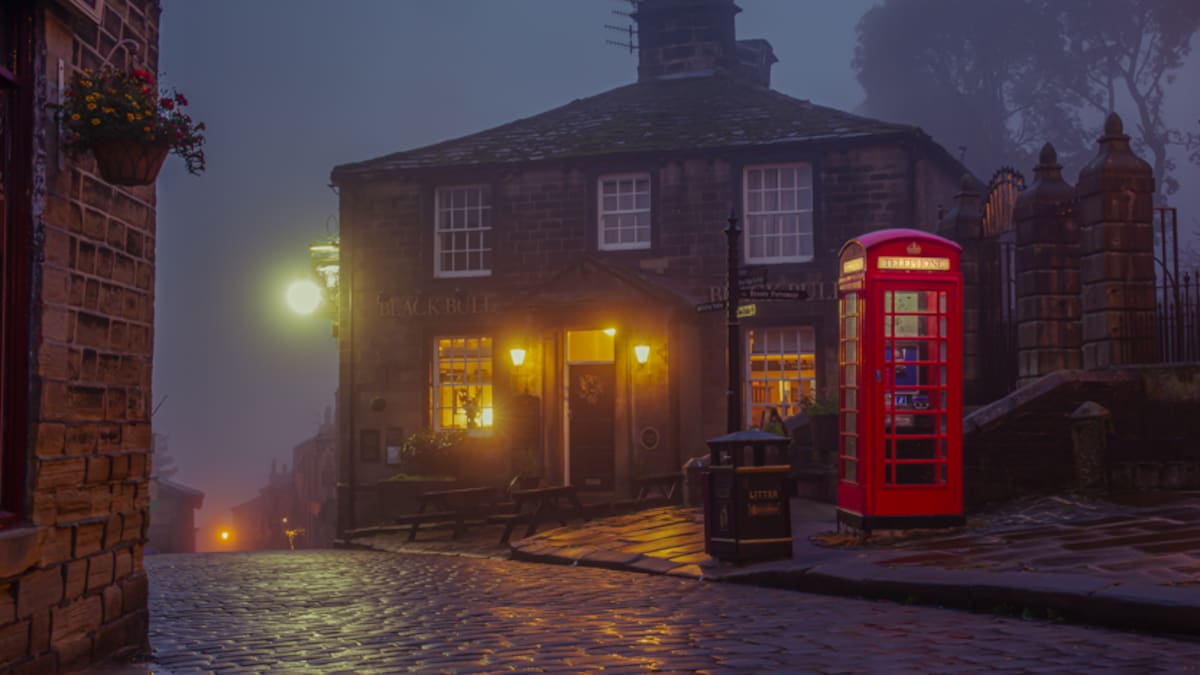
Located 10km northwest of Thornton is Haworth. Shrouded in a careful negotiation between Gothic romanticism and ordinary village life. In describing the town as quaint, I risk underselling it. The cobblestone streets and preserved shopfronts are both atmospheric and startlingly lived-in.
Haworth, Yorkshire. Photo / Imogene Bedford
On a springtime Saturday morning, it’s bustling with day-trippers and locals in hair rollers, and a craft fair is being held in the old parsonage. I buy a merino beret and gloves for £13 (NZ$30) in a vague attempt to look as though I belong here, to no avail.
The Brontë Parsonage Museum is meticulously laid out with artifacts and scholarship in every room, each object arranged with a care that humanises three women who have become mythic figures.
Unique exhibitions, like Layla Khoo’s recreation of the manuscript for Wuthering Heights, showcase the collective storytelling that keeps their memory alive. Each sentence of the novel is in the hand of a different person who felt tethered to someone long dead, an example of how literature builds an unlikely intimacy between strangers.
Jacob Elordi at the Brontë Birthplace, Yorkshire. Photo / Imogene Bedford
The cemetery next to the parsonage has an eerie kind of beauty, the headstones unevenly reclaimed by the earth. Several members of the family are buried in a vault beneath St Michael and All Angel’s Church, below where patriarch Patrick would have given sermons to the village.
Lunch at the Haworth Old Post Office is a highlight, offering refined dining in a building that still feels somewhat like it has letters to sort. The original counter has been kept, and the owners are kind enough to show me the Victorian cash drawer; its century-old compartments still intact.
The Moors, Yorkshire. Photo / Imogene Bedford
Salomon’s weren’t launched until 1947, so I set off in boots and a long skirt to maintain historical accuracy. Trudging along through the brush, the idea wanes slightly in romanticism, replaced by the more immediate feeling that Victorian women were much hardier than I, and probably cold most of the time.
For Kiwis, the scenery of the north is not altogether unfamiliar: sloping banks of green teem with livestock, patchwork farmland that at times resembles Waikato. But this, of course, doesn’t make the moorland any less breathtaking.
Mossy, jagged rocks and dry-stone walls cut through the hillsides, some engraved with words that aren’t fit for publication. It somehow deepens the historic character of the whole walk, like the landscape itself has become an archive over time.
Haworth, Yorkshire. Photo / Imogene Bedford
The Keighley and Worth Railway offers its own panoramic views of the countryside, the standing corridors packed with visitors jostling for the best window position. As we loop around, trackside onlookers film the vintage carriage, a continuation of the British infatuation with trains, I find both endearing and inexplicable.
Later that evening, I indulge another English obsession – Spain – by ordering a tapas selection at Pave, where locals balance sangrias al fresco. People pass and chat throughout the village, the narrow streets assuming renewed energy as dusk falls.
Parting with the birthplace itself is more difficult than I expected, despite a fair few more bumps in the night. I get the sense I, like so many before me, have left my own mark here without even realising it. Yet, I have further afield to go. The Dales await.
Low Row, Yorkshire. Photo / Imogene Bedford
Emerald Fennell’s adaptation of the iconic novel is already at the centre of many of the area’s visitor attractions. I stop at Dales Bike Centre on the drive, a popular cafe that is said to have been a favourite of Margot Robbie’s during filming. The flat white does not need the celebrity endorsement.
Driving along winding roads listening to The Sundays and Kate Bush, you can easily imagine what inspired Emily to conceive of the feral attachment between Cathy and Heathcliff. It’s the sort of imagery a picture really can’t appropriately capture, a loneliness to the landscape that builds almost oppressively.
These desolate stretches offer their own kind of peace, occasionally breaking out into valleys where scattered townships lie quietly. Stone houses are usually named rather than numbered, lending even the smallest villages a fairy tale quality. In Hawes and Hardraw, alpine hikes are the main event, though inns and teashops offer shelter from the bracing winds.
The Green Dragon Inn, Yorkshire Dales. Photo / Imogene Bedford
Sunday roast at the Green Dragon Inn marks my first ever encounter with Yorkshire pudding, and the close of another day spent romanticising a climate that really only seems suited to the English countryside.
Yorkshire hospitality makes up for the temperature in warmth, each sentence punctuated with a casual “love”. Inside the pub, low timber beams and a roaring fireplace make me feel ever so briefly as if I have been transported into something between Game of Thrones and a cosy period drama.
That sense of cinematic escapism lingers beyond the building’s walls. Behind the inn, a few pounds will get you a view of the Hardraw Force waterfall, itself featured in Robin Hood: The Prince of Thieves. But unlike Hood and his Merry Men, I have the luxury of a freestanding golden tub to return to.
Hardraw Force, Yorkshire. Photo / Imogene Bedford
The north has charmed me, despite, or perhaps because of, the macabre atmosphere so carefully curated by the Brontës across their combined works. Travelling back into the Midlands, I find myself mourning it already.
The moors receding behind me, for a moment, it feels like the landscape is just as reluctant to let me go – a spectre that lingers long after it disappears in the rearview.
Checklist
UK
GETTING THERE
Fly from Auckland to Manchester with one stopover with multiple airlines, including Emirates, Cathay Pacific and Singapore Airlines.
The drive time from Manchester Airport to Thornton is about one hour, or trains will get you from Manchester Victoria Train Station to Bradford Interchange in 50 minutes.
DETAILS
visitbritain.com/en
The journalist travelled courtesy of Visit Britain.