
There was “no evidence” the Muslim man was radicalised when he came to New Zealand in 2011, the coroner said, nor during his early years in the country.
The inquest would address whether Samsudeen’s years in custody, and months in segregation, had affected his radicalisation. It would also canvass whether he was getting the appropriate mental health, religious and cultural support while in prison, the coroner said.
Samsudeen claimed refugee status after arriving in New Zealand from Sri Lanka and was granted permanent residency in 2014, the court heard.
The coroner said the man was identified for his “violent extremism” by March 2016 “at the latest” and the following year he was arrested, charged and remanded in custody.
He remained in prison on remand for four years, including 17 months in segregation, before he was found guilty on two charges of possessing objectionable publications, namely Islamic State propaganda and violent religious hymns, in 2021.
He was given a community-based sentence and released in July 2021.
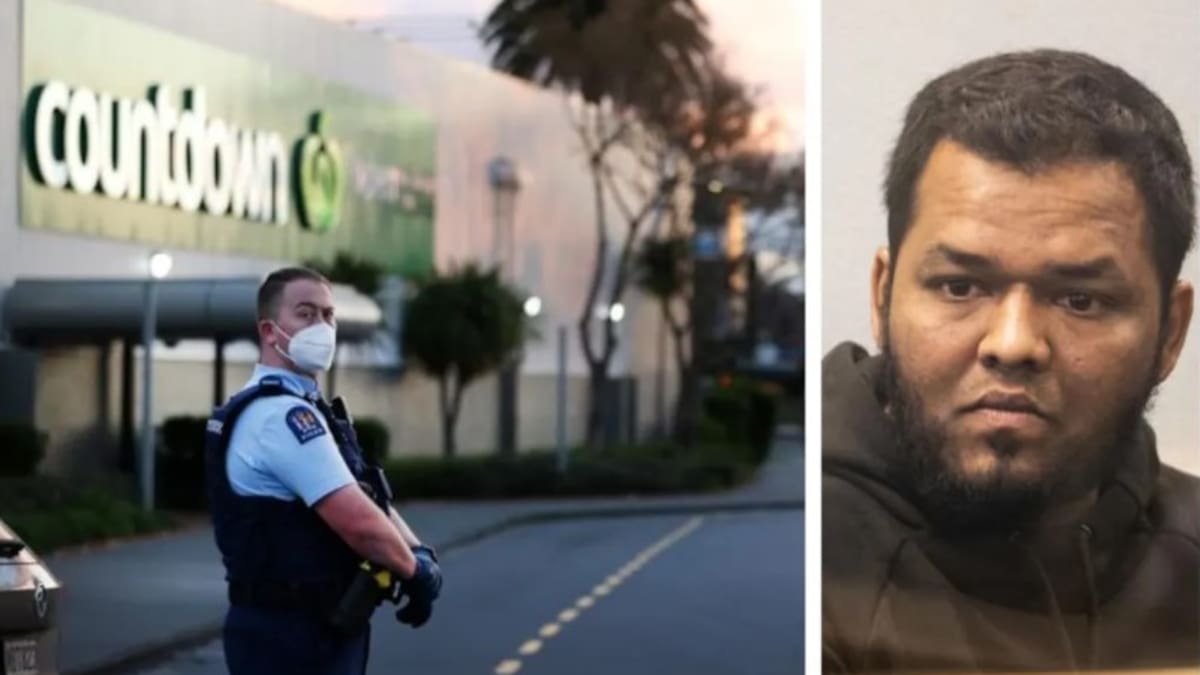
Seven weeks after being released into the community, on September 3, 2021, Samsudeen carried out a knife attack in West Auckland’s Lynnmall Countdown supermarket.
Emergency services rush a victim to an ambulance after the September 2021 attack. Photo / Alex Burton
Another important aspect to be examined by the inquest, the coroner said, was the man’s attitudes towards women before the attack, and his mental health.
The coroner disclosed that after his release from prison, Samsudeen had acted inappropriately towards a female police officer and lawyer, including “distressing” instances of stalking and harassment.
The inquest was again to see if these factors were noticeable by the relevant government agencies and community members at the time, and whether that should have graded Samsudeen as a higher risk to the public.
Ahamed Samsudeen in the High Court at Auckland in 2018. Photo / Greg Bowker
His probation officer
The first witness at today’s hearing was Samsudeen’s probation officer, whose name and identity is suppressed.
As Samsudeen was seen as high risk, the probation officer said he first met with the man months before his prison release to build trust and a good rapport.
Before this he had done a “thorough” review of the man’s prison case file, which showed that when first incarcerated, Samsudeen was “polite and respectful” to prison staff.
However, by the time the probation officer visited him in prison, he said the man’s behaviour had “drastically changed”, including reports of him being verbally abusive to Corrections officers, throwing urine and faeces at them and using racial slurs.
He said the first meeting went well for about 10-15 minutes but he could feel “tension building” as he sensed Samsudeen didn’t trust him.
When they began to talk about prison release conditions, the man started angrily pacing, kicking the door and the meeting was cut short, the probation officer said.
While he didn’t meet with Samsudeen for some months, the probation officer said he spent his time finding a place for the man to live and an appropriate imam, or religious leader, for his release.
He found an Auckland mosque Samsudeen could stay in and introduced the man to the mosque’s chairperson in June.
Upon Samsudeen’s release, the probation officer described his team’s management of him as “intensive”.
“He was my entire caseload,” the probation officer said.
But it became clear the man was demanding and difficult, he said, and the use of electronics was his main focus.
Part of the man’s sentence conditions was that he undergo a psychological assessment, but the probation officer said Samsudeen continued to make excuses to put off meeting with a Corrections staff psychologist.
In mid-July 2021, Samsudeen was given a phone with internet access but a month later, he was denied further internet devices as he was wiping his phone history before it was checked by police.
On September 1, 2021, the probation officer learned the man had been ordered not to associate with a female police officer.
Two days later, on September 3, on the morning of the attack, the probation officer said Samsudeen rang him about another non-association order made against him, this time in the name of his female lawyer, whose identity is suppressed.
In retrospect, the probation officer said Corrections had “completely changed its approach” when dealing with Muslim prisoners and/or offenders since the supermarket terror attack.
He said he knew of a few individuals across New Zealand who had been similarly influenced by Islamic State and “grievances” in their home countries, who had become “success stories”.
In those cases, he said family involvement and psychologists played a huge role in that success.
Coroner Marcus Elliott at the first stage of the Samsudeen inquest in 2025. Photo / Michael Craig
Time to ‘settle down’
The probation officer was questioned by the lawyer Fletcher Pilditch, KC, who was working in the interests of Samsudeen’s family.
He queried why the probation officer hadn’t met with the man more regularly, both before and after his release, given he was trying to build trust and a rapport with him.
The probation officer said that after the first meeting didn’t go well, it was “probably” a decision of his managers that he delay meeting with Samsudeen in prison again until June 2021, to give time for Samsudeen to “settle down”.
Pilditch asked why Samsudeen, upon release, only reported to the probation officer in person fortnightly, and by phone every other week, and whether that was enough “face-to-face” contact to “build trust”.
The probation officer said the “amount of hostility” Samsudeen showed in their meetings meant there was “no use” in them meeting more frequently.
Pilditch also asked if Samsudeen was showing any evidence of mental illness during those meetings, to which the probation officer replied he wasn’t, apart from his “heightened state” of hostility and intimidation.
The lawyer also pointed out that the probation officer could have ordered Samsudeen to see a psychologist, as per the man’s court-ordered sentence conditions.
But the probation officer explained that their staff psychologists wanted “consent” from Samsudeen to assess him, and that there was no point in assessing a person who was not willing.
The inquest continues.
Ella Scott-Fleming has been a journalist for three years and previously worked at the Otago Daily Times, Gore Ensign and Metro Magazine. She has an interest in court and general reporting. She’s currently based in Auckland covering justice related stories.