

Prominent Australian economist Saul Eslake declared on Sky News last Monday that “the OECD has shown that Australia has had the highest core inflation rate of all but one of the 38 members of the OECD.”
He was apparently commenting on that day’s news release from the Organisation for Economic Cooperation and Development (OECD) titled CONSUMER INDEX, 6 July 2026.
With his usual confidence Eslake criticised the Australian Reserve Bank’s management of interest rates and the Albanese Labor Government’s first home buyers scheme, adding a gratuitous reference to a budget measure renegotiated after last year’s Economic Roundtable as a “broken promise”.
But here’s the thing. The OECD report did not say what Eslake claimed. It showed Australia’s core inflation – all CPI items excluding food and energy – at 3.5%. It also showed Belgium’s at 4.1%, Mexico’s at 4.3%, Lithuania’s at 4.6%, Colombia’s at 6.5%, Iceland’s at 6.7% and Turkiye’s at a punishing 30.6%. Australia is not second bottom. Nowhere near.
The implication – that Australia’s economic management is deficient – is therefore not supported.
So how did this arise? Did the economist not read the OECD document, but rely on the mendacious report the day before in the Australian Financial Review (AFR)? Or did he trust a copycat fabricated story in the Murdoch media that morning? Or did he concoct the false narrative himself in compliance with Sky News’ editorial policy of only ever broadcasting economic “news” damaging to Labor?
We don’t know because our requests for an explanation went unanswered.
Malicious falsehoods nationwide
All the newsrooms these days fall over each other trying to replicate every false story any one of them creates. This happened with the dire threats of recession in January and February, anxiety in March and April over interest rates when they were smack in the middle of the optimum band, hyperventilating over the May budget, warning it would inevitably cause house prices to rise and simultaneously to fall – and now core inflation.
Headlines last week included:
‘Australia has had the highest core inflation rate out of all but one of the OECD members’ (Sky News, 6 July)
‘Australia’s core inflation now second highest in world, expert blames spending’ (news.com.au, 6 July)
‘Shock inflation ranking. Australia becomes international outlier’ (Nine News, 6 July)
‘Australia’s inflation among highest in world’ (Yahoo Finance, 6 July)
The AFR fake chart
This latest spate of blatant lies appears to have started with an AFR article by Michael Read headed, ‘Australia tops inflation rankings among all major developed economies’. This claimed ‘Australia has become an international inflation outlier’ with ‘the equal-highest core inflation rate among major developed economies and the second-highest across all advanced economies, behind only Iceland …’
He included this chart to illustrate the concept he wanted readers to swallow:
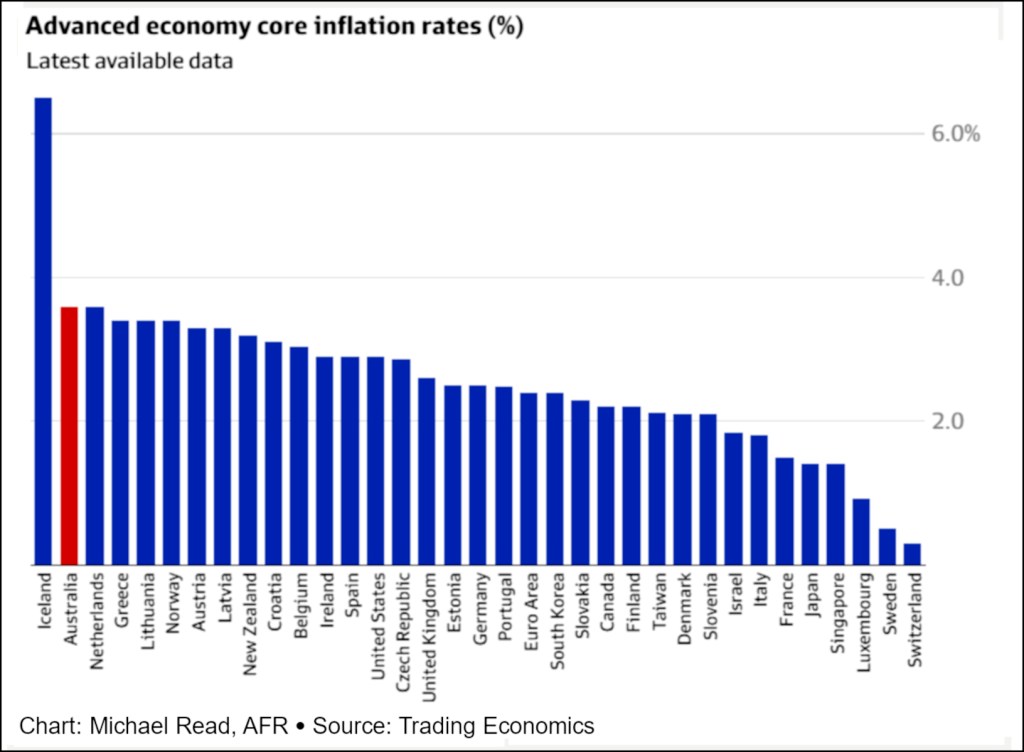 Chart: Australian Financial Review
The obvious ruse is selecting an arbitrary group of 34 economies plus the Euro Area and claiming they are all comparable. It left out seven OECD members and many other advanced economies.
Disturbingly, it used May data for some countries (Australia, Luxembourg, Netherlands) but June for others (Belgium, Portugal, Spain) – when commodity prices were different.
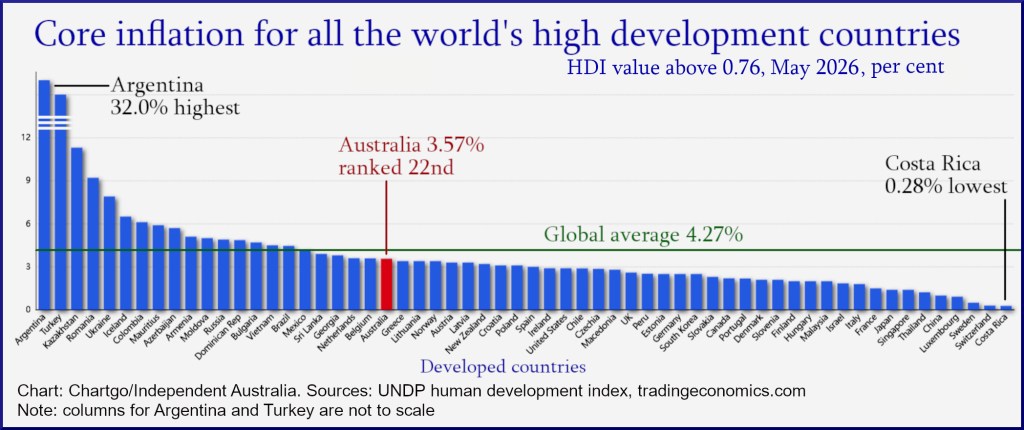
A far more valid exercise is to compare all advanced economies, those with UNDP human development index numbers above 0.76, for which core inflation numbers for May are published at tradingeconomics.com.
There are sixty of these, ranging from Costa Rica with just 0.28% to Argentina with 32.0%. See chart below.
 Courtesy: Independent Australia
Unfortunately, country names are difficult to read on this chart, but that’s not important. What matters is Australia is not second worst. Its core inflation of 3.57% ranks 22nd, below the average of 4.27%.
The AFR article went on to claim falsely that Australia is still in a cost-of-living crisis, and inflation is uncontrolled. They want us to forget inflation was above 10% for much of the time the right wing Coalition was in office in the 1980s.
The article ended with another economist, John Simon, not just implying Australia’s inflation is excessive but actually saying “What’s been experienced in Australia is not a global phenomenon.”
The actual data – which economists called upon by the lying newsrooms seem reluctant to access – shows Australia’s inflation is indeed global and not an outlier.
ABC News changes its tune
In a surprising bright spot last week, the ABC’s business reporter Alan Kohler did a full 180 degree turn and announced that Australia is not heading for a recession after all. The economy is so strong, in fact, it needs dampening:
“Economic growth is a solid if unexciting 2.5 per cent, job growth is reasonably strong and unemployment is down … Inflation is coming down, consumer spending is growing … In fact, the economy is doing so well the Reserve Bank has been raising interest rates to slow it down.”
This is most welcome, as just last month this column counted Kohler among the “shonks and charlatans” in the newsrooms who had issued ridiculous warnings of an imminent recession.
Let’s hope his colleagues join him. They have some catching up to do, however, with Gareth Hutchens recently bewailing a slowing economy, and getting a KPMG senior economist to insist things are ‘worse now than they were almost four decades ago.’
Absolute nonsense! But public economists know Australia’s newsrooms want destructive falsehoods and that’s what they seem happy to deliver.
*
This is a slightly edited version of an article published earlier today in Independent Australia. The original article is available here in full for free: