
The Late Ordovician extinction, close to the Ordovician-Silurian boundary about 443 million years ago, is usually read as a two-part marine crisis rather than a single blow. The first pulse is commonly tied to rapid cooling, Gondwanan glaciation and a fall in sea level. The second is commonly tied to the end of that icehouse interval, when warming seas and oxygen-poor water hit many of the survivors.
That broad outline is well supported, but the details are still argued over. A recent synthesis by Christian Rasmussen and colleagues in National Science Review describes the Late Ordovician mass extinction as a crisis of earth, fire and ice, with climate change, sea-level movement, ocean chemistry and possible volcanic forcing all under discussion. The useful point is not that one switch flipped. It is that two different environmental states seem to have been deadly in different ways.
The first pulse came with cooling
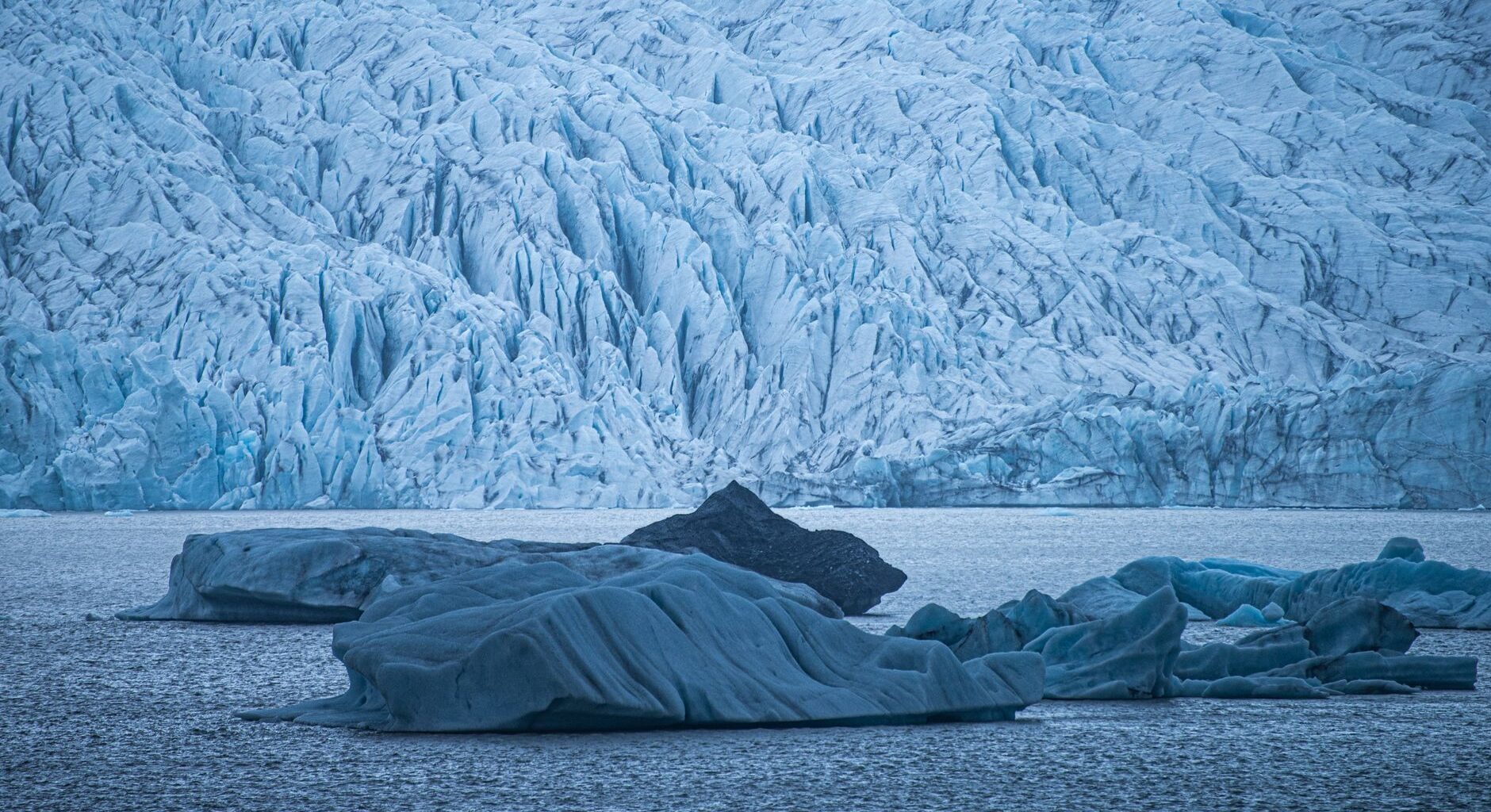
The first extinction pulse occurred as Earth moved into one of the sharpest glacial intervals of the Phanerozoic, the roughly 541-million-year span of abundant animal fossils. Gondwana, then positioned across the South Pole, developed major ice sheets. As water was locked into land ice, sea level fell and shallow marine habitats contracted.
That matters because Ordovician life was overwhelmingly marine. Much of the diversity lived in shallow seas spread across continental shelves and inland seaways. When those seas drained back, whole habitats were removed. In a Nature Geoscience study led by Erin Saupe, climate and species simulations supported the idea that Late Ordovician extinction intensity was partly explained by exceptionally rapid and severe cooling, combined with the geography of the continents at the time.
The geography is not a minor detail. The same amount of cooling does not produce the same biological outcome on every version of Earth. If species are distributed along coastlines and shallow platforms in a way that leaves them few places to track their preferred temperatures, climate change becomes more dangerous.
Sea level did some of the killing
The simplest version of the first pulse is that cold killed warm-adapted organisms. That is partly right, but it is incomplete. The loss of sea area may have been just as important as the temperature itself.
In a 2012 Proceedings of the National Academy of Sciences paper, Seth Finnegan and colleagues found that the Late Ordovician extinction had a selective climate signal. The study linked extinction risk to temperature change and habitat loss, rather than treating the event as an indiscriminate crash across marine life.
This is why the phrase “sea levels collapsed” needs to be read literally. It does not mean a few coastlines shifted. It means shallow seas that had supported large communities became smaller, colder or exposed. For animals tied to particular shelf settings, there may have been nowhere equivalent to go.
The second pulse was not more of the same
The second pulse came as the glaciation waned. Ice retreated, sea level rose, and warmer conditions returned. That sounds like relief, but the fossil and geochemical record points to a different kind of stress: oceans with too little oxygen, and in some settings, sulfide-rich water.
Emma Hammarlund and colleagues argued in a 2012 Earth and Planetary Science Letters paper that sulfidic conditions were an important driver of the end-Ordovician extinction. In this reading, the later crisis was linked not to cold water removing habitat, but to expanding low-oxygen and sulfide-bearing marine environments.
Anoxia means seawater lacks enough dissolved oxygen for many animals to survive. Euxinia is more severe: oxygen-poor water contains hydrogen sulfide, a toxic compound produced by microbial processes under certain conditions. These are not abstract chemical labels. They describe water columns where many animals cannot breathe, feed or reproduce normally.
Why warming seas can lose oxygen
Warm water holds less dissolved oxygen than cold water. Warming can also strengthen layering in the ocean, reducing the mixing that brings oxygen from the surface into deeper waters. If nutrients increase at the same time, microbial decay of organic matter can consume still more oxygen.
That combination helps explain why deglaciation could be dangerous. A rising sea can restore shelf area, but if parts of that shelf are flooded by oxygen-poor water, the new habitat is not necessarily habitable. Several studies have treated the late Hirnantian and earliest Silurian as a time when black shales and geochemical markers record expanded anoxia, including a Geological Society of America Bulletin review by Michael Melchin and colleagues on environmental changes in the Late Ordovician to Early Silurian.
In plain terms, the first pulse narrowed the living space through cold and falling seas. The second brought some of the water back, but not always with the oxygen that animals needed.
What survived the cold did not necessarily survive the rebound
The two-pulse structure helps explain why survival in the first phase did not guarantee survival in the second. Cold-adapted communities could expand during the glacial interval, only to be stressed when warming, sea-level rise and low-oxygen conditions followed. That is why the Late Ordovician extinction is often described as a climate reversal crisis: the biosphere was hit first by one extreme and then by another.
The scale was large. Species-level estimates are necessarily uncertain because the fossil record is uneven, but summaries often place marine species losses near 85 percent. Genus and family counts are more robust, and they still put the event among the largest mass extinctions in the history of animal life.
One important caution is that researchers do not all draw the same boundaries around the pulses. Some work emphasizes two main intervals. Some argues for a more prolonged second phase extending into the earliest Silurian. Some studies give more weight to volcanic activity, metals or nutrient cycling. The cold-then-anoxic framing is a strong summary, not a finished map of every mechanism.
The unsettling part is the speed of the swing
The Late Ordovician extinction is sometimes treated as unusual because one part of it was linked to cooling, while several other mass extinctions are more strongly associated with warming. That contrast is real, but it can obscure the larger lesson. The danger was not only the direction of climate change. It was the speed and scale of environmental disruption, and the way climate, sea level and ocean chemistry moved together.
A marine animal adapted to warm shallow water could be squeezed by cooling and falling seas. A cold-interval survivor could then be caught by warming, rising seas and oxygen loss. In both cases, the problem was not change in one variable. It was the rearrangement of the whole place the animal lived.
The Late Ordovician record does not give a simple moral. It shows a biosphere surviving one climate shock and then meeting another, with the ocean itself changing character between the two.
Produced with AI assistance. Reviewed by the ScienceBlog.com editorial team before publication.