
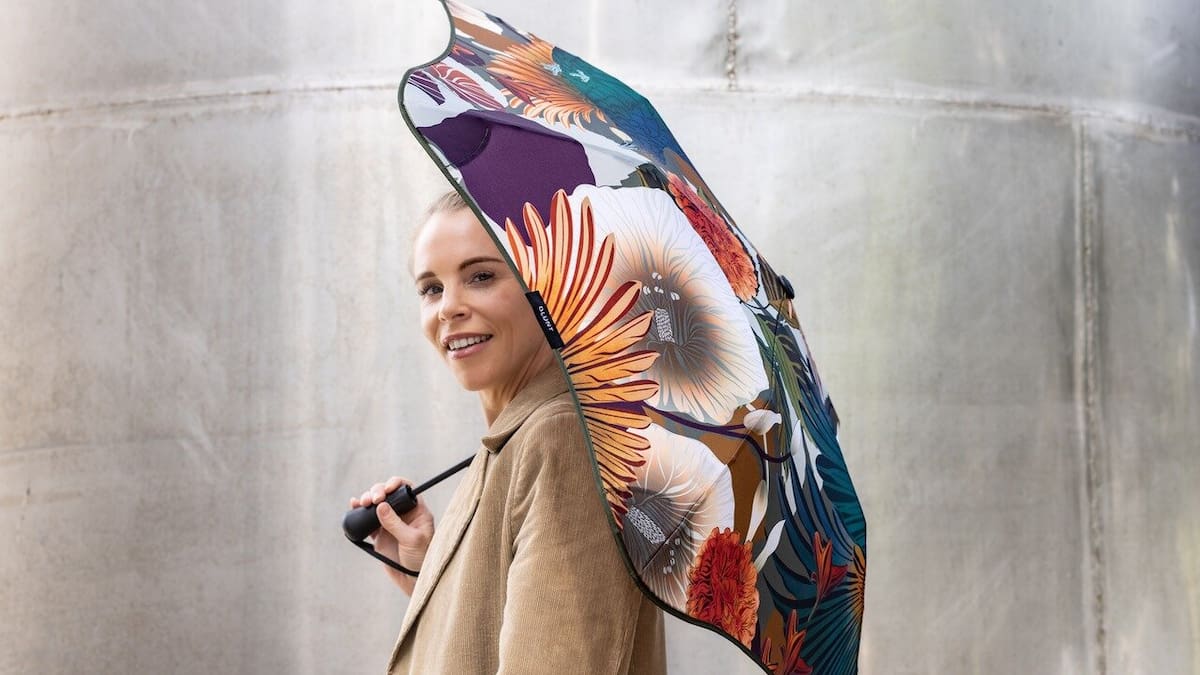
New Zealand-founded brand Blunt marks 20 years with a new global HQ and fresh vision.
After what feels like Auckland’s driest start to winter, it’s apt that when I leave to meet Blunt umbrellas founder Greig Brebner at the brand’s new Epsom HQ a slow drizzle begins to kick in.
The brand turns 20 this year and the stylish new base is an immersive experience that Brebner likens to entering a modern maker’s space. It’s a definite step up from its previous, much smaller spot in neighbouring Newmarket.
“Moving here felt like leaving a flat and finally buying our first house,” Brebner says. “We’ve grown up, and like many adults, now have a mortgage and a lot more responsibilities.”
Blunt umbrellas founder Greig Brebner.
Blunt was founded by Brebner after a moment of clarity on the streets of London in 1999. Surrounded by a sea of half-broken umbrellas – spokes bent, metal tips protruding at eye level – the engineer didn’t just see a flawed product.
“When you’re in a new environment your brain kicks up a few gears,” he says, “and walking in the rain I thought ‘how can these things be allowed?’ They are so dangerous, especially if you’re a bit taller, like me. The energy I spent trying to navigate a sea of spikes just made me think there had to be a better way.”
He saw an opportunity to do something nobody had bothered to do properly in 100 years. What followed was four years of obsessive development, a fundamental rethinking of how an umbrella is engineered, and a patented technology that changed the category.
As it celebrates its 20th year in business, Blunt umbrellas has a new global HQ in Epsom.
“The umbrella as a product had lost its way, it was all about trying to make them cheaper and faster, then when they break you just throw them away,” he says. “I knew I could elevate the experience and make it a really enjoyable product to use.”
He says the team didn’t really know what they were doing in the early days, “but we knew what we wanted to do”.
In addition to making the umbrella tips less dangerous by rounding the ends, the umbrellas are engineered to provide greater tension and strength, resulting in better wind resistance and a lower chance of turning inside out. They’re also designed to be repairable, with the canopy, frame, shaft and handle all able to be replaced.
Greig Brebner says he wanted to make umbrellas an enjoyable product to use.
Back in New Zealand, the first run of 200 sold well, “but we still didn’t know what we were doing. The design was good but the quality not so great. It was a tough lesson, but it validated the market and that people were willing to pay for a well-designed umbrella”.
Now, Blunt is sold in more than 30 countries and there have been more than 2 million umbrellas sold in the company’s 20 year history.
With a price point between $129 and $229, Brebner says some people were initially put off, and sometimes still are.
“That’s why brand awareness and word of mouth became so important for us. We’re not a luxury item but we are premium, and once they know how good we are they are willing to commit.”
The art of collaboration has been instrumental in getting that brand awareness out, and Brebner is the first to admit he and his team aren’t “fashion people, we’re engineers first and foremost. And we knew we had to partner with the right people to bring that element of the brand to life”.
Fashion designer Karen Walker was Blunt’s first collaboration partner.
Designer Karen Walker was Blunt’s first partner in 2015, “and before that we’d tried a few different designs, but they had never really made an impact. She taught us so much”.
It was also an organic relationship, with the idea sparked by an interview the team had read in which Walker confessed to owning seven Blunt umbrellas.
The company’s five collaborative designs with Auckland artist Flox (Hayley King) have been successful, as well as its partnerships with Forest & Bird and Graham Tipene, a Tā Moko artist of Ngāti Whātua, Ngāti Kahu, Ngāti Hine, Ngāti Hauā, and Ngāti Manu descent.
Brebner lists the design created with Tipene as one of his favourites. “It just blew our socks off,” he says. “They flew out the door in three hours. Completely sold out.”
Graham Tipene, a Tā Moko artist, collaborated with NZ umbrella brand Blunt after winning a design competition at the 2023 Best Design Awards.
The collaboration was an organic one, after the artist arrived at the Best Design Awards (where he had previously been a judge) and found an A5 sheet of paper with a blank umbrella template had been given to every guest. Blunt had asked anyone interested to create their own design, with the top picks announced at the end of the night.
“I sat there and drew all night,” Tipene says. Four of his designs were named in the top six, one of which was declared the winner.
Blunt was keen to further the relationship, so last year Tipene worked with the team to create a limited edition design to be released for Matariki. Tipene’s daughter Te Ngakau Mahaki was responsible for the inspiration behind the final design and facilitating the process, adding another collaborative element at whānau level.
Takaparawhau Bastion Point is essentially the artist’s backyard, “and she told me [she] wanted to talk about the sunrise seen here, and the light off the water”.
“It was really her vision, which I then brought to life,” Tipene says of the design.
King says she has appreciated the trust Blunt has placed in her over the years. The original brief for each design is relatively open, she says, “which gives me the freedom to explore ideas that feel authentic to my practice”.
“Of course there are always practical considerations when you’re designing for a product, but creatively I was encouraged to bring my own visual language to the table. That trust is a big part of why the partnership has endured over multiple collections.”
She says each Blunt collaboration becomes a little time capsule, “capturing where I was creatively at that particular moment, and together they tell a story of how both brands have evolved over the years. What began as a single collaboration has evolved into an ongoing creative relationship, which is quite rare and something I feel very grateful for”.
The new global HQ for Blunt, which has used collaborations to help raise brand awareness.
Artist Karl Maughan’s recent sold-out collaboration came from a design drawn from his work Rawhiti Terrace (2018).
“It was a really fun process and the end result was incredible… I love it when someone comes to me with a really great idea as when it is a great idea, it’s always going to work,” he says.
More New Zealand success stories