
For the first time, researchers have identified an ancient Maya mathematician by name after decoding a painted wall text from the archaeological site of Xultun in northeastern Guatemala. The finding links a mathematical formula to an individual named Sak Tahn Waax, giving historians the first direct evidence of a Classic Maya scholar claiming credit for scientific work.
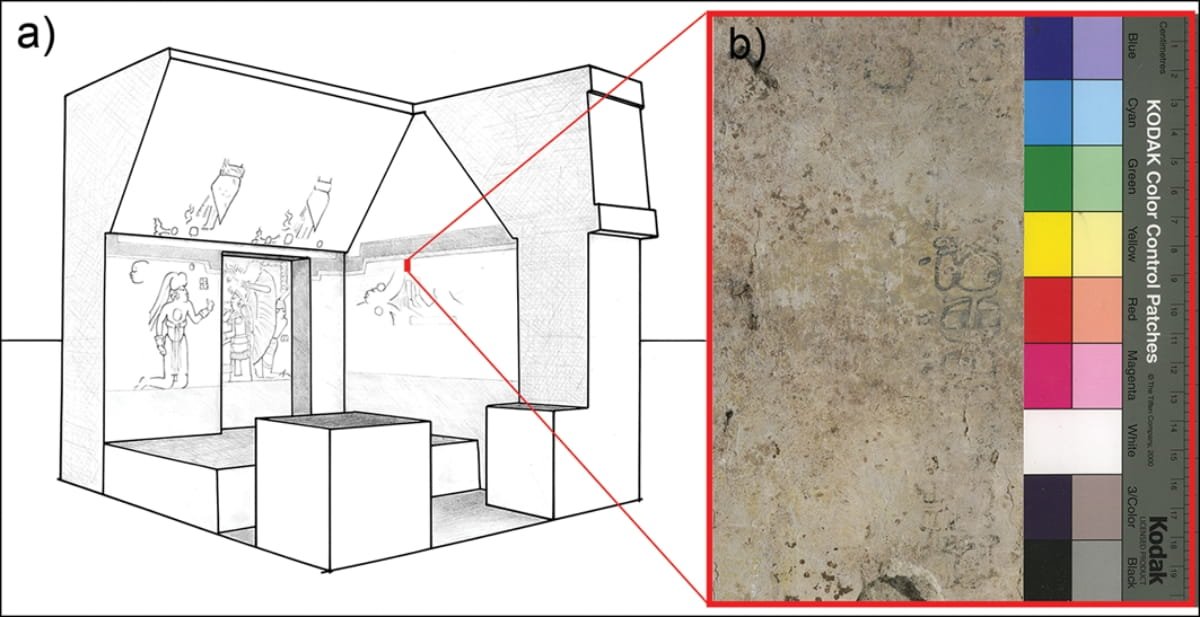 a) Artist’s reconstruction of structure 10K-2, showing painted figures on north and east wall, and the location of the signed mathematical formula discussed in the text; b) Text 19 as it appeared on the east wall of structure 10K-2. Credit: Photograph by F.D. Rossi; drawing by H. Hurst, Antiquity (2026)
The study focused on a small painted inscription, called a microtext, inside Structure 10K-2 at Xultun. Researchers rebuilt and translated the damaged writing using scale drawings, high quality photographs, digital scans, and image enhancement. Their work revealed eleven damaged hieroglyphs, including the name Sak Tahn Waax, which means “White-chested Fox.”
The text dates to around 781 CE, during the Classic Maya period, which lasted from 250 to 900 CE. At the time, astronomy and mathematics shaped many parts of Maya life. Scholars tracked the movement of the Sun, Moon, Venus, Mars, and other planets. They also worked with several calendar systems to set the dates for royal events, public ceremonies, and religious rites.
Until now, no surviving Maya inscription had identified the mathematician or astronomer behind these complex calculations. Artists, scribes, and sculptors often signed their work, yet the scholars who handled timekeeping and planetary studies stayed anonymous.
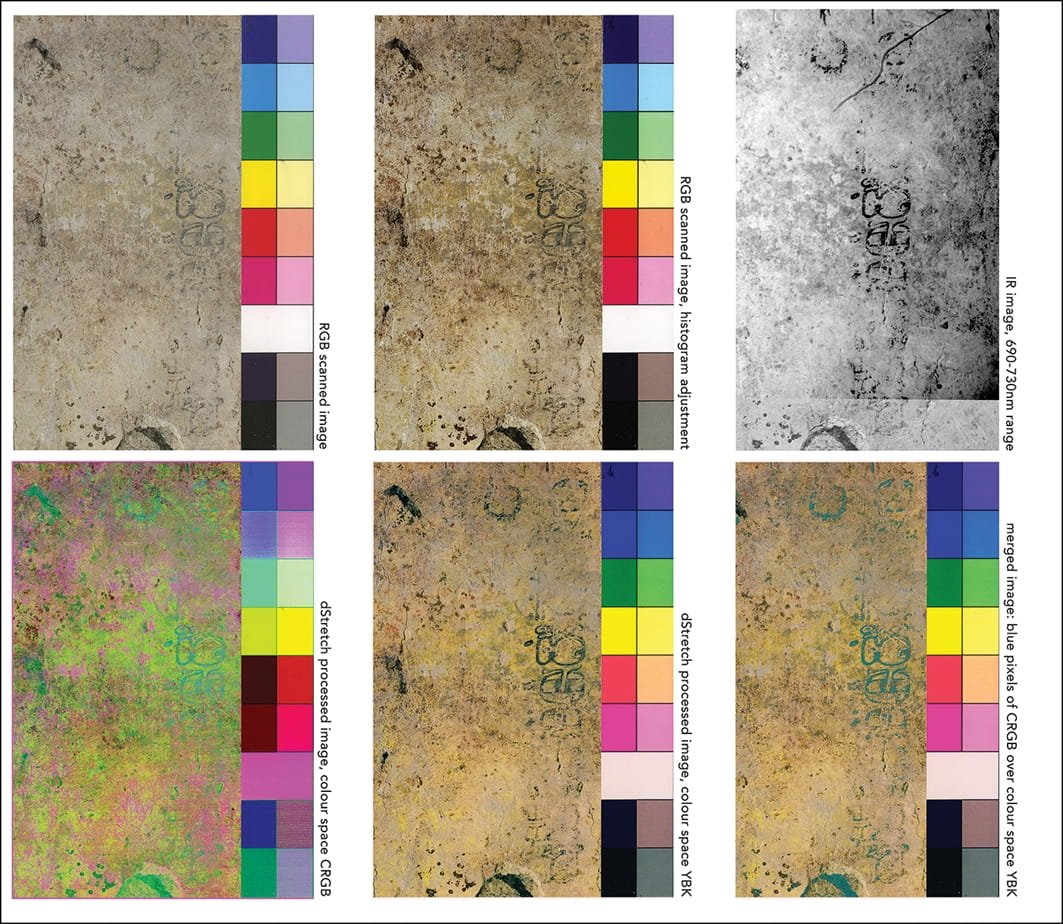 Scanned images of Text 19, east wall, structure 10K-2, with dStretch modifications. Credit: Images by W.A. Saturno, F.D. Rossi & G. Ware; image processing using dStretch by H. Hurst, Antiquity (2026)
The Xultun wall offers a rare look inside their work. More than 50 mathematical and astronomical notes cover the room’s painted walls. Instead of formal inscriptions, these writings appear to be rough drafts, tables, and calculations used while ideas were still taking shape. Researchers compare them to an early draft of a manuscript or a sketch before a finished painting.
One section stands out because of both the author’s name and the formula itself. The calculation uses familiar Maya time cycles, including the 260 day ritual calendar, the solar year, and the cycles of Venus and Mars. The way these cycles connect differs from every other known Maya text.
Researchers say the formula reflects Sak Tahn Waax’s own way of linking planetary movements with calendar cycles. Rather than repeating an older method, the text presents a new pattern based on careful sky watching. By placing his name at the end of the formula, the scholar claimed authorship of his work, a practice never documented before for a Classic Maya mathematician.
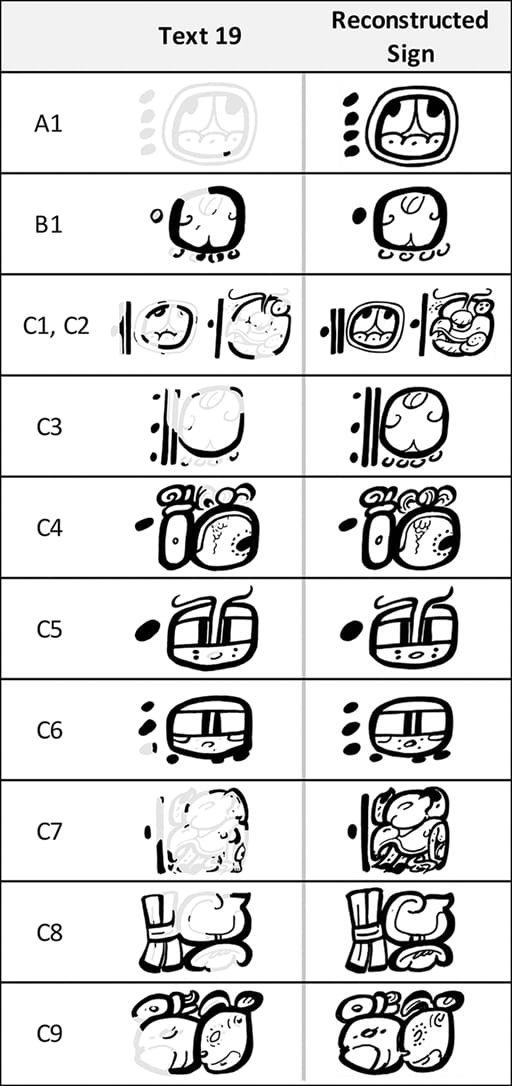 Illustration of Text 19, visible text (left) and reconstructed glyphs (right). Credit: Drawings by D. Stuart & F.D. Rossi, Antiquity (2026)
The finding also changes how researchers view Maya writing. Most surviving inscriptions focus on kings, royal families, military victories, or stories about gods. Scientific notes and everyday working records rarely survive, making the Xultun mural chamber an unusual source of information about Maya intellectual life.
Researchers say the inscription places an Indigenous Maya scholar among named astronomers and mathematicians from other ancient societies, including Greece, China, India, and Mesopotamia. Those cultures preserved the names of many scientific thinkers, while Maya experts remained unknown until now.
Although the Xultun mural chamber was uncovered 16 years ago, researchers continue finding new details hidden within its painted walls. The name Sak Tahn Waax adds a human face to Maya science and marks the first known case of a Classic Maya mathematician signing his own work.
Publication: Rossi, F. D., Stuart, D., & Hurst, H. (2026). The identification and work of an eighth-century Maya mathematician. Antiquity, 1–16. doi:10.15184/aqy.2026.10378