
No wonder the people who have bought in the central city, thinking they were going to be part of a vibrant downtown community, are dismayed.
They say they don’t want to live in what they describe as pretend neighbourhoods. And I don’t blame them.
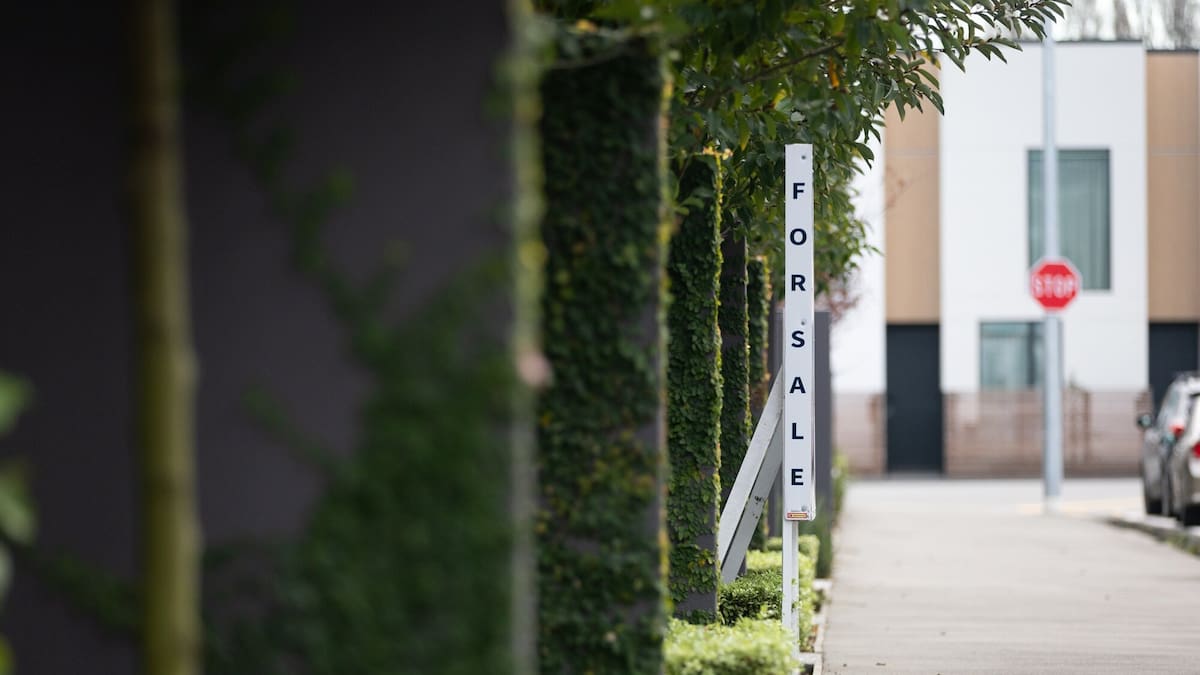
Permanent residents face issues such as overflowing rubbish due to the high number of Airbnb properties, with some developments having up to 80% used this way. Photo / Anna Heath
They say being surrounded by Airbnb properties is worse than living next to a hotel. There’s no reception, no security and the cleaners only deal with what’s inside.
Meaning it’s the permanent residents living nearby who end up dealing with things like overflowing rubbish and recycling bins.
In one new development, about 80% of the places have become Airbnb-type properties.
At another one, with 25 new townhouses, the people living there reckon only four of them are occupied by long-term residents.
Not that they’re imagining things, either. Because there are numbers to back them up.
In the last year, 484 new homes were built in the central city in Christchurch. But the number of people living permanently in the area in that same period only increased by 50.
That’s less than 1% growth in the number of people living in the centre of town.
Sure, some of these properties may be sitting unsold. But the vast majority will have been snapped-up by people wanting to make money out of Christchurch being the hot domestic tourism destination at the moment.
Not that it works out for everyone. I was talking to someone from Wellington recently who bought an apartment near the stadium, thinking they were going to ride the Airbnb money-go-round. They ended up selling the place at a loss after realising that the market was flooded.
Which, maybe, was always going to happen to a certain extent. When you consider that, after the 2011 earthquake, just over 1200 buildings in Christchurch’s CBD were demolished.
Leaving plenty of space for new office buildings, retail precincts, apartments and townhouses.
Which brings me to the Christchurch City Council. Which, in my view, has willingly turned a blind eye to properties being overtly marketed to buyers as potential Airbnb properties. Even when they aren’t consented for short-term rental accommodation.
After the quakes, the council set itself a target of having 20,000 people living permanently in the centre of town by 2028. Two years shy of that target date, we’re only about halfway there.
Further proof that the development and real estate sectors have been given too much sway with too little oversight.
This lax attitude was reflected in recent comments by Mayor Phil Mauger, who questioned whether the council should even bother with any sort of crackdown.
He said the council could do a lot of work and spend a lot of money, but would it be worth it?
Tell that to the people who have signed up to the council’s vision of a thriving central city community of fulltime residents.
Who have watched this council do such a brilliant job of sitting on its hands, that right now it has no idea how many Airbnb or similar properties there are in the centre of town.
Not that I’m suggesting we go down the route of Barcelona where, by 2028, there’ll be no short-term apartment rentals.
That would be counter-productive in a city that is only just getting back on its feet after the earthquake devastation 15 years ago.
But why not put a limit on the number of places in the centre of town that can be used for short-term rental accommodation?
It’s the least we could do for the people who do actually call the area home.
John MacDonald is the Canterbury Mornings host for Newstalk ZB. With two decades of experience in communications based in Christchurch, John has a deep understanding of, and connections with, Christchurch and wider Canterbury.
Catch up on the debates that dominated the week by signing up to our Opinion newsletter – a weekly round-up of our best commentary.