
Greens critical Labor ‘still hasn’t legislated a single enforceable protection’ on Josh Butler
The Greens have again called for a moratorium on new datacentres until the government’s new legislated standards are in place, claiming there cannot be a “free for all” until the new laws are enacted.
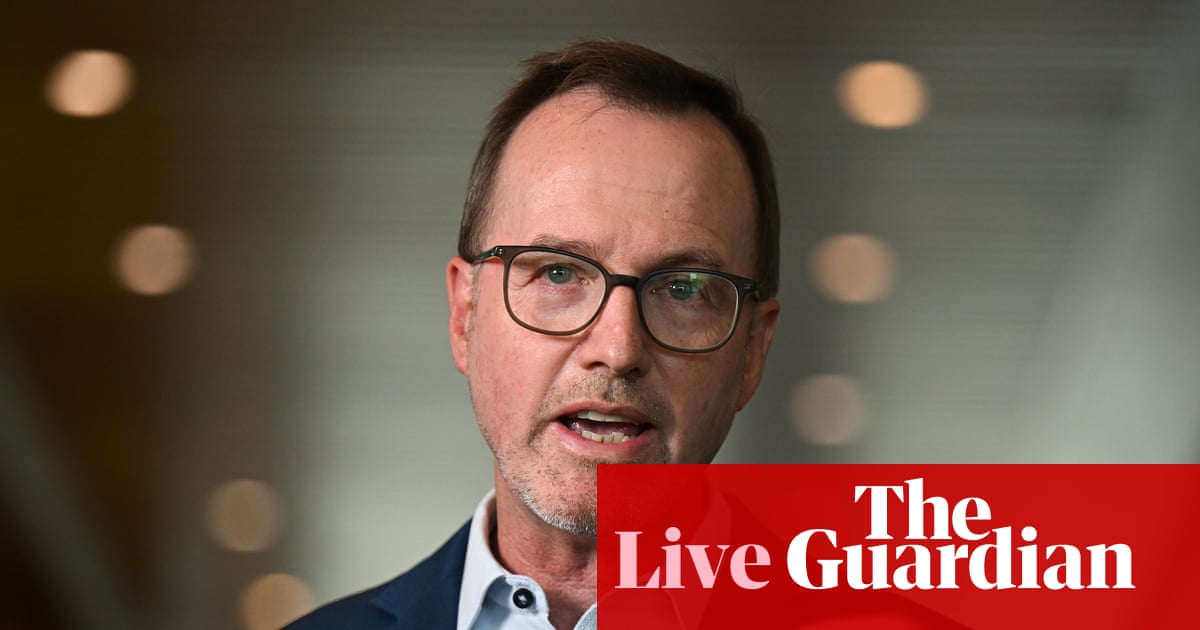
Senator David Shoebridge was also critical of the delay in responding to the AI issue.
“A coordination office in Canberra doesn’t stop a single kid getting harmed tonight, and no amount of branding changes the fact that this government still hasn’t legislated a single enforceable protection,” he said in a statement.
Sarah Hanson-Young has called for a pause on new datacentre builds, and said this was important in the period before Labor’s new laws – which Anthony Albanese said won’t be introduced into parliament until “early next year” – came into force. She said:
double quotation markWe need a moratorium on the building of datacentres until there are laws in place to properly regulate their impact in Australia including energy, water use, environment and communities. It is essential that we get the rules right. To do that we need a pause on the approval and construction of new hyperscale datacentres while we do this important policy work.
Just because big tech companies want to move at hyperspeed, doesn’t mean that we need to fast-track and roll out the red carpet for them. We need to take the time to get this right, if we don’t there will be serious consequences for our energy grid, water, environment and climate.
Shoebridge raised concerns about “consent, privacy and surveillance risk”.
double quotation markAustralians need an independent AI regulator with real powers, mandatory guardrails, and legislated protections for kids, workers and creators.
 A datacentre in Sydney. Photograph: Hollie Adams/ReutersShare
Updated at 02.35 EDT
Key events
 Tory Shepherd
Barnaby Joyce claims Australia is a ‘Christian nation’ and says many First Nations people would agree
One Nation’s Barnaby Joyce has claimed First Nations people would agree with him that Australia is a “Christian nation”.
The New England MP made the comments at an anti-abortion gala – where he accepted a prize for “political courage” – in Sydney over the weekend.
In an exchange posted on social media, Benjamin van der Linden from a group called Make Australia Christian Again asked Joyce if Australia was a Christian nation. Joyce said:
double quotation markYes, it was premised on Christian principles.
A lot of Indigenous people would tell you straight up and proper Australia’s a Christian nation.
Read more:
Kat Wong
Melbourne council votes to scrap Lime ebikes for failing to meet ‘bare minimum standards’
Shared ebikes will disappear from some inner-city Melbourne streets after a council scrapped its agreement with Australia’s largest electric bike operator.
The City of Yarra on Tuesday voted to end its memorandum of understanding with Lime, terminating its almost six-year-long trial.
Though some councillors noted shared ebikes were an affordable and environmentally friendly transport option, others said the operator had not done enough to prevent users from blocking footpaths, dumping ebikes or riding while drunk.
Read the full story here:
Photograph: Jessica Hromas/The GuardianShare
Updated at 02.42 EDT
Greens critical Labor ‘still hasn’t legislated a single enforceable protection’ onJosh Butler
The Greens have again called for a moratorium on new datacentres until the government’s new legislated standards are in place, claiming there cannot be a “free for all” until the new laws are enacted.
Senator David Shoebridge was also critical of the delay in responding to the AI issue.
“A coordination office in Canberra doesn’t stop a single kid getting harmed tonight, and no amount of branding changes the fact that this government still hasn’t legislated a single enforceable protection,” he said in a statement.
Sarah Hanson-Young has called for a pause on new datacentre builds, and said this was important in the period before Labor’s new laws – which Anthony Albanese said won’t be introduced into parliament until “early next year” – came into force. She said:
double quotation markWe need a moratorium on the building of datacentres until there are laws in place to properly regulate their impact in Australia including energy, water use, environment and communities. It is essential that we get the rules right. To do that we need a pause on the approval and construction of new hyperscale datacentres while we do this important policy work.
Just because big tech companies want to move at hyperspeed, doesn’t mean that we need to fast-track and roll out the red carpet for them. We need to take the time to get this right, if we don’t there will be serious consequences for our energy grid, water, environment and climate.
Shoebridge raised concerns about “consent, privacy and surveillance risk”.
double quotation markAustralians need an independent AI regulator with real powers, mandatory guardrails, and legislated protections for kids, workers and creators.
A datacentre in Sydney. Photograph: Hollie Adams/ReutersShare
Updated at 02.35 EDT
 Caitlin Cassidy
Royal commissioner rejects line of questioning in cross-examination of Mark Scott
The royal commissioner, Virginia Bell, has rejected the line of questioning in a cross-examination of the vice-chancellor of the University of Sydney, Prof Mark Scott, over comments made by one of his former students.
Gabi Crafti SC is representing the Australasian Union for Jewish Students and Jewish communal groups. She asked Scott whether he had heard the evidence of Yasmin Johnson, a Jewish pro-Palestine activist who appeared as a witness on Monday.
Crafti pointed to Johnson’s confirmation that she gave a speech in August 2025 on the University of Sydney’s campus “in which she called for the destruction of the State of Israel”.
double quotation markIs that tolerated at the University of Sydney?
Scott said she was a “guest speaker” and the university is not “vetting speeches in advance”.
double quotation markI totally reject her views. I do not believe that is an appropriate use of academic freedom and discourse. And I in no way support or associate myself with her comment.
Crafti asked if he would “permit that kind of thing to happen at the University of Sydney going forward”, at which point the commissioner intervened:
double quotation markYou don’t have to answer that, Professor. Ms Crafti, I think that’s a difficult proposition to put to the witness. Will you not permit that to go ahead? We’re talking about a university where a whole range of views might in many contexts be expressed. I’m not going to allow that question.
Updated at 02.34 EDT
 Luca Ittimani
OpenAI welcomes chance to shape Australia’s standards as a ‘priority market’
OpenAI has committed to working with creators and industry on the new national AI standards the prime minister announced today.
A spokesperson for the company said it had been engaging with the government for months on its commitment to building AI access and infrastructure in Australia and welcomed the chance to help shape Australia’s approach. They said:
double quotation markAustralia has enormous potential to benefit from AI, and we want to work for and with Australia to help realise Australia’s AI ambitions. This is truly a once-in-a-generation opportunity for Australia’s economy and it’s crucial the country gets this right.
We are committed to engaging constructively throughout this process with the government, creators and industry on an approach that is practical, sustainable and right for Australia.
Anthony Albanese today suggested artists and other creatives would keep copyright protections against AI model training and reuse. OpenAI said it was open to commercial agreements with individual publishers where appropriate, such as those it has signed with News Corp and Guardian Media Group, owner of this website.
OpenAI said Australia was a “priority market” with half of all adults using ChatGPT.
Updated at 01.58 EDT
Caitlin Cassidy
Mark Scott says there was a risk of the University of Sydney’s pro-Palestine encampment ‘blowing up’ by forcibly disbanding it
The vice-chancellor of the University of Sydney, Prof. Mark Scott, has told the royal commission into antisemitism that he feared forcibly disbanding the campus’s pro-Palestine encampment could have led to it “blowing up” and causing conflict.
The encampment, established on its front lawn in mid-2024, was the first and longest running in the nation. Scott said the university “didn’t anticipate” one would be established at the university because it hadn’t been part of its “protest tradition” and there weren’t substantial preparations in place.
A pro-Palestine encampment at the University of Sydney in April 2024. Photograph: Jessica Hromas/The Guardian
In line with other universities, he said their priority was to “try and see a peaceful resolution” of the encampment, but said it may have been a “real failure” not to consult further with Jewish groups.
double quotation markHow can we bring this encampment to a close peacefully without seeing the destruction and the turmoil that we’d seen at major universities around the world? … I still felt the risk of the encampment blowing up by forcibly ending it. Police in riot gear taking students away could have seen an encampment 10 times the size the day after. And if you look at the experience in the United States, who knows who would have been drawn in to that kind of conflict.
But I can see that our Jewish students and staff paid a price for that as the encampment dragged on. And I am sorry to them that it took so long for us to get it done. And I’m sorry we did not keep them more closely engaged in dialogue and listen more intently to them as it was going.
Updated at 01.54 EDT
Recording industry association says it’s time for AI companies to licence content
Aria, the Australian Recording Industry Association, said it’s now time for AI companies to move forward on content licensing after Anthony Albanese’s speech on the technology boom.
Annabelle Herd, Aria’s CEO, said in a statement:
double quotation markThe prime minister could not have been clearer: Australian writers and musicians keep ownership and control of their work. Artists control what that work is worth, not the government and not a technology company.
Control of price, value and terms of use are what underpin a commercial licensing market. The artist decides what their work is worth and who may use it. That is how licensing works everywhere else in the world and it is how it should work here. In the prime minister’s words: anything less is theft.
This is clear message to AI companies: now is the time to get on with licensing. Right now deals are being signed across music, journalism and publishing around the world. Australia’s creative industries are ready do business.
Updated at 01.34 EDT
Caitlin Cassidy
University of Melbourne interim vice-chancellor disputes claim of a sector-wide failure to properly adopt antisemitism definition
Interim vice-chancellor of the University of Melbourne (UoM), Prof Glyn Davis AC, has pushed back on an audit conducted by the emeritus professor Greg Craven on behalf of the antisemitism envoy, Jillian Segal, which found no university was properly adopting a definition of antisemitism.
He told the royal commission that he didn’t accept Craven’s assessment that the UoM hadn’t incorporated a definition of antisemitism into their policies and procedures. The UoM was the first university in Australia to publicly adopt the International Holocaust Remembrance Alliance definition of antisemitism in 2023.
He said:
double quotation markIt has been adopted in the same sense that the commonwealth government has adopted it. That is, a statement of principle and as a working definition of antisemitism and that’s crucial … It isn’t a definition by itself that takes you to disciplinary actions. It was not written for that point. That isn’t its character …
I don’t accept that we haven’t engaged with the definition, drawn it into our policies, used it to inform our discussions. It’s part of the protocol for our appeals. It informs appeals panels when they come to make decisions. In that sense, I think it’s perhaps an overstatement.
Photograph: EQRoy/AlamyShare
Updated at 01.22 EDT
 Nick Visser
That’s all for me. Ima Caldwell will snag things from here. Enjoy the rest of your arvo.
ShareLuca Ittimani
Business council backs Labor’s plans for AI standards
The Business Council of Australia has thrown its support behind the government’s AI approach.
Bran Black, the BCA’s chief executive, backed the new AI office, suggesting it should focus on the effect of AI on workplaces as a priority.
He supported the government’s “measured” timeline for bringing in nationally coordinated standards with plans to consult first then legislate next year.
double quotation markWe would always support engagement and consultation right across the economy including with different levels of government businesses, unions, community groups, and so forth. Take the time to do that and do it well.
The BCA was less supportive of Labor’s moves to mandate developers bring new energy and water infrastructure. Black said the council would push the government to instead give priority to those developers.
double quotation markWe can’t be too prescriptive because we are in a race and we are in a competitive contest in that regard …
AirTrunk … [has] just made a $42bn commitment to build datacentres, not in Australia, but in India. … We don’t want to see ourselves get out of step with International counterparts and that as a consequence, we would lose investment.
Updated at 00.59 EDT