
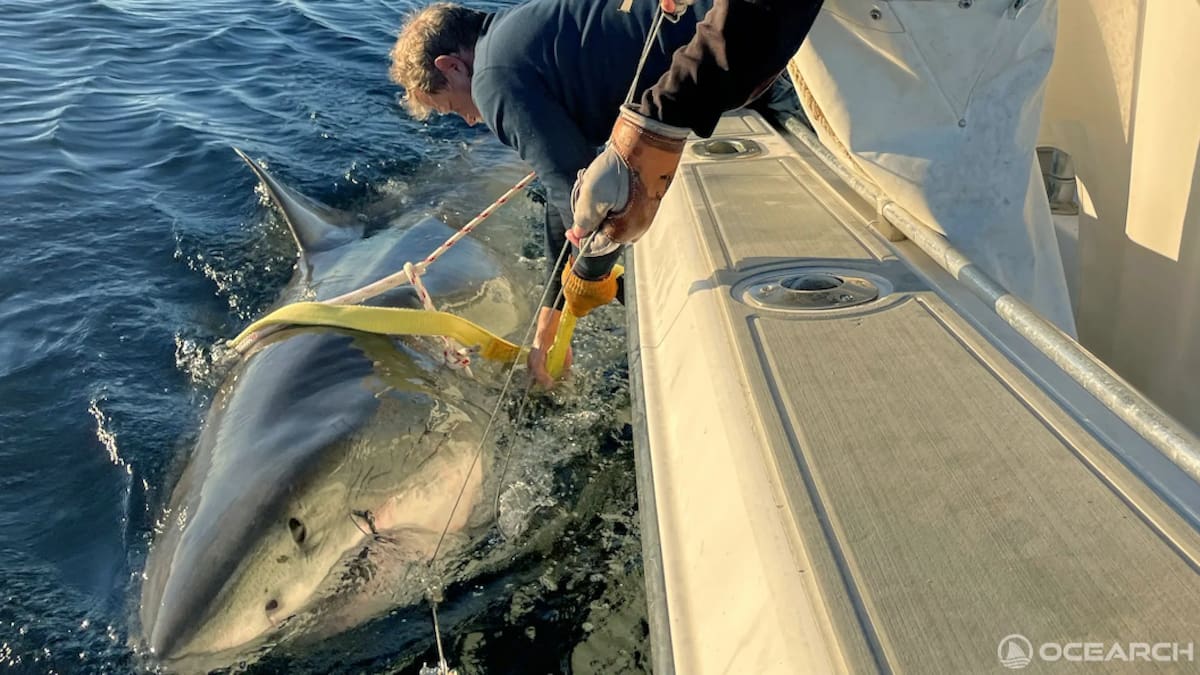
The male shark briefly transmitted data from its satellite tag on July 11 (local time), confirming it is still alive and active somewhere off the United States East Coast.
“Every ping from Contender gives us a window into the life of a mature male white shark – how he moves, feeds, and contributes to the population’s recovery,” Ocearch founder Chris Fischer said in a previous post about the shark.
“His journey connects Florida to Canada, and his story represents the power of collaboration between science, innovation, and the public who follow him in real time.”
Contender has travelled thousands of kilometres along the eastern seaboard of the United States since first being tagged, moving north through waters off North Carolina, New Jersey and Cape Cod, Massachusetts, following the seasonal migration patterns typical of large great whites.
Contender has travelled thousands of kilometres along the eastern seaboard of the United States since first being tagged. Photo / Ocearch
Before the latest transmission, the shark had not been detected since late April 2026, when tracking data placed it off the coast of North Carolina.
Despite the excitement surrounding the new signal, researchers were unable to determine Contender’s exact location.
The transmission was classified as a “Z-ping”, meaning the shark surfaced only briefly before diving again. Because the tagged fin was only above the water for a few moments, the satellite tracking system could not collect enough information to calculate a precise position.
Contender – the shark’s nickname – is a 4.2m great white estimated to weigh about 750kg. Photo / Ocearch
Scientists say the brief signal nevertheless confirms that Contender continues to roam the western North Atlantic, potentially near US coastal waters and possibly exploring emerging feeding grounds for great white sharks, according to Ocearch.
Its movements are helping researchers build a clearer picture of how great white sharks use critical habitats along the eastern coast of North America.
Previous Ocearch research has found that 88% of great white sharks tagged in the southeastern United States eventually travel to Atlantic Canada, highlighting the region’s importance as a seasonal feeding and residency area.