
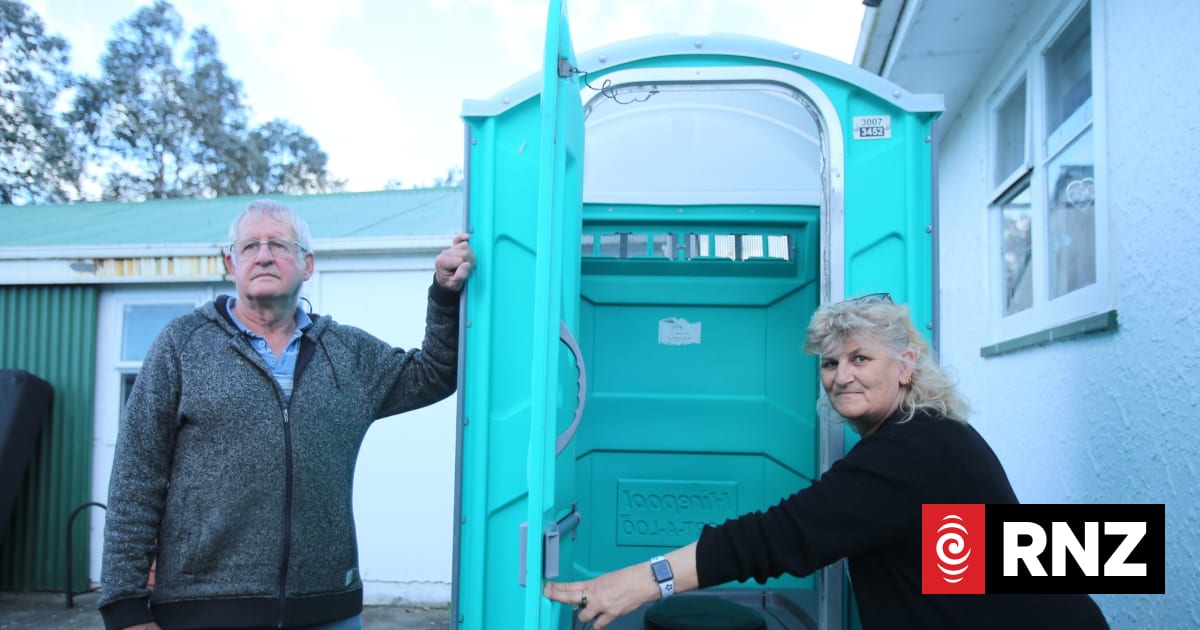
In his final weeks, a Masterton man living with bowel cancer was walked out to a portaloo because the town’s sewer network was failing.
His wife Hazel Smith is still fighting for reprieve several years after his death, as are many other Kuripuni residents, some of whom had raw sewage spill out onto their lawns in recent heavy rain.
Smith has lived in her Colombo Rd home for about 30 years, and has dealt with the council’s wastewater problem for more than 10 years, she said.

When heavy rain fell, stormwater infiltrated the town’s aged sewer network, inundating it and sending wastewater back up pipes and onto people’s properties.
“I lost my husband through bowel cancer,” Smith said.
“I was taking him out to a portaloo in his last weeks to use the toilet because he couldn’t use his.
“A lady around the corner toilet trained her toddler on a portaloo because she couldn’t use hers.”
Meanwhile, Smith said she remained “stuck” waiting for a solution.
Despite Masterton District Council (MDC) installing holding tanks for household wastewater in her front yard in 2023, her property was still impacted by wastewater overflows when an extreme rainfall event hit in June.
“This is my castle and I can’t even use my toilet,” Smith said.
“We can’t rent our house out, we can’t sell it. People won’t buy it knowing they’ll need portaloo when it rains.”
So far this winter, the council had dropped off a portaloo three times, Smith said.
Her neighbour Gary Kessler had also been impacted by the failing network for more than a decade.
Despite a holding tank also being installed at his property, toilet paper and sewage continued to spill onto his property in heavy downpours.
“It is so embarrassing walking past our gate seeing the tank right by the gate and it overflows there,” Kessler said.
“You can’t go to the loo, you can’t shower or bath, and you can’t wash the dishes or your clothes for at least three days.”
Masterton Ratepayers and Residents Association (MRRA) member Robbie Hullena had been advocating for affected residents since 2022.
“After 10 years, ratepayers and residents in the Colombo Rd and Cockburn St area are still needing portaloos in heavy rainfall.
“If this is not the highest priority for Masterton District Council (MDC), then what is?”
Masterton’s urban area had about 210km of wastewater pipes and the council’s plan was to renew between 2-4km of this each year, targeted at the sections of sewer pipe most at risk of failure.
The 2024-2034 Long-Term Plan allocated $23.2 million for sewer reticulation renewal work across the district, with $2m planned to be spent on sewer reticulation renewals this year, funded from depreciation reserves.
The total replacement value of the sewerage reticulation network, as at 2025, was $162.9m.
The oldest pipes were laid in the early 1900s, with ages of reticulation dating from then, up to the present day.
MDC group manager of infrastructure Tyler Ross said the council acknowledged the impact the recent extreme weather events had on the district.
The impacts had been “quite distressing for some members of our community”, he said.
“Our teams have worked hard during and following the event to support those impacted, and identify the causes.”
Where properties had experienced a sewage overflow, MDC contractors could be arranged through a service request to disinfect the property, he said.
Ross said during the June rain event, the Homebush wastewater treatment plant was processing 600 litres per second, compared to a usual flow of 150 litres per second.
This demonstrated how significant the infiltration of stormwater into the wastewater network was, he said.
“The impact of the event continued to be felt across the town into July, with high groundwater levels, saturated soils, and significant volumes of debris in the town’s system,” Ross said.
When significant rainfall was forecast for early July, council contractors were quickly deployed across the network to inspect and clear sections of the sewer network to minimise any impacts where possible, particularly if the rainfall was greater than forecast, he said.
“We are confident that these measures helped to reduce the overall impacts across the town. However, with the high groundwater levels, ponding from the saturated soils, and portions of the network that are likely to have debris washed into the system creating blockages, sewer overflows were again experienced by some properties.”
Ross said stormwater and groundwater infiltration was a problem for the sewer network and that MDC had ongoing actions to reduce its impacts.
The wastewater system overloads when the flow exceeds the capacity of the pipes and other infrastructure. In times of heavy rain, the flow increases significantly due to stormwater entering the system.
When the flow volume exceeds the capacity of the pipes, wastewater will back up, and is forced out of gully traps. This back-up will also prevent toilets being used as there is nowhere for flushed wastewater to go.
Because the wastewater system relies on gravity to flow, the impact may be further down the network than the source of the stormwater.
Stormwater can enter the wastewater system in a number of ways.
Cracks in ageing pipes allow water in the ground to be forced into wastewater pipes.
Some pipes involved may be part of the council’s wastewater network, but other pipes involved are from private properties that connect to the wastewater network known as laterals.
Property owners are responsible for their laterals (pipe connections) from their property boundary.
LDR is local body journalism co-funded by RNZ and NZ On Air.