
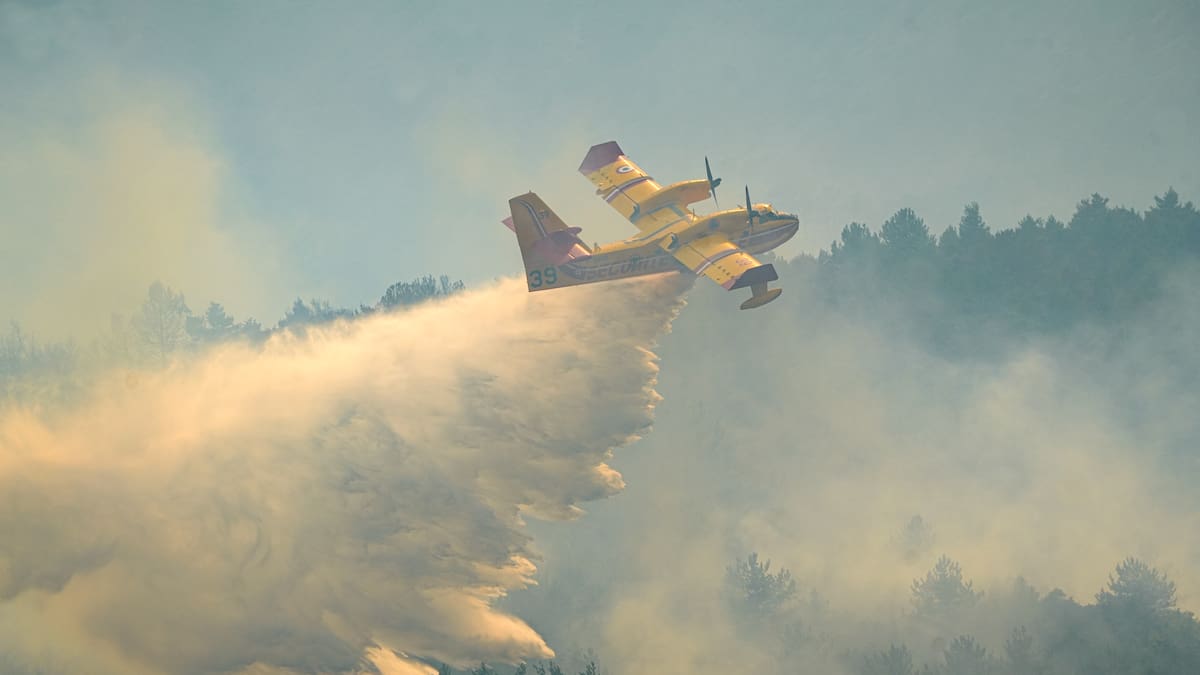
The fire erupted on Sunday in the sprawling Fontainebleau Forest, about 60km southeast of the capital.
The wildfire quickly spread across the forest, almost doubling in size in 24 hours, and disrupted rail and road traffic during a busy Bastille Day holiday long weekend.
Throughout the day, aircraft in the skies and firefighters on the ground were trying to douse the flames.
A second fire broke out on Monday afternoon and had ravaged about 100ha, forcing the evacuation of about 1000 people in and around Fontainebleau.
A source said one of the two suspects arrested was an 18-year-old man.
The scale of the fire led to the deployment of four Canadair aircraft – an unprecedented move in the greater Paris region – as well as two Dash planes and three water-bombing helicopters.
Commander of operations Jean-Marc Sicard said 187 water drops were carried out and more than 600 firefighters remained mobilised overnight.
President Emmanuel Macron said on X that all available resources had been deployed to fight what he described as “an exceptionally large wildfire”.
Authorities were investigating whether the fire was started intentionally, with a source saying there were “about 10 fire ignition points within a perimeter of 1000 metres, which suggests that it could have been deliberately set”.
The death toll from wildfires in Spain has reached 13, making it one of the deadliest natural disasters of its kind in recent times.
The blaze that broke out on Thursday has transformed picturesque rural settlements into ghost towns and left a trail of destruction in the southeastern province of Almeria, home to many foreign residents, near the Mediterranean coast.
Authorities have cautioned that the number of missing people meant the toll might rise further.
Firefighters continue to fight the fire, which has scorched about 7000ha of forest and scrubland.
Spanish Prime Minister Pedro Sanchez blamed climate change during a tour of the disaster zone, saying increasingly erratic weather made civil protection emergencies “increasingly frequent”.
At its peak last week, the wildfires spread at up to 100m a minute, trapping victims in their vehicles or on foot as they tried to flee.
Authorities suspect the wildfire began when a power line broke, setting fire to vegetation that had been parched after hot weather that pushed temperatures above 40C.
Scientists say climate change caused by humans burning fossil fuels is making extreme weather such as heatwaves, which contribute to wildfires, more likely and more intense.
– AFP