
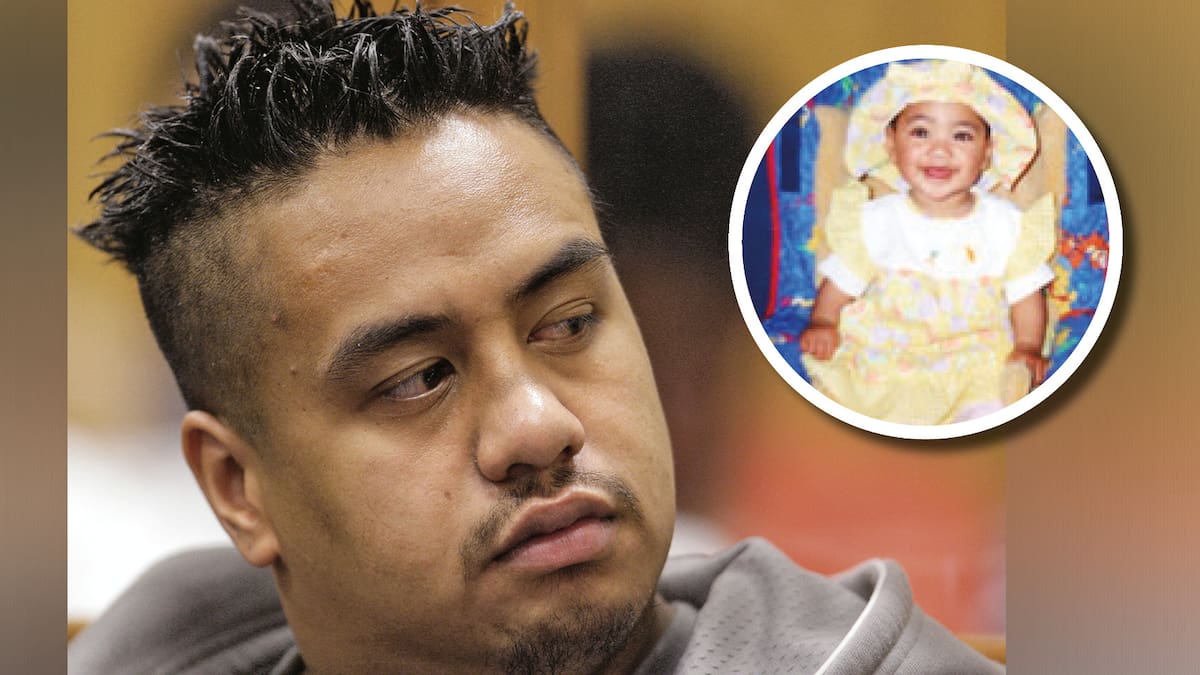
He and his brother, Wiremu Curtis, were jailed for life with non-parole periods of 17 and a half years.
Wiremu Curtis was earlier denied parole and remains behind bars.
The parole board heard at Michael Curtis’ first hearing in January last year that he had been involved in 43 prison incidents, including possessing drugs and fighting with inmates and prison officers.
However, during the past 18 months, he had changed.
Curtis’ lawyer, Michelle Lander, told parole board members, including convenor Kathryn Snook, Chris King, Pauline Hopa and Dr Jeremy Skipworth, that her client’s behaviour could not have been better since he was last before the board.
“His behaviour has been perfect. He still has in-unit employment. The report you have from the psychologist shows he has really engaged really well with the first tranche of treatment.”
Nia Glassie as a baby. Photo / File
She said he still needed more treatment and to be moved into a different unit of the prison, such as a self-care unit, to prepare him for eventual release into the community. He also needed to design a “safety plan” to help ensure he remained crime-free when faced with risky scenarios.
Curtis was asked a series of questions relating to how he felt about his conviction, and what happened in the days before Nia’s death, including the night she suffered fatal injuries.
However, all direct quotes from him were suppressed by the board at the request of Lander to allow Curtis to speak freely.
A prison staff member gave a glowing report to the board, saying Curtis did not respond to peer pressure and stayed away from “dramas”.
He was described as being respectful to staff and the only area where he could improve was in his communication with others.
Hopa asked Curtis about his cultural learning while inside prison and praised him for opening the hearing with a karakia.
He confirmed he was connecting with his Māori culture for the first time.
“How has that been for you, given that you have grown up in the heartland of Māoridom in Rotorua, where everybody carries a taiaha and has a poi and [does] waiata? It is almost a surprise to hear that you had no exposure to that at all and that, surprisingly, you found that here in prison.”
Hopa said Curtis’ whānau name was famous in the motu (region) for a number of different reasons, including kaumātua Sir Toby Curtis and actor Cliff Curtis, whom she described as his wider whānau members.
What the Curtis brothers did
Curtis was convicted and jailed for murder alongside his brother, Wiremu, who at the time was the 17-year-old boyfriend of Nia’s mother Lisa Kuka, then aged 34.
Kuka, a Te Puke kiwifruit worker, was jailed for nine years following two convictions of manslaughter after it was successfully proven she not only failed to protect Nia but also failed to get her medical treatment.
Two others, Oriwa Kemp and Michael Pearson, were convicted and jailed for assaulting Nia.
Those jailed relating to Nia Glassie’s abuse and death were Lisa Kuka (from left), Michael Curtis, Michael Pearson, Wiremu Curtis and Oriwa Kemp. Photo / NZME
Nia suffered three months of torture before her death at the Frank St house where they lived. The Curtis brothers, Kemp and Pearson were supposed to look after Nia and others while Kuka went to work.
Nia was put in a clothes dryer and spun on a hot setting, hung on a clothesline and spun around until she fell, held over a burning fire, thrown at walls and dropped from heights. It was while the Curtis brothers were using Nia to practise wrestling moves that she was fatally kicked in the head.
But her death wasn’t quick. She was left for 33 hours before medical help was sought.
Her mother came home to find her daughter semi-conscious in a soiled bed. She bathed her and put her back to bed before celebrating Michael Curtis’ 21st birthday at the house while her daughter lay dying.
It wasn’t until the next day that Kuka took Nia to Rotorua Hospital. She died 13 days later on August 3, 2007.
Wiremu Curtis will appear before the parole board again in February next year.
What to do if you think a child is being abused
If you believe a child is in immediate danger, call police on 111.
If you’re worried about a child and want to make a referral or report of concern, call on Oranga Tamariki on 0508 FAMILY (0508 326 459) or email contact@ot.govt.nz.
Kelly Makiha is a senior journalist who has reported for the Rotorua Daily Post for more than 25 years, covering mainly police, court, human interest and social issues.